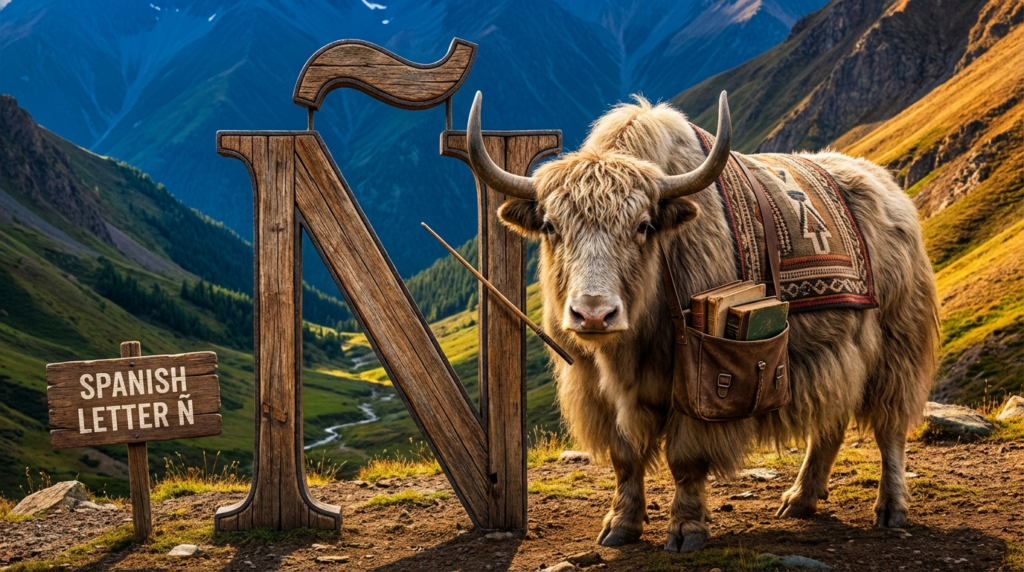
Spanish Letter Ñ Explained
Learn what ñ means, how to pronounce it, when it changes a word completely, and how to type it without wrestling your keyboard.
I once wanted to write Feliz año nuevo. What I actually sent was Feliz ano nuevo. She replied with a correction, a laughing emoji, and the kind of silence that says, “Well, that escalated fast.” That tiny squiggle over the n stopped feeling decorative right there.
So let’s make sure that never happens to you. In Spanish, ñ is not a fancy n. It is its own letter, with its own sound, its own name, and its own job. Once you get it, a lot of common words suddenly stop looking weird and start sounding normal. :contentReference[oaicite:0]{index=0}
Yak Box: The Fast Answer
- Ñ is a separate Spanish letter called eñe.
- It sounds roughly like the ny in canyon or the ni in onion, but as one smooth sound.
- It can change a word completely, so leaving off the tilde is not a cute little typo.
What Is Ñ In Spanish?
Ñ is the 15th letter of the Spanish alphabet, its name is eñe, and it comes after n. Spanish has 27 letters in total, and ñ is the extra one English does not have. It is treated as a real letter, not just an n wearing a hat for attention. :contentReference[oaicite:1]{index=1}
That matters because n and ñ are different letters with different sounds. In dictionaries, they are sorted separately, and in everyday writing they can change meaning fast. Lawless Spanish even points this out with the classic warning: do not drop the tilde and hope for the best. :contentReference[oaicite:2]{index=2}
How To Pronounce Ñ
The sound of ñ is the Spanish consonant /ɲ/. To make it, the middle of your tongue rises toward the roof of your mouth, and the sound comes out through your nose. That sounds technical, yes, but in real life you can think of it as a smooth ny sound said in one piece. :contentReference[oaicite:3]{index=3}
The easiest English shortcut is the ni in onion or the ny in canyon. Those are close, but Spanish ñ is still one single sound, not two sounds bumping into each other. Also, you will not normally find ñ at the end of a word or syllable. :contentReference[oaicite:4]{index=4}
| Rule | What To Do | Example |
|---|---|---|
| Keep it smooth | Say one sound, not n + y | niño = child |
| Lift the middle of the tongue | Let the sound stay soft and nasal | mañana = tomorrow / morning |
| Do not flatten it to plain n | ñ and n are not interchangeable | año ≠ ano |
Six Common Ñ Words You’ll Use Right Away
niño / niña
Meaning: boy / girl
El niño está en la escuela.
The boy is at school.
año
Meaning: year
Este año quiero hablar más español.
This year I want to speak more Spanish.
mañana
Meaning: tomorrow / morning
Mañana te llamo.
I’ll call you tomorrow.
baño
Meaning: bathroom / bath
¿Dónde está el baño?
Where is the bathroom?
señor / señora
Meaning: Mr. / Mrs. / sir / ma’am
Buenos días, señora López.
Good morning, Mrs. López.
cumpleaños
Meaning: birthday
Mi cumpleaños es en junio.
My birthday is in June.
Why Ñ Really Matters
Here is the classic disaster: año means year, but ano means anus. Same letters except for the tilde, wildly different result, absolutely not the New Year message you were going for. :contentReference[oaicite:5]{index=5}
That is why learners need to treat ñ as a full letter every time they read, write, type, and pronounce it. One tiny mark, one very large difference. Grammar can be rude like that.
Where Ñ Came From
The little line over ñ has history. In medieval Spanish, scribes often shortened a double nn by writing one n with a small mark above it. Over time, that mark became the tilde, and the spelling settled into the separate letter ñ. That is why older forms related to Latin double n help explain words like año. :contentReference[oaicite:6]{index=6}
Spanish did not just keep a cute spelling trick. It turned that shortcut into a real letter for a real sound. Other Romance languages solved the same sound in different ways, like gn in French and Italian or nh in Portuguese. :contentReference[oaicite:7]{index=7}
Useful Spanish Words With Ñ
These are high-utility words you will actually see in messages, menus, travel situations, classes, and normal life. No kiddie alphabet parade. Just useful Spanish.
| Spanish | English Meaning | Example Sentence |
|---|---|---|
| español | Spanish | Estoy estudiando español todos los días. I study Spanish every day. |
| pequeño / pequeña | small | Quiero un café pequeño. I want a small coffee. |
| piña | pineapple | La piña está muy dulce. The pineapple is very sweet. |
| sueño | sleep / dream / sleepiness | Tengo sueño porque dormí poco. I’m sleepy because I slept little. |
| enseñar | to teach / to show | La maestra nos va a enseñar una canción. The teacher is going to teach us a song. |
| acompañar | to accompany | Te puedo acompañar al mercado. I can go with you to the market. |
| señal | sign / signal | No vi la señal de alto. I didn’t see the stop sign. |
| bañar | to bathe | Voy a bañar al perro. I’m going to bathe the dog. |
| Spanish | English Meaning | Example Sentence |
|---|---|---|
| extrañar | to miss | Te extraño mucho. I miss you a lot. |
| añadir | to add | Vamos a añadir más sal. We’re going to add more salt. |
| señorita | miss / young lady | La señorita trabaja aquí. The young lady works here. |
| otoño | autumn | En otoño hace más fresco. In autumn it gets cooler. |
| montaña | mountain | La montaña se ve desde mi ventana. The mountain can be seen from my window. |
| compañero / compañera | classmate / coworker / companion | Mi compañera habla muy bien. My classmate speaks very well. |
| señor | sir / Mr. | Ese señor necesita ayuda. That man needs help. |
| mañanita | early morning / little morning | Salimos tempranito en la mañanita. We left very early in the morning. |
How To Type Ñ Without Losing Your Mind
On Mac
Use Option + N, then press n. Apple also documents this for Spanish keyboards and the U.S. International layout. :contentReference[oaicite:8]{index=8}
On iPhone Or iPad
Press and hold n, then choose ñ. Apple also supports Option + N then n when using a connected keyboard. :contentReference[oaicite:9]{index=9}
On Android
Add Spanish in Gboard if needed, then press and hold n to get accented options. Google’s keyboard help also explains how to enable another language layout. :contentReference[oaicite:10]{index=10}
In Microsoft Word
Use Ctrl + Shift + ~, then press n. Microsoft lists the same shortcut for both Word and Outlook. :contentReference[oaicite:11]{index=11}
Practice: N Or Ñ?
- Feliz a__o nuevo.
- ¿Dónde está el ba__o?
- Mi compa__era llega mañana.
- Quiero a__adir más azúcar.
- Ese se__or habla muy rápido.
Show The Answers
- año
- baño
- compañera
- añadir
- señor
Common Mistakes And Fast Fixes
- Mistake: saying plain n.
Fix: add a soft ny glide and keep it as one sound. - Mistake: writing ano when you mean año.
Fix: slow down and type the tilde every single time. - Mistake: spelling Spanish words with English-style ny.
Fix: in Spanish writing, use ñ, not ny, for words like niño and mañana. - Mistake: thinking ñ is just an accent mark.
Fix: remember it is its own letter with its own name: eñe. :contentReference[oaicite:12]{index=12}
Quick Reference Summary
| Topic | What To Remember | Example |
|---|---|---|
| Name | The letter is called eñe | La eñe |
| Alphabet | It is a separate letter after n | n, ñ, o |
| Pronunciation | Say one smooth ny-like sound | niño, mañana |
| Meaning Changes | Missing the tilde can change the word | año vs ano |
| Typing | Learn the shortcut once and use it every time | Mac: Option + N, then n |
Final Yak
If you remember only one thing, remember this: ñ is not optional. It is a real letter, a real sound, and sometimes the difference between sounding clear and sounding hilariously wrong. Learn the shape, hear the sound, type it on purpose, and your Spanish instantly looks more natural.