Demonstratives In Spanish: Este, Ese, Aquel
Pointing at stuff in Spanish shouldn’t feel like a geometry test. Learn the simple “distance” idea behind este, ese, and aquel, then steal the ready-to-use sentences.
The Big Idea: Three “Distance” Zones
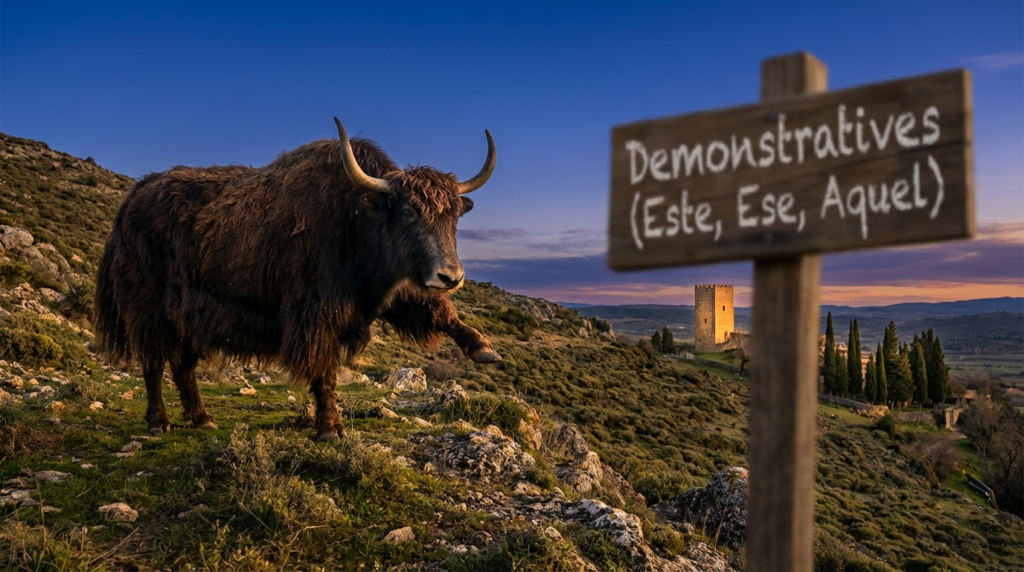
- Este = this (near me)
- Ese = that (near you / not right here)
- Aquel = that over there (far from both of us)
Quick mental picture: my bubble (este), your bubble (ese), way over there (aquel).
The Forms You Actually Need
Demonstratives must match the noun: gender (masculine/feminine) + number (singular/plural). Here are the core forms with meanings and real sentences.
Este = This (Near Me)
este (this, masc. sing.) — Este libro es mío. (This book is mine.)
esta (this, fem. sing.) — Esta mesa es nueva. (This table is new.)
estos (these, masc. pl.) — Estos tacos están buenísimos. (These tacos are really good.)
estas (these, fem. pl.) — Estas llaves son tuyas. (These keys are yours.)
Ese = That (Near You)
ese (that, masc. sing.) — ¿Ese café es tuyo? (Is that coffee yours?)
esa (that, fem. sing.) — Esa canción me gusta. (I like that song.)
esos (those, masc. pl.) — Esos zapatos te quedan bien. (Those shoes look good on you.)
esas (those, fem. pl.) — Esas fotos se ven increíbles. (Those photos look amazing.)
Aquel = That Over There (Far)
aquel (that over there, masc. sing.) — Aquel edificio es muy alto. (That building over there is very tall.)
aquella (that over there, fem. sing.) — Aquella casa es preciosa. (That house over there is beautiful.)
aquellos (those over there, masc. pl.) — Aquellos chicos están jugando. (Those guys over there are playing.)
aquellas (those over there, fem. pl.) — Aquellas montañas se ven nevadas. (Those mountains over there look snowy.)
Yak Box: Adjective Vs. Pronoun (Same Words, Different Job)
Demonstrative adjective goes with a noun: este libro (this book), esa silla (that chair).
Demonstrative pronoun replaces the noun: ¿Cuál quieres? — Este. (Which one do you want? — This one.)
Accent marks note: You may see éste/ésa/aquéllos in older writing. In modern Spanish, demonstrative pronouns are usually written without accents: este, esa, aquellos.
Neutral Forms: Esto, Eso, Aquello
Use these when you’re pointing to an idea, a situation, or something unknown (not a specific masculine/feminine noun).
Esto = This (Idea Here)
esto (this) — Esto es importante. (This is important.)
¿Qué es esto? (What is this?) — ¿Qué es esto? No entiendo. (What is this? I don’t understand.)
Eso = That (Idea There)
eso (that) — Eso no es cierto. (That’s not true.)
Eso es todo (That’s all) — Gracias, eso es todo. (Thanks, that’s all.)
Aquello = That Over There (Distant Idea)
aquello (that thing back then / over there) — Aquello fue un desastre. (That was a disaster.)
Aquello que… (That which…) — Aquello que dijiste me ayudó. (What you said helped me.)
Useful Phrases You’ll Say In Real Life
Steal these. Mix them. Point dramatically if you want.
- ¿Quieres este o ese? (Do you want this one or that one?) — ¿Quieres este o ese? Yo pago. (Do you want this one or that one? I’ll pay.)
- Dame este, por favor. (Give me this one, please.) — Dame este, por favor. El otro no. (Give me this one, please. Not the other one.)
- ¿Te refieres a esa persona? (Do you mean that person?) — ¿Te refieres a esa persona de rojo? (Do you mean that person in red?)
- Mira aquello. (Look at that over there.) — Mira aquello, está increíble. (Look at that over there, it’s amazing.)
- ¿Qué es eso? (What is that?) — ¿Qué es eso en el piso? (What is that on the floor?)
- Esto me encanta. (I love this.) — Esto me encanta: huele riquísimo. (I love this: it smells great.)
- Eso me queda claro. (That’s clear to me.) — Ok, eso me queda claro. (Okay, that’s clear to me.)
- Eso sí. (Now that’s true / That I agree with.) — Eso sí, tienes razón. (That’s true, you’re right.)
- Con eso basta. (That’s enough / That will do.) — Con eso basta, gracias. (That’s enough, thanks.)
- Aquel día… (That day… [back then]) — Aquel día aprendí mucho. (That day I learned a lot.)
- En ese momento… (At that moment…) — En ese momento no sabía qué decir. (At that moment I didn’t know what to say.)
- En este momento… (Right now…) — En este momento estoy ocupado. (Right now I’m busy.)
Mini Reference Tables
| Pattern | Meaning | Sentence |
|---|---|---|
| este/esta + noun | this (near me) | Esta sopa está caliente. (This soup is hot.) |
| ese/esa + noun | that (near you) | Esa tienda está abierta. (That store is open.) |
| aquel/aquella + noun | that over there (far) | Aquel carro es nuevo. (That car over there is new.) |
| esto/eso/aquello | this/that (an idea) | Eso no funciona. (That doesn’t work.) |
| Spanish | English | Sentence |
|---|---|---|
| este | this (masc.) | Este plan me gusta. (I like this plan.) |
| esta | this (fem.) | Esta idea es buena. (This idea is good.) |
| estos | these (masc.) | Estos mensajes son para ti. (These messages are for you.) |
| estas | these (fem.) | Estas calles están vacías. (These streets are empty.) |
| Spanish | English | Sentence |
|---|---|---|
| ese | that (masc.) | Ese asunto es urgente. (That issue is urgent.) |
| esa | that (fem.) | Esa respuesta es perfecta. (That answer is perfect.) |
| esos | those (masc.) | Esos detalles importan. (Those details matter.) |
| esas | those (fem.) | Esas preguntas son difíciles. (Those questions are hard.) |
| Spanish | English | Sentence |
|---|---|---|
| aquel | that over there (masc.) | Aquel lugar se ve tranquilo. (That place over there looks calm.) |
| aquella | that over there (fem.) | Aquella puerta está cerrada. (That door over there is closed.) |
| aquellos | those over there (masc.) | Aquellos precios son altos. (Those prices over there are high.) |
| aquellas | those over there (fem.) | Aquellas luces parpadean. (Those lights over there are flickering.) |
Practice: Quick Drills (No Tears Allowed)
Say the answer out loud first, then check yourself. (Yes, talking to your phone counts.)
Drill 1: Pick The Zone
- You’re holding the phone. Say: “_____ teléfono.” → este teléfono (this phone)
- Your friend is holding a bag. Say: “_____ bolsa.” → esa bolsa (that bag)
- Across the street there’s a café. Say: “_____ café.” → aquel café (that café over there)
- You don’t understand what happened. Say: “_____ es raro.” → eso es raro (that is weird)
Drill 2: Make It Plural
- este libro → estos libros (these books)
- esa silla → esas sillas (those chairs)
- aquella foto → aquellas fotos (those photos over there)
Drill 3: Noun Or No Noun?
- With noun: Me gusta esa película. (I like that movie.)
- No noun: Me gusta esa. (I like that one.)
- Neutral idea: Eso me preocupa. (That worries me.)
Common Mistakes And Fast Fixes
- Mistake: Using esto with a noun. Fix: esto is neutral; use este/esta with nouns. — Esta idea (this idea), not esto idea.
- Mistake: Forgetting agreement. Fix: Match the noun. — esa casa (fem.), ese carro (masc.).
- Mistake: Treating aquel like “fancy ese.” Fix: Use it for distance or “back then.” — Aquel año fue difícil. (That year was hard.)
- Mistake: Overthinking “near me vs near you.” Fix: In real conversation, ese often covers “that” generally; aquel is the “way over there / back then” option.
Quick FAQ: Do I Need Accent Marks On These?
Usually, no. In modern Spanish, demonstratives are normally written without accents whether they’re adjectives or pronouns: este, esa, aquellos. You might still see accents in older texts.
Quick FAQ: Can I Use “Ese” For Most “That” Situations?
Yep, and many people do. Use ese/esa for general “that,” and pull out aquel/aquella when you mean “that over there” or “that time back then.”
Final Yak
If you remember just one thing: este = my zone, ese = your zone, aquel = way over there / back then. Then match the noun (masc/fem, sing/pl). Done. You are officially allowed to point at things with confidence.