


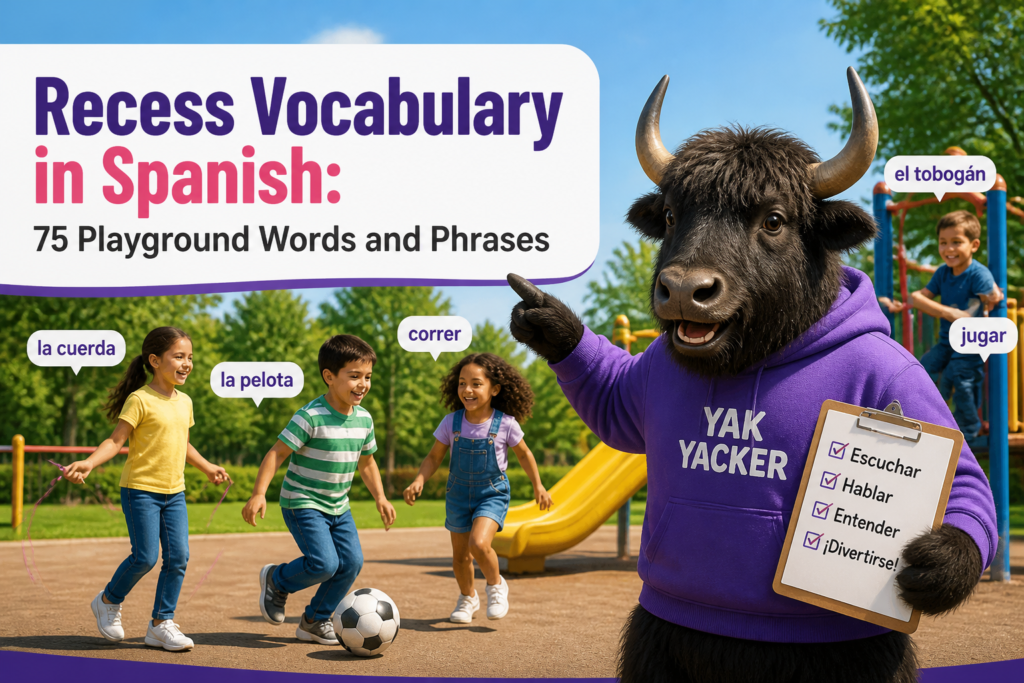
If you’ve ever stood near a school playground in Spanish and thought, “Great, now I know exactly how to say… nothing,” this is for you. Recess is one of those everyday moments where useful Spanish shows up fast: kids running, teachers calling, someone asking to join a game, someone else dramatically claiming, “¡Yo primero!” Because of course they did.
For the broader learning path, visit our parent guide.
In this guide, you’ll learn practical recess vocabulary in natural Latin American Spanish, with a few notes on Spain where it helps. You’ll get words for playground equipment, games, commands, movements, and the little phrases people actually say while waiting for the bell to ring. By the end, you should be able to understand and join basic recess conversations without the classic awkward stare of doom.
For extra background on standard Spanish usage, a boring-but-useful reference is the Real Academia Española. Not glamorous. Very helpful. Like a good umbrella.
Fast Recess Basics
In Spanish, recess is often el recreo in school settings. You may also hear el descanso for a break, but el recreo is the safer playground word. The verb jugar means “to play,” and a lot of recess language is built around it.
One tiny but useful thing: Spanish tends to sound more direct than English on the playground. Short commands like ¡Corre! or ¡Ven! are normal. Nobody is writing a committee memo about it.
Recess Vocabulary and Phrases
| Spanish | Pronunciation | Meaning | Example Sentence | Translation | Learner Note |
|---|---|---|---|---|---|
| el recreo | el reh-CRAY-oh | recess, break time at school | Tenemos recreo a las once. | We have recess at eleven. | Most common school word for recess. |
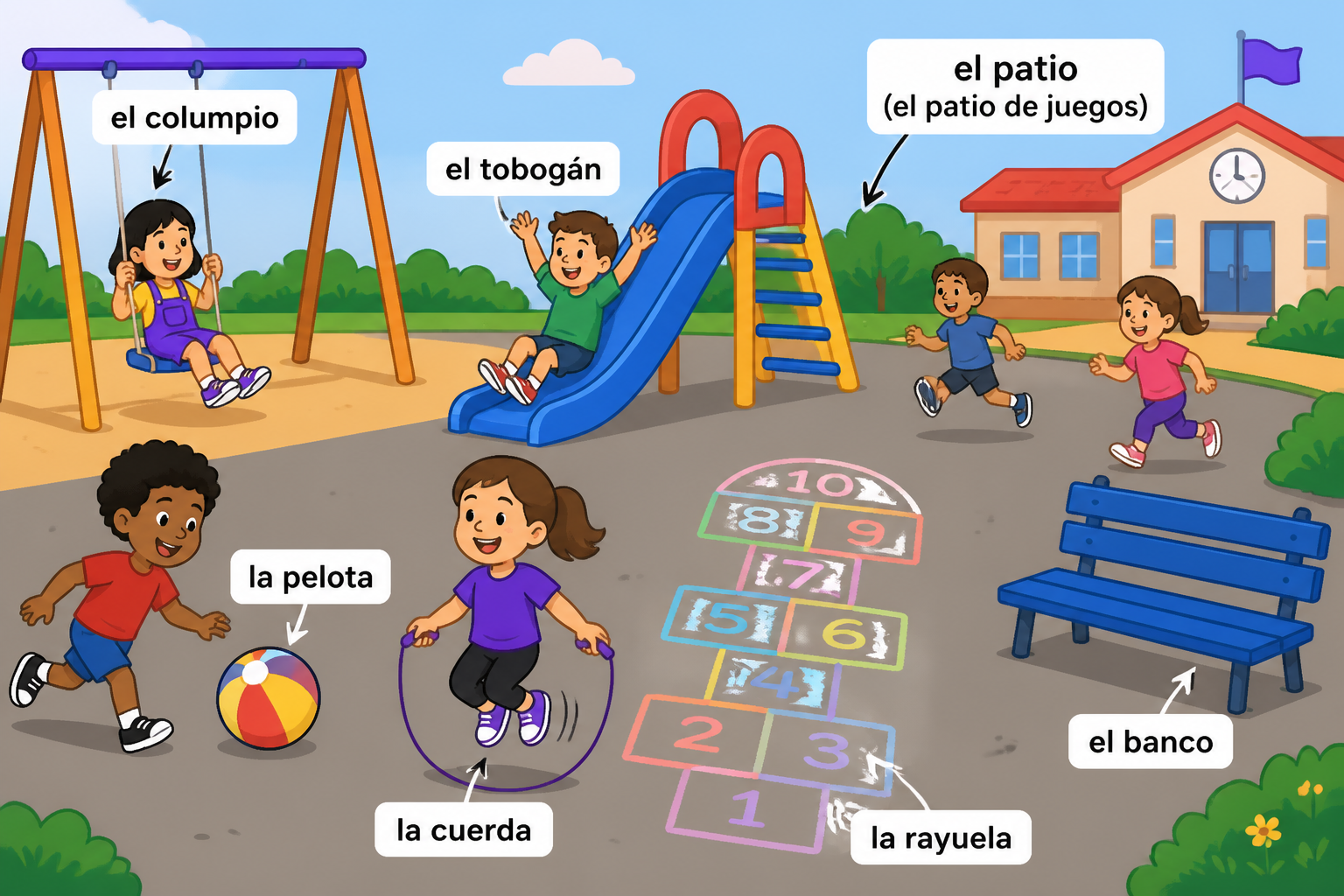
| el patio | el PAH-tyoh | courtyard, schoolyard, playground area | Los niños están en el patio. | The children are in the playground area. | Very common for the school yard. |
| el patio de juegos | el PAH-tyoh deh HWEH-gos | playground | El patio de juegos está lleno. | The playground is full. | Literal and clear; common in many places. |
| el columpio | el koh-LOOM-pyoh | swing | Me encanta el columpio. | I love the swing. | Plural: los columpios. |
| el tobogán | el toh-boh-GAN | slide | Hay un tobogán rojo. | There is a red slide. | The accent mark matters on the last syllable. |
| el sube y baja | el SOO-beh ee BAH-hah | see-saw, teeter-totter | Los niños usan el sube y baja. | The children use the see-saw. | Very common in Latin America. |
| las barras | las BAH-ras | bars, monkey bars | Me subí a las barras. | I climbed the monkey bars. | Usually used in the plural for playground bars. |
| la cuerda | lah KWEHR-dah | rope | Saltamos la cuerda. | We jump rope. | Also used for rope games. |
| saltar la cuerda | sahl-TAHR lah KWEHR-dah | to jump rope | Hoy vamos a saltar la cuerda. | Today we’re going to jump rope. | Useful phrase, not just the single noun. |
| la pelota | lah peh-LOH-tah | ball | ¿Tienes la pelota? | Do you have the ball? | Very broad word: ball in general. |
| el balón | el bah-LOHN | ball, often a soccer ball | Trae el balón para jugar. | Bring the ball to play. | Often sounds more specific or sporty. |
| la cancha | lah KAHN-chah | court, field, play area | Jugamos en la cancha. | We play on the field/court. | Common for sports areas at school. |
| el juego | el HWEH-goh | game | Ese juego es divertido. | That game is fun. | Useful general word. |
| jugar | hoo-GAHR | to play | ¿Quieres jugar conmigo? | Do you want to play with me? | One of the most useful recess verbs. |
| jugar a… | hoo-GAHR ah | to play at / to play a game | Vamos a jugar a la rayuela. | Let’s play hopscotch. | Use a before many games. |
| correr | koh-RREHR | to run | Los niños corren por el patio. | The children run around the playground. | The double r is rolled more strongly. |
| caminar | kah-mee-NAHR | to walk | Vamos a caminar hacia la cancha. | Let’s walk toward the field. | Useful for moving calmly between areas. |
| brincar | breen-KAHR | to jump | Los niños brincan en fila. | The children jump in a line. | Very common in Latin America; saltar can also mean jump. |
| saltar | sahl-TAHR | to jump | Vamos a saltar la cuerda. | We’re going to jump rope. | Also means “to skip over” in some contexts. |
| empujar | ehm-poo-HAHR | to push | No empujes a nadie. | Don’t push anyone. | Important classroom and playground verb. |
| jalar | hah-LAHR | to pull | No jales la cuerda tan fuerte. | Don’t pull the rope so hard. | Very common in Latin America. |
| espera | ehs-PEH-rah | wait | Espera tu turno. | Wait your turn. | Friendly, short command. |
| mi turno | mee TOOR-noh | my turn | Ahora es mi turno. | Now it’s my turn. | Useful in every game ever invented. |
| tu turno | too TOOR-noh | your turn | Ahora es tu turno. | Now it’s your turn. | tu has no accent because it’s possessive. |
| primero | pree-MEH-roh | first | Yo voy primero. | I go first. | Very common in games and lines. |
| después | dehs-PWEHS | after, later | Después juegas tú. | After that, you play. | Accent mark matters. |
| otra vez | OH-trah behs | again | ¡Otra vez! | Again! | Classic playground phrase. |
| más fuerte | mahs FWEHR-teh | harder, louder, stronger | Empuja más fuerte. | Push harder. | Use carefully; tone matters. |
| más despacio | mahs dehs-PAH-syoh | slower | Camina más despacio. | Walk more slowly. | Great for safety or instructions. |
| rápido | RAH-pee-doh | fast, quickly | Corre rápido. | Run fast. | Simple, very useful adjective/adverb. |
| lento | LEHN-toh | slow | Ese juego es lento. | That game is slow. | Can describe speed or pace. |
| cuidado | kwee-DAH-doh | careful, watch out | ¡Cuidado con la resbaladilla! | Watch out for the slide! | Very common safety word. |
| no te caigas | noh teh KAI-gahs | don’t fall | No te caigas del columpio. | Don’t fall off the swing. | Reflexive verb caerse = to fall down. |
| sube | SOO-beh | go up / climb up | ¡Sube al tobogán! | Go up the slide! | Short command form. |
| baja | BAH-hah | go down | Baja despacio. | Come down slowly. | Useful with slides and stairs. |
| sentarse | sehn-TAHR-seh | to sit down | Nos vamos a sentar en la banca. | We’re going to sit on the bench. | Reflexive verb; common in instructions. |
| la banca | lah BAHN-kah | bench | La maestra está en la banca. | The teacher is on the bench. | Common in parks and schools. |
| la fila | lah FEE-lah | line | Haz fila para bajar. | Make a line to come down. | Very common at school. |
| hacer fila | ah-SEHR FEE-lah | to line up | Los niños hacen fila para entrar. | The children line up to go in. | Important school phrase. |
| el silbato | el seel-BAH-toh | whistle | La maestra usa el silbato. | The teacher uses the whistle. | Very useful in school settings. |
| la maestra | lah mah-ES-trah | female teacher | La maestra llama a todos. | The teacher calls everyone. | Masculine: el maestro. |
| el maestro | el mah-ES-troh | male teacher | El maestro está vigilando. | The teacher is watching. | Common school vocabulary. |
| la campana | lah kahm-PAH-nah | bell | Suena la campana del recreo. | The recess bell rings. | Great school word. |
| sonar | soh-NAHR | to sound, ring | La campana va a sonar. | The bell is going to ring. | Not the same as English “sonar.” |
| entrar | ehn-TRAHR | to enter, go in | Después del recreo, vamos a entrar. | After recess, we’re going to go in. | Very common school verb. |
| salir | sah-LEER | to go out, leave | Salimos al recreo a las diez. | We go out for recess at ten. | Can also mean “to leave.” |
| divertido | dee-behr-TEE-doh | fun, entertaining | Ese juego es divertido. | That game is fun. | Adjective must match the noun: divertida for feminine nouns. |
| aburrido | ah-boo-RREE-doh | bored, boring | No quiero estar aburrido. | I don’t want to be bored. | Useful for feelings and descriptions. |
| la amistad | lah ah-mees-TAHD | friendship | El recreo ayuda con la amistad. | Recess helps with friendship. | More abstract, but very school-friendly. |
| el amigo / la amiga | el ah-MEE-goh / lah ah-MEE-gah | friend | Mi amiga juega conmigo. | My friend plays with me. | Gender changes with the person. |
| ¿Quieres jugar? | kyeh-REHS hoo-GAHR | Do you want to play? | ¿Quieres jugar conmigo? | Do you want to play with me? | One of the best beginner playground questions. |
| ¿Puedo jugar? | PWEH-doh hoo-GAHR | Can I play? | ¿Puedo jugar con ustedes? | Can I play with you all? | Polite and natural. |
| ven | behn | come | ¡Ven acá! | Come here! | Short command form of venir. |
| vamos | BAH-mohs | let’s go / we go | ¡Vamos a jugar! | Let’s play! | Very common encouragement word. |
| ya | yah | already, now, go ahead | ¡Ya me toca! | It’s my turn now! | Extremely common in real speech. |
| todavía | toh-dah-VEE-ah | still, not yet | Todavía no termina el recreo. | Recess is not over yet. | Accent mark matters. |
| fútbol | FOOT-bohl | soccer | Jugamos fútbol en el recreo. | We play soccer at recess. | In most of Latin America, this means soccer. |
| baloncesto | bah-lohn-SEHS-toh | basketball | Después jugamos baloncesto. | After that, we play basketball. | Common in both Latin America and Spain. |
| escondite | ehs-kohn-DEE-teh | hide-and-seek | Jugamos a las escondite. | We play hide-and-seek. | More naturally: el escondite in many places. |
| rayuela | rahy-WEH-lah | hopscotch | La rayuela está dibujada en el piso. | Hopscotch is drawn on the ground. | Very useful playground game word. |
| la cuerda para saltar | lah KWEHR-dah PAH-rah sahl-TAHR | jump rope | La cuerda para saltar es roja. | The jump rope is red. | Longer but very clear phrasing. |
| la resbaladilla | lah rehs-bah-lee-DYAH | slide | La resbaladilla está caliente. | The slide is hot. | Very common in Mexico and some other countries; elsewhere tobogán. |
Common Playground Commands
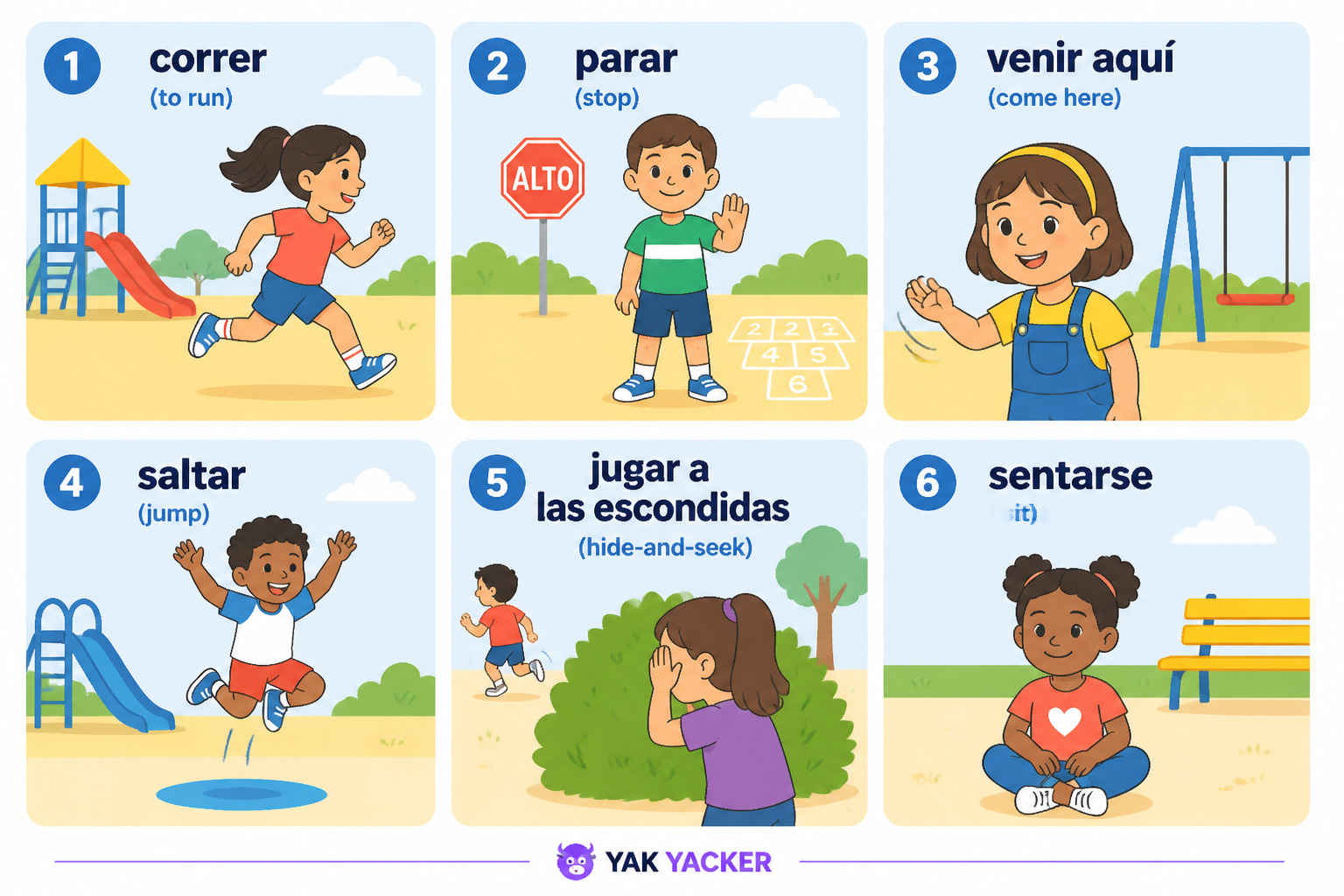
These are the kind of short phrases you hear all the time during recess. They’re simple, but that’s exactly why they matter. Little words do a lot of work when everyone is moving fast.
| Spanish | Pronunciation | Meaning | Example Sentence | Translation | Learner Note |
|---|---|---|---|---|---|
| ¡Corre! | KOH-reh | Run! | ¡Corre más rápido! | Run faster! | Short command from correr. |
| ¡Para! | PAH-rah | Stop! | ¡Para un momento! | Stop for a moment! | Very common and direct. |
| ¡Ven aquí! | behn ah-KEE | Come here! | ¡Ven aquí, por favor! | Come here, please! | Politer with por favor. |
| ¡Sígueme! | SEE-goo-meh | Follow me! | ¡Sígueme al patio! | Follow me to the playground! | Command formMore Spanish to explore How to Type Spanish Accents on Your Phone and Computer Best graded readers for Spanish The Boy and the Sheep: A1 Beginner Spanish Story with Audio Martina the Little Cockroach: A1 Beginner Spanish Story with Audio |