Poner in Spanish: Easy Meanings, Conjugation, and Real-Life Uses
Learn the Spanish verb poner without drowning in grammar soup. You will see what it means, when it turns into ponerse, and how to use it in normal human sentences.
The first time I heard a server in Mexico ask ¿Le pongo más café?, I froze for half a second. Nobody was “putting” coffee anywhere dramatic. He just meant, “Would you like some more?” That is the day poner stopped being a boring dictionary verb and turned into one of the most useful verbs in Spanish.
That is the trick with poner: it does mean to put, yes, but Spanish did not sign a contract promising one neat English translation per verb. Poner also shows up in daily phrases for turning things on, setting things up, paying attention, getting dressed, changing mood, and suddenly starting an action. Rude? Maybe. Useful? Very.
Yak Tip
Do not memorize poner as only “to put.” Learn it in chunks: poner la mesa, poner música, ponerse la chamarra, ponerse triste, ponerse a estudiar. That is how it sticks.
What Poner Really Means
At its core, poner is about placing, adding, setting, or causing something. In Mexican Spanish, you will also hear it in super common everyday uses like poner atención and ¿Le pongo más salsa? In other regions, some of those ideas may use a different verb more often, but poner is still one you need early.
| Pattern | English Meaning | Example |
|---|---|---|
| poner algo en | to put something in/on | Pongo las llaves en la mesa. = I put the keys on the table. |
| poner la mesa | to set the table | Mi hermano pone la mesa. = My brother sets the table. |
| poner música / la tele | to put on music / the TV | Pon música tranquila. = Put on some calm music. |
| poner atención | to pay attention | Pon atención, por favor. = Pay attention, please. |
| poner + adjective / noun idea | to make someone become / feel | El ruido me pone nervioso. = The noise makes me nervous. |
| ponerse + clothing / state | to put on / to become | Me pongo la chamarra. = I put on my jacket. |
| ponerse a + infinitive | to start doing something | Se puso a llorar. = He started crying. |
Six High-Value Uses You Will Actually Hear
Poner Algo Somewhere
English meaning: to put or place something.
Example: Voy a poner el celular en la mochila. = I’m going to put the phone in the backpack.
Poner La Mesa
English meaning: to set the table.
Example: ¿Puedes poner la mesa mientras yo cocino? = Can you set the table while I cook?
Poner Música
English meaning: to put on music.
Example: Siempre pone música cuando limpia la casa. = She always puts on music when she cleans the house.
Poner Atención
English meaning: to pay attention.
Example: Si no pones atención, te lo vas a perder. = If you don’t pay attention, you’re going to miss it.
Ponerse Ropa
English meaning: to put on clothes.
Example: Me pongo los tenis y nos vamos. = I’ll put on my sneakers and we’ll go.
Ponerse + State
English meaning: to become a mood, color, or temporary state.
Example: Se puso rojo cuando lo felicitaron. = He turned red when they congratulated him.
Present Tense Conjugation You Need First
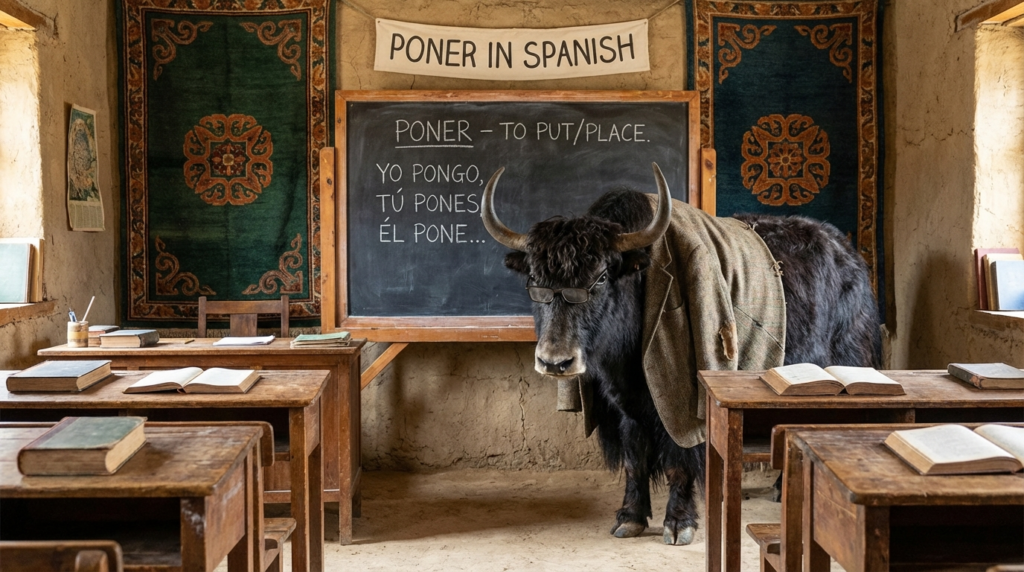
The present tense is mostly regular, except for the yo form: pongo. That one matters a lot because it also helps you build forms like ponga.
| Subject | Present | English |
|---|---|---|
| yo | pongo | I put / I place |
| tú | pones | you put |
| él / ella / usted | pone | he / she / you put |
| nosotros / nosotras | ponemos | we put |
| ellos / ellas / ustedes | ponen | they / you all put |
Mexico note: in everyday Mexican Spanish, ustedes is the normal plural “you,” not vosotros. So beginners usually need ponen much earlier than ponéis.
The Irregular Forms Worth Memorizing Early
| Form | Why It Matters | Example |
|---|---|---|
| pongo | present tense yo form | Yo pongo la comida en el refri. = I put the food in the fridge. |
| puse | preterite yo form | Ayer puse la mesa. = Yesterday I set the table. |
| pondré | future stem | Mañana pondré más sillas. = Tomorrow I’ll put out more chairs. |
| pondría | conditional stem | Yo pondría menos azúcar. = I would add less sugar. |
| puesto | past participle | Ya he puesto la alarma. = I’ve already set the alarm. |
| ponga | subjunctive / formal command base | Quiero que pongas atención. = I want you to pay attention. |
| pon | affirmative tú command | Pon eso aquí. = Put that here. |
Poner Vs. Ponerse
Poner
Use poner when you put something somewhere, add something, set something up, or cause an effect.
- Pongo el libro aquí. = I put the book here.
- Le pongo limón a los tacos. = I add lime to the tacos.
- La noticia me puso triste. = The news made me sad.
Ponerse
Use ponerse when the action happens to yourself: clothes, mood, color, temporary state, or suddenly starting an action.
- Me pongo la chamarra. = I put on my jacket.
- Se puso feliz. = She got happy.
- Nos pusimos a estudiar. = We started studying.
A useful shortcut: if you can say “put on yourself,” “become,” or “start doing,” there is a good chance ponerse is the one you want.
Useful Phrases And Real-Life Sentences
| Spanish | English Meaning | Example |
|---|---|---|
| poner la mesa | to set the table | Antes de cenar, siempre ponemos la mesa. = Before dinner, we always set the table. |
| poner música | to put on music | Voy a poner música mientras manejo. = I’m going to put on music while I drive. |
| poner la alarma | to set the alarm | No olvides poner la alarma para mañana. = Don’t forget to set the alarm for tomorrow. |
| poner atención | to pay attention | Pon atención a la pronunciación. = Pay attention to the pronunciation. |
| ponerle sal a algo | to add salt to something | No le pongas tanta sal a la sopa. = Don’t add so much salt to the soup. |
| poner nombre | to name | Le pusieron Luna a su perrita. = They named their dog Luna. |
| poner una queja | to file a complaint | Voy a poner una queja en recepción. = I’m going to file a complaint at reception. |
| poner una multa | to issue a fine | Le pusieron una multa por estacionarse mal. = They gave him a fine for parking badly. |
| me pone nervioso/a | it makes me nervous | Hablar en público me pone nerviosa. = Speaking in public makes me nervous. |
| ponerse la ropa | to put on clothes | El niño ya se puso los zapatos. = The boy already put on his shoes. |
| ponerse triste / feliz / serio | to become sad / happy / serious | Se puso serio cuando oyó la noticia. = He became serious when he heard the news. |
| ponerse rojo/a | to turn red | Me pongo roja cuando me da pena. = I turn red when I feel embarrassed. |
| ponerse de pie | to stand up | Todos se pusieron de pie al entrar la maestra. = Everyone stood up when the teacher came in. |
| ponerse a estudiar | to start studying | Ya me voy a poner a estudiar. = I’m going to start studying now. |
One regional note: in Mexico, poner atención is extremely common. In some other places, prestar atención may sound more natural. Learn both, then enjoy sounding less confused in more countries. Charming strategy.
A Very Useful Mexican Extra
Ponerle ganas means to put in effort or to really try.
Example: Si le pones ganas, vas a mejorar muchísimo. = If you put in the effort, you’re going to improve a lot.
This one is very common in Mexico and worth learning early because it sounds natural, supportive, and a little more alive than textbook Spanish.
Common Mistakes And Fast Fixes
- Mistake: using poner when you mean usar.
Wrong: Pongo mi teléfono para mandar un mensaje.
Better: Uso mi teléfono para mandar un mensaje. = I use my phone to send a message. - Mistake: using plain poner for your own clothes.
Wrong: Pongo la chamarra.
Better: Me pongo la chamarra. = I put on my jacket. - Mistake: forgetting the irregular yo form.
Remember: it is yo pongo, not yo pono. Spanish can be generous sometimes, but not that generous. - Mistake: assuming all past forms are regular.
Remember: the preterite is puse, pusiste, puso… - Mistake: forgetting the future stem.
Remember: it is pondré, not poneré.
Practice With Poner
Try these quickly before peeking. Your brain deserves at least five seconds of effort.
1) Translate: “I put the keys on the table.”
Pongo las llaves en la mesa.
2) Translate: “She put on her sweater.”
Se puso su suéter.
3) Translate: “The movie made me sad.”
La película me puso triste.
4) Translate: “We started studying at eight.”
Nos pusimos a estudiar a las ocho.
5) Fill in the blank: “Mañana yo ___ la alarma.”
pondré
6) Fill in the blank: “No ___ tanta salsa, por favor.”
pongas
Quick Reference Summary
| If You Want To Say… | Use | Example |
|---|---|---|
| put or place something | poner | Pon el vaso aquí. |
| put on your own clothes | ponerse | Me pongo la gorra. |
| become sad, happy, red, serious | ponerse | Se puso feliz. |
| start doing something | ponerse a + infinitive | Me puse a leer. |
| make someone feel something | poner + object + adjective | Me pone nervioso. |
| give a command | pon | Pon atención. |
Final Yak
If you remember only five things, make them these: pongo, puse, pondré, pon, and the giant difference between poner and ponerse. After that, learn the chunks people actually say: poner la mesa, poner atención, poner música, me pone nervioso, and ponerse a + infinitive. That alone will make your Spanish sound much more real.