Poder Conjugation In Spanish
Learn puedo, pude, podía, podría, pueda, and the patterns behind them, without turning one useful verb into a full-time emotional crisis.
There’s a classroom joke that poder is the verb that waits until you finally feel confident, then reappears as pude and acts like you’ve never met. Rude, honestly. The good news is that poder is not random. It follows a few clear patterns, and once you see them, this super-common Spanish verb gets a lot less dramatic.
In real life, you use poder all the time: to say what you can do, ask permission, make polite requests, talk about what you could do in the past, and even say something might happen. This guide focuses on the forms adults actually need in conversation, email, travel, work, and everyday life.
Yak Tip: Memorize chunks first: puedo, no puedo, ¿puedes…?, ¿podrías…?, no pude, podía. These do more real work than a giant chart you forget tomorrow.
What Poder Means In Real Spanish
| Spanish Pattern | English Meaning | Example |
|---|---|---|
| poder + infinitive | can / to be able to | Puedo ayudarte hoy. I can help you today. |
| ¿Puedo + infinitive? | may I? / can I? | ¿Puedo pasar? May I come in? |
| ¿Puedes…? / ¿Podrías…? | can you…? / could you…? | ¿Podrías cerrar la ventana? Could you close the window? |
| puede que + subjunctive | may / might | Puede que llueva. It might rain. |
| se puede | it is allowed / one can | Aquí se puede pagar con tarjeta. You can pay by card here. |
| no se puede | it is not allowed | No se puede fumar aquí. Smoking is not allowed here. |
Master Chart: The Most Useful Poder Forms
Mexican Spanish note: in Mexico, people normally use ustedes for plural “you,” not vosotros. I still include vosotros in the chart so other textbooks and websites do not suddenly look like alien documents.
| Pronoun | Present | Preterite | Imperfect | Future | Conditional |
|---|---|---|---|---|---|
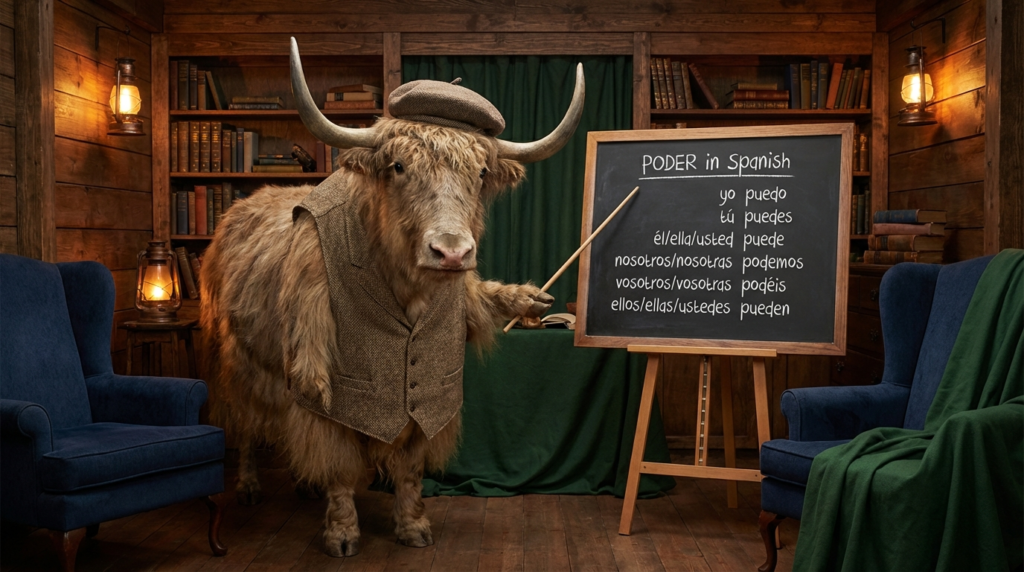
| yo | puedo | pude | podía | podré | podría |
| tú | puedes | pudiste | podías | podrás | podrías |
| él / ella / usted | puede | pudo | podía | podrá | podría |
| nosotros / nosotras | podemos | pudimos | podíamos | podremos | podríamos |
| vosotros / vosotras | podéis | pudisteis | podíais | podréis | podríais |
| ellos / ellas / ustedes | pueden | pudieron | podían | podrán | podrían |
The Three Pattern Families That Make Life Easier
| Pattern | Where You See It | Example |
|---|---|---|
| pued- | Present and present subjunctive, except nosotros and vosotros | puedo, puedes, pueda |
| pud- | Preterite and imperfect subjunctive | pude, pudieron, pudiera |
| podr- | Future and conditional | podré, podrías, podrán |
Present Tense: The Form You Use Constantly
The present tense of poder means can, am able to, or sometimes may. It has the classic o → ue stem change in every form except nosotros and vosotros.
- Yo puedo hablar con el gerente. — I can speak with the manager.
- No puedes entrar todavía. — You can’t come in yet.
- ¿Puede ayudarme, por favor? — Can you help me, please?
- Podemos salir después de la junta. — We can leave after the meeting.
- Ustedes pueden sentarse aquí. — You can sit here.
The Past Tense Trap: Pude Vs Podía
This is where many learners get ambushed. Both forms can translate as could in English, but they do not mean the same thing.
Podía
English meaning: could / used to be able to
Use podía for general ability, repeated ability, or background description in the past. It says the ability existed, but it does not tell you whether the action actually happened.
- De niño podía dormir en cualquier parte. — As a kid, I could sleep anywhere.
- Antes no podía concentrarme. — Before, I couldn’t concentrate.
Pude
English meaning: was able to / managed to
Use pude for a specific completed situation in the past. It often suggests success or failure in one concrete moment.
- Al final pude abrir el archivo. — In the end, I managed to open the file.
- No pude dormir anoche. — I couldn’t sleep last night.
A fast memory trick: podía = ability in general; pude = one actual situation. English hides that difference a lot, which is why Spanish learners end up squinting at both forms like they personally caused the problem.
Future And Conditional: Podré And Podría
These forms use the podr- stem. Nice of poder to change again, obviously.
- Mañana podré terminar el informe. — Tomorrow I will be able to finish the report.
- No podremos ir esta noche. — We won’t be able to go tonight.
- ¿Podrías mandarme el enlace? — Could you send me the link?
- Podríamos comer después. — We could eat later.
Podría is especially useful because it can mean would be able to, could, or make a request sound softer and more polite.
Subjunctive Forms You Actually Need
| Pronoun | Present Subjunctive | Imperfect Subjunctive |
|---|---|---|
| yo | pueda | pudiera / pudiese |
| tú | puedas | pudieras / pudieses |
| él / ella / usted | pueda | pudiera / pudiese |
| nosotros / nosotras | podamos | pudiéramos / pudiésemos |
| vosotros / vosotras | podáis | pudierais / pudieseis |
| ellos / ellas / ustedes | puedan | pudieran / pudiesen |
Use the present subjunctive after common triggers like hope, doubt, emotion, and possibility.
- Espero que puedas venir. — I hope you can come.
- Es bueno que podamos hablar. — It’s good that we can talk.
- Puede que lleguen tarde. — They might arrive late.
- Quería que pudieras quedarte. — I wanted you to be able to stay.
Very useful chunk: puede que + subjunctive = may / might. So: Puede que tenga tiempo means “I may have time,” not “I can that I have time,” because Spanish enjoys not translating itself word for word. Fair enough.
Perfect Forms, Participle, And Gerund
| Form | English Meaning | Example |
|---|---|---|
| podido | been able | He podido resolverlo. I have been able to solve it. |
| he / has / ha + podido | have / has been able to | ¿Has podido hablar con ella? Have you been able to speak with her? |
| había podido | had been able to | No había podido llamarte. I hadn’t been able to call you. |
| pudiendo | being able / while being able | Aun pudiendo ir, prefirió quedarse. Even though he was able to go, he preferred to stay. |
In everyday conversation, he podido is much more useful than the gerund. Start there first.
Imperative: Yes, It Exists. No, It Is Not Very Normal.
You may see imperative forms in charts: puede, pueda, podamos, poded, puedan. Grammatically, they exist. In real life, giving someone a command with poder often sounds awkward because “be able to!” is not usually what people actually want to say.
So instead of trying to command with poder, Spanish usually uses another verb or a polite request:
- Better than a weird command: Abre la puerta. — Open the door.
- Polite request: ¿Puedes abrir la puerta? — Can you open the door?
- More formal: ¿Podría abrir la puerta? — Could you open the door?
Poder Vs Saber: A Classic Mix-Up
| Spanish | English Meaning | Example |
|---|---|---|
| saber + infinitive | to know how to do something | Sé cocinar comida mexicana. I know how to cook Mexican food. |
| poder + infinitive | to be able to do something right now / in this situation | No puedo cocinar ahora. I can’t cook right now. |
Sé nadar means “I know how to swim.”
Puedo nadar means “I can swim” or “I’m able to swim” in this situation.
Common Mistakes And Fast Fixes
- Wrong: yo podo
Right: yo puedo
Why: the present tense changes from o to ue. - Wrong for one finished event: Ayer podía abrir la puerta.
Better: Ayer pude abrir la puerta.
Why: pude fits one completed situation. - Wrong: Puede que viene.
Right: Puede que venga.
Why: puede que is followed by the subjunctive. - Wrong idea: using saber when you mean present ability
Right: No puedo ir hoy.
Why: this is about possibility, not knowledge. - Clunky request: forcing an imperative form of poder
Better: ¿Puedes ayudarme? or Ayúdame.
Why: it sounds more natural.
Quick Reference Summary
| Meaning | Best Pattern | Example |
|---|---|---|
| ability now | puedo + infinitive | Puedo hacerlo. — I can do it. |
| permission | ¿Puedo + infinitive? | ¿Puedo entrar? — May I come in? |
| specific success or failure in the past | pude + infinitive | No pude ir. — I couldn’t go. |
| general past ability | podía + infinitive | Podía correr mucho. — I could run a lot. |
| polite request | ¿Podrías + infinitive? | ¿Podrías esperar? — Could you wait? |
| possibility | puede que + subjunctive | Puede que llueva. — It might rain. |
| allowed / not allowed | se puede / no se puede | No se puede estacionar aquí. — You can’t park here. |
| have been able to | he / has / ha podido | Hemos podido terminar. — We have been able to finish. |
Practice Section
Fill in each blank with the best form of poder.
- Hoy no ______ ir; tengo demasiado trabajo.
- Cuando era niña, ______ pasar horas dibujando.
- Ayer por fin ______ hablar con soporte técnico.
- ¿______ mandarme ese archivo, por favor?
- Espero que mañana ______ venir temprano.
- No ______ abrir la puerta anoche.
- Aquí no ______ fumar.
- Tal vez no vengan; ______ estar cansados.
See The Answers
- puedo
- podía
- pude
- podrías
- puedas
- pude
- se puede does not fit here because the sentence is already built with Aquí no…, so the best full answer is se puede: Aquí no se puede fumar.
- pueden if you mean “they may be tired” in a simple, direct way, but the more natural chunk for pure possibility is puede que estén cansados.
Final Yak
If you remember only one thing, make it this: poder is really three small families wearing one trench coat — pued-, pud-, and podr-. Learn what each family does, and the whole conjugation chart stops trying to look mysterious.
Start with puedo, podía, pude, podría, and pueda. Those five forms will carry an absurd amount of your real Spanish.