


If you want to talk about work in Spanish without sounding like a nervous robot at a job fair, you’re in the right place. This guide gives you practical job vocabulary, common work phrases, and the kind of everyday language people actually use in offices, shops, interviews, and casual conversations.
For the broader learning path, visit our parent guide.
You’ll learn words for jobs, workplaces, tasks, schedules, coworkers, and job-search basics. A tiny but useful fact: in Spanish, trabajo means “work” or “job,” but empleo usually means “job” in a more formal or official sense. English loves to make simple things weird; Spanish at least keeps the drama manageable.
By the end, you’ll be able to describe what someone does for work, ask about a job, and understand the most common vocabulary around employment. For a broader business context, you can also check this related guide on popular business vocabulary in Spanish.
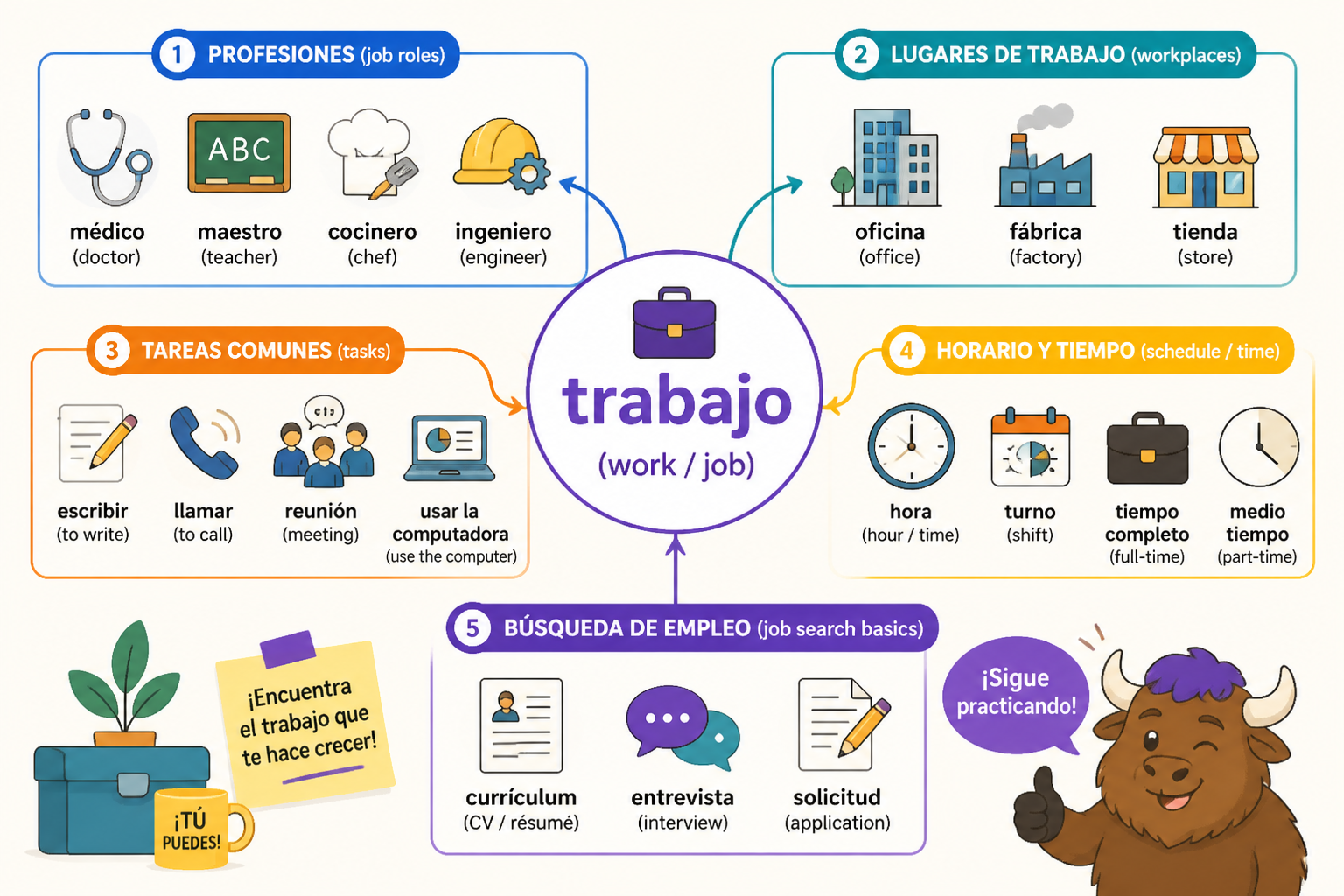
Core Job Words You’ll Hear All the Time
| Spanish | Pronunciation | Meaning | Example Sentence | Translation | Learner Note |
|---|---|---|---|---|---|
| trabajo | trah-BAH-hoh | work; job | Mi trabajo empieza a las ocho. | My work starts at eight. | Very common. Also means “work” in general. |
| empleo | em-PLEH-oh | job; employment | Busco empleo en una oficina. | I’m looking for a job in an office. | Slightly more formal than trabajo. |
| puesto | PWES-toh | position; job role | Consiguió un puesto nuevo. | He/she got a new position. | Useful in interviews and hiring. |
| oficina | oh-fee-SEE-nah | office | Trabajo en una oficina pequeña. | I work in a small office. | Feminine noun: la oficina. |
| empresa | em-PREH-sah | company | La empresa tiene veinte empleados. | The company has twenty employees. | Very common in work settings. |
| jefe / jefa | HEH-feh / HEH-fah | boss | Mi jefa es muy organizada. | My boss is very organized. | Gender changes with the person. |
| compañero / compañera | kohn-pah-NYEH-roh / -rah | coworker; classmate; companion | Mis compañeros son amables. | My coworkers are kind. | Very flexible word. Context matters. |
| empleado / empleada | em-pleh-AH-doh / -dah | employee | La empleada atiende a los clientes. | The employee helps customers. | Common in retail, offices, and services. |
| cliente | klee-EN-teh | customer; client | El cliente está esperando. | The customer is waiting. | Same form for masculine and feminine. |
| salario | sah-LAH-ryoh | salary | El salario no es muy alto. | The salary is not very high. | Neutral and widely used. |
| sueldo | SWEL-doh | salary; pay | Mi sueldo llega el viernes. | My paycheck arrives on Friday. | Very common in daily conversation. |
| horario | oh-RAH-ryoh | schedule; timetable | Tengo un horario flexible. | I have a flexible schedule. | Useful for work and school. |
Jobs and Professions Vocabulary
Here are common jobs in Spanish. Some are obvious, some are sneaky little traps, and some look suspiciously like English because Spanish enjoys borrowing with style.
| Spanish | Pronunciation | Meaning | Example Sentence | Translation | Learner Note |
|---|---|---|---|---|---|
| doctor / doctora | dohk-TOHR / dohk-TOH-rah | doctor | La doctora trabaja en el hospital. | The doctor works at the hospital. | Use médico / médica too. |
| enfermero / enfermera | en-fer-MEH-roh / -rah | nurse | El enfermero cuida a los pacientes. | The nurse takes care of the patients. | Very common in hospitals. |
| profesor / profesora | pro-feh-SOHR / -rah | teacher; professor | La profesora explica muy bien. | The teacher explains very well. | In Latin America, this often means “teacher.” |
| abogado / abogada | ah-boh-GAH-doh / -dah | lawyer | Mi hermana es abogada. | My sister is a lawyer. | Very common career word. |
| ingeniero / ingeniera | een-heh-NYEH-roh / -rah | engineer | El ingeniero diseñó el puente. | The engineer designed the bridge. | Stress is on the “nyeh” sound. |
| arquitecto / arquitecta | ar-kee-TEHK-toh / -tah | architect | La arquitecta trabaja en proyectos grandes. | The architect works on big projects. | Good for construction and design. |
| contador / contadora | kohn-tah-DOHR / -doh-rah | accountant | El contador revisa los números. | The accountant checks the numbers. | Strong business vocabulary. |
| cocinero / cocinera | koh-see-NEH-roh / -rah | cook; chef | La cocinera prepara la cena. | The cook prepares dinner. | For restaurants and home cooking. |
| mesero / mesera | meh-SEH-roh / -rah | waiter; waitress | El mesero trae el menú. | The waiter brings the menu. | Common in Latin America. |
| médico / médica | MEH-dee-koh / -kah | doctor | La médica revisa al paciente. | The doctor checks the patient. | More formal than doctor. |
| periodista | peh-ryoh-DEES-tah | journalist | La periodista escribe noticias. | The journalist writes news. | Same form for all genders. |
| piloto | pee-LOH-toh | pilot | El piloto anunció la salida. | The pilot announced the departure. | Useful for travel conversations. |
| policía | poh-lee-SEE-ah | police officer | La policía llegó rápido. | The police officer arrived quickly. | Can refer to a person or the police force. |
| bombero / bombera | bohm-BEH-roh / -rah | firefighter | Los bomberos apagaron el fuego. | The firefighters put out the fire. | Regular, practical word. |
| electricista | eh-lehk-tree-SEES-tah | electrician | El electricista arregló el cable. | The electrician fixed the cable. | Handy for repairs. |
| fontanero / fontanera | fon-tah-NEH-roh / -rah | plumber | Llamamos al fontanero por el grifo. | We called the plumber because of the faucet. | Common in Spain; in Latin America, plomero is often more common. |
| plomero / plomera | plo-MEH-roh / -rah | plumber | El plomero vino esta mañana. | The plumber came this morning. | More common in many parts of Latin America. |
| carpintero / carpintera | kar-peen-TEH-roh / -rah | carpenter | La carpintera hizo la mesa. | The carpenter made the table. | Useful for trade vocabulary. |
| mecánico / mecánica | meh-KAH-nee-koh / -kah | mechanic | El mecánico revisó el coche. | The mechanic checked the car. | Common in everyday life. |
| gerente | heh-REN-teh | manager | La gerente está en una reunión. | The manager is in a meeting. | Very common in office language. |
| recepcionista | reh-sep-syoh-NEES-tah | receptionist | La recepcionista saludó al visitante. | The receptionist greeted the visitor. | Works in hotels, clinics, offices. |
| secretario / secretaria | seh-kreh-TAH-ryoh / -rah | secretary | La secretaria organiza las citas. | The secretary organizes the appointments. | Can sound old-fashioned in some workplaces; asistente administrativo/a may be preferred. |
Useful Work Phrases for Everyday Conversations
These are the phrases people actually use when talking about jobs, schedules, and work life. Nice and practical. No HR jargon trying to eat your brain.
| Spanish | Pronunciation | Meaning | Example Sentence | Translation | Learner Note |
|---|---|---|---|---|---|
| ¿A qué te dedicas? | ah keh teh deh-DEE-kahs | What do you do for work? | —¿A qué te dedicas? —Soy diseñador gráfico. | —What do you do for work? —I’m a graphic designer. | Very common and natural. |
| Trabajo como… | trah-BAH-hoh KOH-moh | I work as… | Trabajo como enfermero. | I work as a nurse. | Good way to state your job. |
| Busco trabajo. | BOOS-koh trah-BAH-hoh | I’m looking for work. | Busco trabajo en un hotel. | I’m looking for work in a hotel. | Very useful for job searching. |
| Estoy desempleado/a. | eh-STOY deh-sem-pleh-AH-doh / -dah | I’m unemployed. | Ahora estoy desempleada. | Right now I’m unemployed. | Formal or neutral; common in official contexts. |
| Tengo una entrevista. | TEN-goh OO-nah en-tre-BEE-stah | I have an interview. | Mañana tengo una entrevista de trabajo. | Tomorrow I have a job interview. | Very handy phrase. |
| Me contrataron. | meh kon-trah-TAH-ron | I got hired. | Me contrataron esta semana. | I got hired this week. | Past tense, very useful. |
| Lo / la despidieron. | loh / lah dehs-pee-DYEH-ron | He / she got fired. | Lo despidieron ayer. | He got fired yesterday. | Keep it neutral and careful; context matters. |
| Salgo del trabajo a las cinco. | SAHL-goh del trah-BAH-hoh ah las SEEN-koh | I leave work at five. | Salgo del trabajo a las cinco todos los días. | I leave work at five every day. | Very natural daily Spanish. |
| Entro a las ocho. | EN-troh ah las OH-choh | I start at eight; I go in at eight. | Entro a las ocho y media. | I start at 8:30. | Often used for work or school schedules. |
| Estoy ocupado/a. | eh-STOY oh-koh-PAH-doh / -dah | I’m busy. | No puedo hablar ahora, estoy ocupado. | I can’t talk now, I’m busy. | Use ocupada for feminine speaker. |
| Tengo una reunión. | TEN-goh OO-nah reh-oo-nee-ON | I have a meeting. | Tengo una reunión con mi jefe. | I have a meeting with my boss. | Very common office phrase. |
| Estoy en una llamada. | eh-STOY en OO-nah yah-MAH-dah | I’m on a call. | Ahora estoy en una llamada con un cliente. | I’m on a call with a client right now. | Great for office and phone conversations. |
| Mi turno empieza ahora. | mee TOOR-no em-PEE-sah ah-OH-rah | My shift starts now. | Mi turno empieza a las tres. | My shift starts at three. | Turno is a shift or turn. |
| Trabajo de lunes a viernes. | trah-BAH-hoh deh LOO-nes ah bee-ER-nes | I work Monday to Friday. | Trabajo de lunes a viernes. | I work Monday to Friday. | Very common schedule expression. |
| Trabajo por mi cuenta. | trah-BAH-hoh pohr mee KWEN-tah | I’m self-employed. | Trabajo por mi cuenta desde casa. | I work for myself from home. | Useful for freelancers and independent workers. |
| Trabajo desde casa. | trah-BAH-hoh DEHS-deh KAH-sah | I work from home. | Trabajo desde casa dos días por semana. | I work from home two days a week. | Super common now. Thanks, modern life. |
| Hago horas extras. | AH-goh OH-ras EKS-tras | I do overtime. | Hoy hago horas extras. | Today I’m doing overtime. | Very useful work phrase. |
| Tengo experiencia. | TEN-goh eks-peh-ryen-SEE-ah | I have experience. | Tengo experiencia en ventas. | I have experience in sales. | Great for interviews. |
| No tengo experiencia. | noh TEN-goh eks-peh-ryen-SEE-ah | I don’t have experience. | No tengo experiencia en este campo. | I don’t have experience in this field. | Honesty is fine; just keep it confident. |
| Necesito un aumento. | neh-seh-SEE-toh oon ah-OO-men-toh | I need a raise. | Necesito un aumento de salario. | I need a salary raise. | Bold move. Use carefully. |
Job Search Words You’ll See On Forms and Listings
Job ads and application forms love to sound slightly more official than everyday conversation. Here’s the vocabulary that helps you survive the paperwork.
| Spanish | Pronunciation | Meaning | Example Sentence | Translation | Learner Note |
|---|---|---|---|---|---|
| currículum | koo-REE-koo-lum | résumé; CV | Envié mi currículum por correo. | I sent my résumé by email. | Often shortened to CV too. |
| solicitud | soh-lee-see-TOOD | application; request | Completa la solicitud en línea. | Complete the application online. | Common in forms and hiring. |
| vacante | bah-KAN-teh | job opening; vacancy | Hay una vacante en recepción. | There is a job opening at reception. | Very useful in listings. |
| requisito | reh-kee-SEE-toh | requirement | El inglés es un requisito. | English is a requirement. | Great for reading job ads. |
| entrevista de trabajo | en-tre-BEE-stah deh trah-BAH-hoh | job interview | Tengo una entrevista de trabajo mañana. | I have a job interview tomorrow. | More specific than just entrevista. |
| contrato | kohn-TRAH-toh | contract | Firmé el contrato hoy. | I signed the contract today. | Very important in work vocabulary. |
| jornada completa | hor-NAH-dah kohm-PLEH-tah | full-time work | Busca un puesto de jornada completa. | He/she is looking for a full-time position. | Common in ads. |
| media jornada | MEH-dee-ah hor-NAH-dah | part-time work | Prefiero trabajar media jornada. | I prefer to work part-time. | Useful everyday phrase. |
| horario flexible | oh-RAH-ryoh flehk-SEE-bleh | flexible schedule | La empresa ofrece horario flexible. | The company offers a flexible schedule. | Great in modern work settings. |
| beneficios | beh-neh-FEE-syMore Spanish to explore How to Type Spanish Accents on Your Phone and Computer Best graded readers for Spanish The Boy and the Sheep: A1 Beginner Spanish Story with Audio Martina the Little Cockroach: A1 Beginner Spanish Story with Audio |