


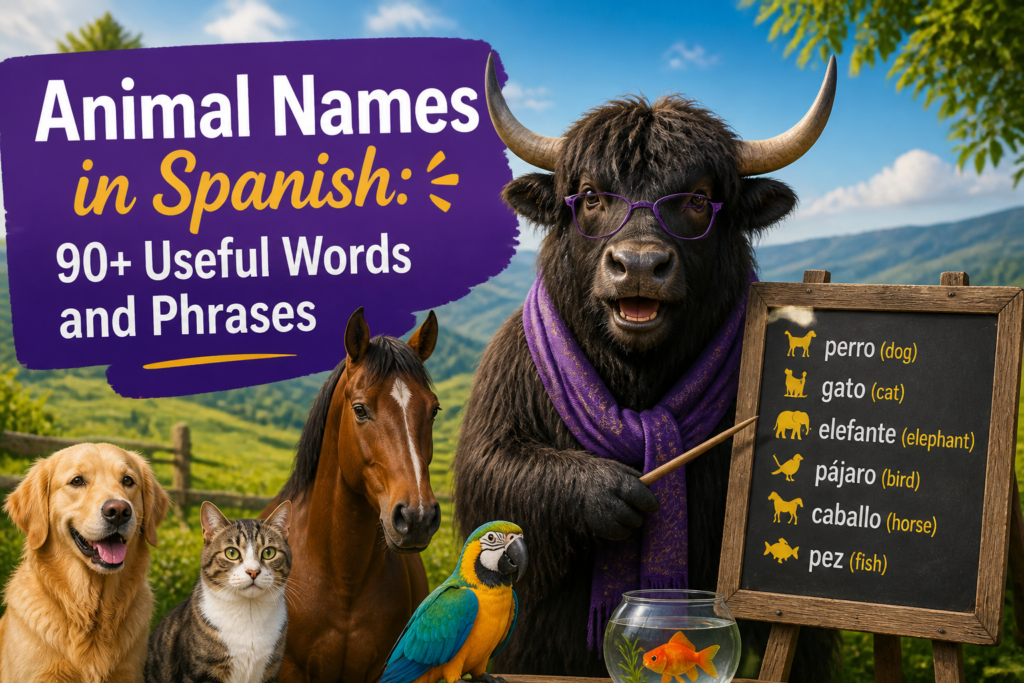
Animals are one of the easiest ways to build Spanish vocabulary fast, because they show up everywhere: in books, conversations, jokes, city life, travel, and yes, the occasional dramatic metaphor. Spanish has a lot of animal words that are simple, useful, and surprisingly handy when you want to describe people, habits, or what you just saw in the park.
For the broader learning path, visit our parent guide.
By the end of this guide, you’ll know common animal names in Spanish, a bunch of real-life phrases, and some grammar and pronunciation details that keep learners from tripping over the usual little language banana peel.
One fun detail: Spanish animal vocabulary often behaves like a normal noun with gender and articles, so el perro and la perra are not just “dog” and “female dog,” they also show you how Spanish nouns like to keep life organized and mildly annoying at the same time.
If you want a bigger vocabulary foundation too, it helps to pair this lesson with 100 Essential Spanish Words & Phrases and, for nature-related words, Habitats Vocabulary in Spanish. For a look at borrowed words and Indigenous influence, the guide on Indigenous and Other Loanwords in Spanish is a nice rabbit hole. Or cat hole. Whatever.
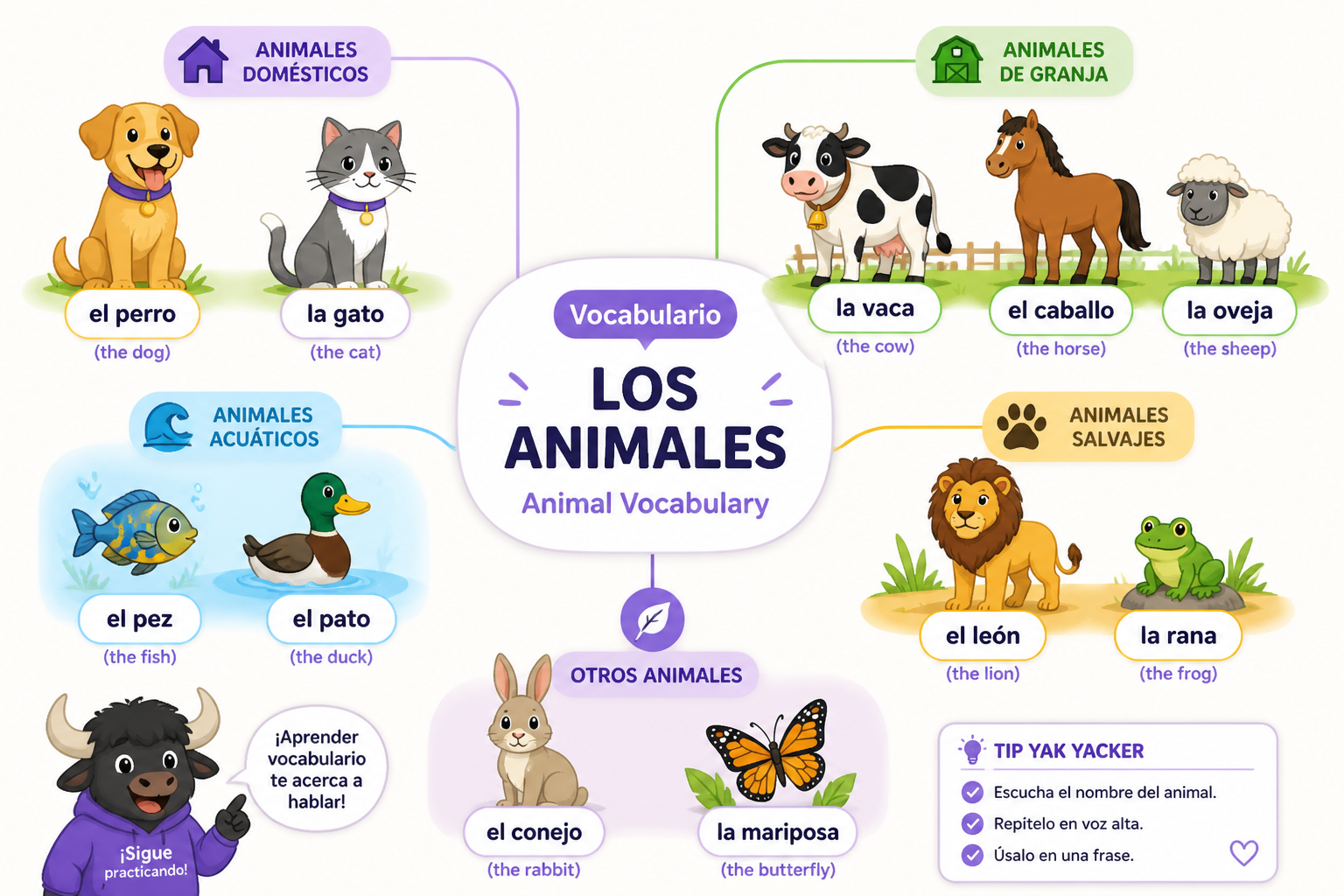
Basic Animal Names You’ll Use All The Time
These are the everyday animals you’re most likely to hear in conversation, school, travel, nature, and animal videos that are absolutely “for learning” and not at all just procrastination in disguise.
| Spanish | Pronunciation | Meaning | Example Sentence | Translation | Learner Note |
|---|---|---|---|---|---|
| el perro | PEH-rroh | dog | El perro duerme en el sofá. | The dog sleeps on the sofa. | Masculine noun. The double r is rolled/trilled. |
| la perra | PEH-rrah | female dog | La perra es muy tranquila. | The female dog is very calm. | Use only when gender matters. |
| el gato | GAH-toh | cat | El gato se subió a la mesa. | The cat jumped onto the table. | Very common noun; easy pronunciation. |
| la gata | GAH-tah | female cat | La gata está mirando por la ventana. | The female cat is looking out the window. | Also used informally in some regions for “girl,” so context matters. |
| el pájaro | PAH-hah-roh | bird | Vi un pájaro azul en el árbol. | I saw a blue bird in the tree. | In many places, ave is also common for “bird,” often a bit more general or literary. |
| el pez | pes | fish | El pez nada muy rápido. | The fish swims very fast. | Plural changes to peces. |
| la vaca | BAH-kah | cow | La vaca come pasto en el campo. | The cow eats grass in the field. | Classic farm vocabulary. |
| el caballo | kah-BAH-yoh | horse | El caballo corre por la pradera. | The horse runs through the meadow. | The ll sounds like a soft “y” in most Latin American Spanish. |
| el cerdo | SEHR-doh | pig | El cerdo duerme en el corral. | The pig sleeps in the pen. | Useful in farm and food vocabulary. |
| la gallina | gah-YEE-nah | hen / chicken | La gallina puso un huevo. | The hen laid an egg. | For the animal, not the cooked food. |
| el pollo | POH-yoh | chicken, chick | Comí pollo al mediodía. | I ate chicken at midday. | Often means “chicken meat” in food contexts. |
| la oveja | oh-BEH-hah | sheep | La oveja tiene lana blanca. | The sheep has white wool. | j sounds like a strong “h.” |
More Common Animals And Nature Words
Once you know the basics, you can move into animals you might see in a zoo, on a farm, in the countryside, or in a wildlife documentary where the narrator somehow sounds personally offended by the existence of the snake.
| Spanish | Pronunciation | Meaning | Example Sentence | Translation | Learner Note |
|---|---|---|---|---|---|
| el pato | PAH-toh | duck | El pato nada en el lago. | The duck swims in the lake. | Simple, useful, and easy to remember. |
| el ganso | GAN-soh | goose | El ganso hizo mucho ruido. | The goose made a lot of noise. | Also used in some places in expressions about silliness. |
| la tortuga | tor-TOO-gah | turtle / tortoise | La tortuga camina muy despacio. | The turtle walks very slowly. | In Spanish, tortuga can cover both turtle and tortoise depending on context. |
| la rana | RAH-nah | frog | La rana saltó al estanque. | The frog jumped into the pond. | A fun, short word with clear vowels. |
| la serpiente | sehr-PYEHN-teh | snake | La serpiente se escondió en la hierba. | The snake hid in the grass. | Watch the stress: ser-pien-te. |
| el cocodrilo | koh-koh-DREE-loh | crocodile | El cocodrilo abrió la boca. | The crocodile opened its mouth. | Very clear stress on -dri-. |
| el caimán | kai-MAHN | caiman / alligator-type reptile | Vimos un caimán cerca del río. | We saw a caiman near the river. | Common in Latin America, especially in wildlife contexts. |
| la lagartija | lah-gahr-TEE-hah | lizard | La lagartija se calentó al sol. | The lizard warmed up in the sun. | g before a is hard like “g” in go. |
| el conejo | koh-NEH-hoh | rabbit | El conejo come zanahorias. | The rabbit eats carrots. | The j sound is the throaty Spanish “h.” |
| el ratón | rah-TOHN | mouse | Hay un ratón en la cocina. | There is a mouse in the kitchen. | Accent mark matters: ratón. |
| la ardilla | ahr-DEE-yah | squirrel | La ardilla subió al árbol. | The squirrel climbed the tree. | ll is usually a “y” sound in Latin America. |
| el murciélago | moor-syeh-LAH-goh | bat | El murciélago sale de noche. | The bat comes out at night. | A longer word, but very common in nature vocabulary. |
Zoo Animals And Wild Animals
This group is especially useful for travel, children’s books, documentaries, and those moments when somebody asks, “What animals did you see?” and suddenly your brain becomes a blank white wall. Not ideal.
| Spanish | Pronunciation | Meaning | Example Sentence | Translation | Learner Note |
|---|---|---|---|---|---|
| el león | leh-OHN | lion | El león duerme bajo un árbol. | The lion sleeps under a tree. | Accent mark is important: león. |
| la leona | leh-OH-nah | female lion | La leona cuida a sus crías. | The lioness cares for her cubs. | Good word for animal families. |
| el tigre | TEE-greh | tiger | El tigre está en la selva. | The tiger is in the jungle. | Classic zoo word. |
| el elefante | eh-leh-FAHN-teh | elephant | El elefante bebe agua. | The elephant drinks water. | Clear stress on the final syllable group. |
| la jirafa | hee-RAH-fah | giraffe | La jirafa tiene el cuello largo. | The giraffe has a long neck. | The j sounds like English “h.” |
| el mono | MOH-noh | monkey | El mono salta entre los árboles. | The monkey jumps between the trees. | Also used informally for “silly” in some contexts. |
| el oso | OH-soh | bear | El oso busca comida. | The bear looks for food. | Short and common. |
| el lobo | LOH-boh | wolf | El lobo aúlla de noche. | The wolf howls at night. | Useful in stories and idioms. |
| el zorro | SO-rroh | fox | El zorro es muy astuto. | The fox is very clever. | The double r is rolled. |
| el venado | beh-NAH-doh | deer | Vimos un venado en el bosque. | We saw a deer in the forest. | In some countries, ciervo is also common. |
| el jaguar | hah-GWAHR | jaguar | El jaguar vive en la selva. | The jaguar lives in the jungle. | In many regions, this word is also culturally important. |
| el rinoceronte | ree-noh-seh-ROHN-teh | rhinoceros | El rinoceronte tiene un cuerno grande. | The rhinoceros has a big horn. | Long word, but the pieces are predictable. |
Pets, Farm Animals, And Everyday Favorites
Pets and farm animals are extra useful because they show up in everyday stories, class activities, children’s songs, and basic conversation. If you can describe a pet, you can usually survive a small talk moment without panic. That’s a win.
| Spanish | Pronunciation | Meaning | Example Sentence | Translation | Learner Note |
|---|---|---|---|---|---|
| el hamster | AM-stehr | hamster | Mi hermano tiene un hamster pequeño. | My brother has a small hamster. | Spelling may appear as hámster. |
| el conejillo de Indias | koh-neh-HEE-yoh deh IN-dyeh-as | guinea pig | El conejillo de Indias es muy tierno. | The guinea pig is very cute. | Literally “little rabbit of India,” which is one of those names language gives you when nobody is checking for logic. |
| el caballo | kah-BAH-yoh | horse | El caballo galopa por el campo. | The horse gallops across the field. | Useful in ranch, farm, and riding contexts. |
| la oveja | oh-BEH-hah | sheep | Las ovejas están en el corral. | The sheep are in the pen. | Plural: ovejas. |
| la cabra | KAH-brah | goat | La cabra subió a la roca. | The goat climbed onto the rock. | Very common in rural vocabulary. |
| el burro | BOO-rroh | donkey | El burro lleva las cargas. | The donkey carries the loads. | Also used in slang in some places to mean “stupid,” so be careful. |
| el pollito | poh-YEE-toh | chick | El pollito sigue a su madre. | The chick follows its mother. | Diminutive form of pollo. |
| el cachorro | kah-CHO-rroh | puppy / cub | El cachorro duerme mucho. | The puppy sleeps a lot. | Used for young animals in general. |
| la mascota | mas-KOH-tah | pet | Mi mascota es un gato negro. | My pet is a black cat. | Super useful word for talking about pets. |
| el dueño / la dueña | DWEH-nyoh / DWEH-nyah | owner | La dueña de la mascota llegó tarde. | The pet’s owner arrived late. | Note the ñ sound, like “ny” in canyon. |
Birds, Insects, And Tiny Creatures
These words are especially useful if you like nature, gardens, parks, or the very specific experience of trying to describe a bug while waving your hands like a malfunctioning windmill.
| Spanish | Pronunciation | Meaning | Example Sentence | Translation | Learner Note |
|---|---|---|---|---|---|
| el colibrí | koh-lee-BREE | hummingbird | El colibrí voló cerca de las flores. | The hummingbird flew near the flowers. | Accent on the final syllable. |
| el águila | AH-gwee-lah | eagle | El águila vuela muy alto. | The eagle flies very high. | Accent mark matters; feminine noun despite ending in -a. |
| la paloma | pah-LOH-mah | pigeon / dove | La paloma está en la plaza. | The pigeon is in the square. | Context decides whether it feels like “pigeon” or “dove.” |
| el grillo | GREE-yoh | cricket | Escuché un grillo por la noche. | I heard a cricket at night. | ll often sounds likeMore Spanish to explore How to Type Spanish Accents on Your Phone and Computer Best graded readers for Spanish The Boy and the Sheep: A1 Beginner Spanish Story with Audio Martina the Little Cockroach: A1 Beginner Spanish Story with Audio |