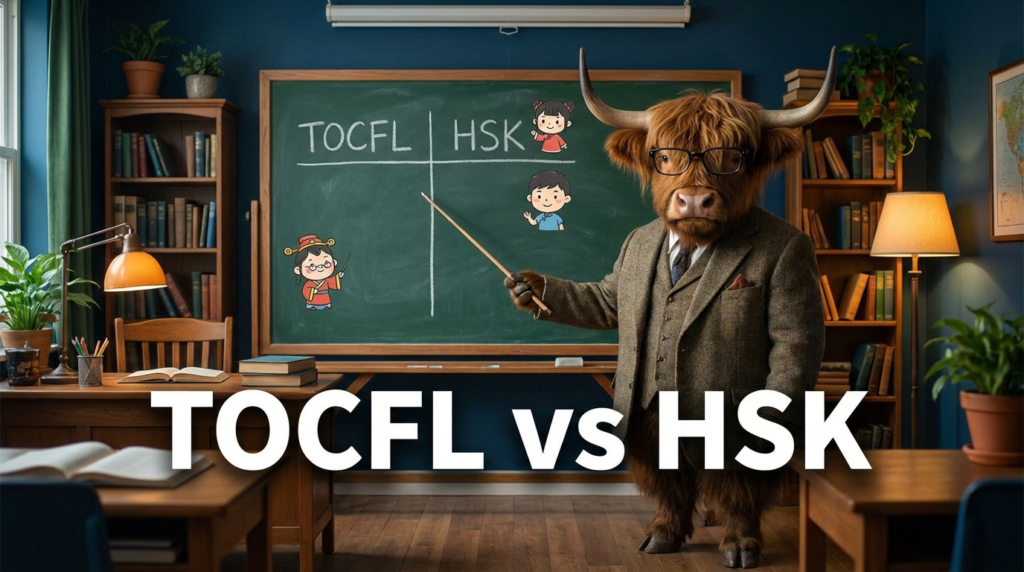
TOCFL vs HSK: Which Mandarin Test Should You Take?
Subtitle In Chinese: 华语文能力测验 (Huáyǔwén Nénglì Cèyàn) vs 汉语水平考试 (Hànyǔ Shuǐpíng Kǎoshì)
If you need “a Mandarin certificate” for school, work, or immigration paperwork, you’ll usually hear two names: TOCFL and HSK. They both measure Mandarin ability, but they’re used in different places and for different goals.
This guide helps you choose fast, then teaches the real-life simplified Chinese you’ll need for registration, test day, and talking about your score—without sounding like a robot reading a textbook.
Yak Snark Box: Tests love pretending they’re “just a helpful benchmark.” Sure. And I “just happened” to eat the entire snack bag while “studying.” Pick the test that matches where you’ll use the certificate—everything else is just suffering with extra steps.
The Simple Choice Rule
- If your target is Mainland China (universities, some employers, many official processes), HSK (汉语水平考试 (Hànyǔ Shuǐpíng Kǎoshì)) is usually the default.
- If your target is Taiwan (schools, scholarships, some employers, residency-related processes), TOCFL (华语文能力测验 (Huáyǔwén Nénglì Cèyàn)) is usually the default.
- If you’re not sure yet, pick the one your school/employer explicitly asks for. If nobody asked (yet), pick the test tied to the place you’re most likely to study or work.
Both tests check practical language skills like listening (听力 (tīnglì)) and reading (阅读 (yuèdú)). What matters most is where the certificate is recognized and what level they require.
Quick Vocabulary Cards You’ll Actually Use
These are the words you’ll see on registration pages, study plans, and nervous group chats the night before the exam.
报名
pinyin: bàomíng
meaning: to register / sign up
准考证
pinyin: zhǔnkǎozhèng
meaning: exam admission ticket
考场
pinyin: kǎochǎng
meaning: exam room / test site
成绩
pinyin: chéngjì
meaning: score / results
通过
pinyin: tōngguò
meaning: to pass (a test/requirement)
听力
pinyin: tīnglì
meaning: listening (section/skill)
阅读
pinyin: yuèdú
meaning: reading (section/skill)
写作
pinyin: xiězuò
meaning: writing (section/skill)
Useful Phrases And Real-Life Sentences
Steal these lines for emails, messages, and test-day survival. Each one is beginner-friendly and actually useful.
- 我想报名TOCFL。 (Wǒ xiǎng bàomíng TOCFL.) — I want to register for TOCFL.
Example: 我想报名TOCFL,但我不确定级别。 (Wǒ xiǎng bàomíng TOCFL, dàn wǒ bù quèdìng jíbié.) — I want to register for TOCFL, but I’m not sure about the level. - 我需要HSK证书。 (Wǒ xūyào HSK zhèngshū.) — I need an HSK certificate.
Example: 申请学校的时候,我需要HSK证书。 (Shēnqǐng xuéxiào de shíhou, wǒ xūyào HSK zhèngshū.) — When applying to school, I need an HSK certificate. - 这个成绩够吗? (Zhège chéngjì gòu ma?) — Is this score enough?
Example: 老师,这个成绩够吗? (Lǎoshī, zhège chéngjì gòu ma?) — Teacher, is this score enough? - 我想通过这个考试。 (Wǒ xiǎng tōngguò zhège kǎoshì.) — I want to pass this exam.
Example: 我想通过这个考试,所以每天练听力。 (Wǒ xiǎng tōngguò zhège kǎoshì, suǒyǐ měitiān liàn tīnglì.) — I want to pass, so I practice listening every day. - 考试在哪儿考? (Kǎoshì zài nǎr kǎo?) — Where do you take the test?
Example: 考试在哪儿考?我需要去考场吗? (Kǎoshì zài nǎr kǎo? Wǒ xūyào qù kǎochǎng ma?) — Where is the test? Do I need to go to the test site? - 我还没打印准考证。 (Wǒ hái méi dǎyìn zhǔnkǎozhèng.) — I haven’t printed the admission ticket yet.
Example: 我还没打印准考证,现在怎么办? (Wǒ hái méi dǎyìn zhǔnkǎozhèng, xiànzài zěnme bàn?) — I haven’t printed it yet—what do I do now? - 听力太快了。 (Tīnglì tài kuài le.) — The listening is too fast.
Example: 听力太快了,我听不清楚。 (Tīnglì tài kuài le, wǒ tīng bù qīngchu.) — It’s too fast; I can’t hear clearly. - 阅读我还可以。 (Yuèdú wǒ hái kěyǐ.) — My reading is okay.
Example: 阅读我还可以,但写作比较弱。 (Yuèdú wǒ hái kěyǐ, dàn xiězuò bǐjiào ruò.) — Reading is okay, but writing is weaker. - 写作怎么准备? (Xiězuò zěnme zhǔnbèi?) — How do I prepare for writing?
Example: 写作怎么准备?有模拟题吗? (Xiězuò zěnme zhǔnbèi? Yǒu mónǐtí ma?) — How do I prep for writing? Are there mock questions? - 我想做几套模拟题。 (Wǒ xiǎng zuò jǐ tào mónǐtí.) — I want to do a few mock tests.
Example: 这周我想做三套模拟题。 (Zhè zhōu wǒ xiǎng zuò sān tào mónǐtí.) — This week I want to do three mock tests. - 成绩什么时候出来? (Chéngjì shénme shíhou chūlái?) — When do the results come out?
Example: 成绩什么时候出来?我很紧张。 (Chéngjì shénme shíhou chūlái? Wǒ hěn jǐnzhāng.) — When do results come out? I’m nervous. - 我考过了! (Wǒ kǎoguò le!) — I passed!
Example: 我考过了!终于! (Wǒ kǎoguò le! Zhōngyú!) — I passed! Finally!
What’s Different Between TOCFL And HSK?
Where You’ll Use It
HSK (汉语水平考试 (Hànyǔ Shuǐpíng Kǎoshì)) is the test many people use when their destination is Mainland China.
TOCFL (华语文能力测验 (Huáyǔwén Nénglì Cèyàn)) is the test many people use when their destination is Taiwan.
Real-life tip: Don’t “choose a test.” Choose a destination first. Then the test chooses you. (Yes, it’s dramatic. Tests love drama.)
What Skills It Emphasizes
Both tests care about listening (听力 (tīnglì)) and reading (阅读 (yuèdú)). Depending on the level and version, you may also see writing (写作 (xiězuò)) and speaking-related components like 口语 (kǒuyǔ) or 口试 (kǒushì).
Study smarter by training the exact sections you’ll face: don’t spend two weeks perfecting handwriting if your test is mostly multiple choice (选择题 (xuǎnzétí)).
Tables Of Words You’ll See While Preparing
Grouped tables beat one giant vocabulary swamp. You’re welcome.
Test And Section Words
| Hanzi | Pinyin | Meaning | Example (ZH) | Example (Pinyin) | Translation (EN) |
|---|---|---|---|---|---|
| 考试 | kǎoshì | exam | 今天我有考试。 (Jīntiān wǒ yǒu kǎoshì.) | Jīntiān wǒ yǒu kǎoshì. | Today I have an exam. |
| 测验 | cèyàn | test / assessment | 这是一个小测验。 (Zhè shì yí gè xiǎo cèyàn.) | Zhè shì yí gè xiǎo cèyàn. | This is a small test. |
| 听力 | tīnglì | listening | 听力部分最紧张。 (Tīnglì bùfèn zuì jǐnzhāng.) | Tīnglì bùfèn zuì jǐnzhāng. | The listening section is the most stressful. |
| 阅读 | yuèdú | reading | 阅读要练速度。 (Yuèdú yào liàn sùdù.) | Yuèdú yào liàn sùdù. | Reading needs speed practice. |
| 写作 | xiězuò | writing | 写作我每天写一点。 (Xiězuò wǒ měitiān xiě yìdiǎn.) | Xiězuò wǒ měitiān xiě yìdiǎn. | I write a little every day. |
| 口语 | kǒuyǔ | spoken language | 我想提高口语。 (Wǒ xiǎng tígāo kǒuyǔ.) | Wǒ xiǎng tígāo kǒuyǔ. | I want to improve speaking. |
| 词汇 | cíhuì | vocabulary | 词汇量不够。 (Cíhuì liàng bù gòu.) | Cíhuì liàng bù gòu. | My vocabulary size isn’t enough. |
| 语法 | yǔfǎ | grammar | 语法别只背规则。 (Yǔfǎ bié zhǐ bèi guīzé.) | Yǔfǎ bié zhǐ bèi guīzé. | Don’t only memorize grammar rules. |
Registration And Test-Day Words
| Hanzi | Pinyin | Meaning | Example (ZH) | Example (Pinyin) | Translation (EN) |
|---|---|---|---|---|---|
| 报名 | bàomíng | register | 我今天报名了。 (Wǒ jīntiān bàomíng le.) | Wǒ jīntiān bàomíng le. | I registered today. |
| 考点 | kǎodiǎn | test center | 我选了离家近的考点。 (Wǒ xuǎn le lí jiā jìn de kǎodiǎn.) | Wǒ xuǎn le lí jiā jìn de kǎodiǎn. | I chose a test center close to home. |
| 考场 | kǎochǎng | exam room | 请提前到考场。 (Qǐng tíqián dào kǎochǎng.) | Qǐng tíqián dào kǎochǎng. | Please arrive at the exam room early. |
| 准考证 | zhǔnkǎozhèng | admission ticket | 别忘了带准考证。 (Bié wàng le dài zhǔnkǎozhèng.) | Bié wàng le dài zhǔnkǎozhèng. | Don’t forget your admission ticket. |
| 身份证 | shēnfènzhèng | ID card | 需要带身份证。 (Xūyào dài shēnfènzhèng.) | Xūyào dài shēnfènzhèng. | You need to bring an ID. |
| 迟到 | chídào | be late | 我不想迟到。 (Wǒ bù xiǎng chídào.) | Wǒ bù xiǎng chídào. | I don’t want to be late. |
| 选择题 | xuǎnzétí | multiple-choice question | 选择题要看清楚。 (Xuǎnzétí yào kàn qīngchu.) | Xuǎnzétí yào kàn qīngchu. | Read multiple-choice questions carefully. |
| 填空题 | tiánkòngtí | fill-in-the-blank | 填空题我最怕。 (Tiánkòngtí wǒ zuì pà.) | Tiánkòngtí wǒ zuì pà. | Fill-in-the-blank questions scare me most. |
Results And Goal Words
| Hanzi | Pinyin | Meaning | Example (ZH) | Example (Pinyin) | Translation (EN) |
|---|---|---|---|---|---|
| 成绩 | chéngjì | score / results | 成绩出来了。 (Chéngjì chūlái le.) | Chéngjì chūlái le. | The results are out. |
| 分数 | fēnshù | points / score | 我的分数不高。 (Wǒ de fēnshù bù gāo.) | Wǒ de fēnshù bù gāo. | My score isn’t high. |
| 通过 | tōngguò | pass | 我通过了! (Wǒ tōngguò le!) | Wǒ tōngguò le! | I passed! |
| 及格 | jígé | pass (meet minimum) | 只要及格就行。 (Zhǐyào jígé jiù xíng.) | Zhǐyào jígé jiù xíng. | Passing is enough. |
| 证书 | zhèngshū | certificate | 我需要电子证书。 (Wǒ xūyào diànzǐ zhèngshū.) | Wǒ xūyào diànzǐ zhèngshū. | I need an electronic certificate. |
| 成绩单 | chéngjìdān | score report | 成绩单可以下载。 (Chéngjìdān kěyǐ xiàzài.) | Chéngjìdān kěyǐ xiàzài. | You can download the score report. |
| 要求 | yāoqiú | requirement | 学校的要求是什么? (Xuéxiào de yāoqiú shì shénme?) | Xuéxiào de yāoqiú shì shénme? | What is the school’s requirement? |
| 申请 | shēnqǐng | apply | 我准备申请奖学金。 (Wǒ zhǔnbèi shēnqǐng jiǎngxuéjīn.) | Wǒ zhǔnbèi shēnqǐng jiǎngxuéjīn. | I’m preparing to apply for a scholarship. |
Variants That Save You From Sounding Weird
Same idea, different vibe. Use what fits the situation.
| Meaning | Option A | Option B | When To Use |
|---|---|---|---|
| test/exam | 考试 (kǎoshì) | 测验 (cèyàn) | 考试 (kǎoshì) feels more “official”; 测验 (cèyàn) can feel smaller or more “assessment-like.” |
| register | 报名 (bàomíng) | 注册 (zhùcè) | 报名 (bàomíng) is common for exams; 注册 (zhùcè) is common for creating an account. |
| score | 成绩 (chéngjì) | 分数 (fēnshù) | 成绩 (chéngjì) is “results” in a broader sense; 分数 (fēnshù) is the number of points. |
| pass | 通过 (tōngguò) | 考过 (kǎoguò) | 通过 (tōngguò) is formal; 考过 (kǎoguò) is casual and common in speech. |
| times (measure word) | 一次 (yí cì) | 两次 (liǎng cì) | Use 次 (cì) for “times.” Yes, tests can be retaken. Your wallet may disagree. |
Practice: Pick The Right Test And Say It In Chinese
Scenario Drills
- You’re applying to a Taiwan scholarship. Say: “I need a TOCFL certificate.”
答案: 我需要TOCFL证书。 (Wǒ xūyào TOCFL zhèngshū.) - You’re applying to a university program in Mainland China. Say: “Do you require HSK?”
答案: 你们要求HSK吗? (Nǐmen yāoqiú HSK ma?) - You don’t know what level to choose. Say: “I’m not sure about the level.”
答案: 我不确定级别。 (Wǒ bù quèdìng jíbié.) - You want to sound organized. Say: “I’ll do two mock tests this week.”
答案: 这周我做两套模拟题。 (Zhè zhōu wǒ zuò liǎng tào mónǐtí.)
Common Mistakes And Quick Fixes
- Mistake: Using 分数 (fēnshù) when you mean “results overall.”
Fix: Use 成绩 (chéngjì) for overall results; use 分数 (fēnshù) for the number. - Mistake: Saying “I take the test” without a measure word.
Fix: Add 次 (cì): 我考了一次。 (Wǒ kǎo le yí cì.) — I took it once. - Mistake: Forgetting the boring-but-important admission ticket word.
Fix: Memorize 准考证 (zhǔnkǎozhèng). It’s the “don’t ruin your morning” word. - Mistake: Over-studying vocabulary lists and under-studying sections.
Fix: Study by section: 听力 (tīnglì), 阅读 (yuèdú), 写作 (xiězuò). Match the test format.
Quick Reference Summary
| Your Goal | Most Likely Choice | What To Ask For In Chinese |
|---|---|---|
| Study/work paperwork mainly tied to Mainland China | HSK (汉语水平考试 (Hànyǔ Shuǐpíng Kǎoshì)) | 你们要求HSK吗? (Nǐmen yāoqiú HSK ma?) |
| Study/work paperwork mainly tied to Taiwan | TOCFL (华语文能力测验 (Huáyǔwén Nénglì Cèyàn)) | 你们需要TOCFL吗? (Nǐmen xūyào TOCFL ma?) |
| No requirement yet; you’re choosing a direction | Pick by destination | 我不确定级别。 (Wǒ bù quèdìng jíbié.) |
Final Yak Box: If you only remember one sentence, make it this: 你们要求哪个考试? (Nǐmen yāoqiú nǎge kǎoshì?) — Which exam do you require? Ask first. Study second. Panic last.
FAQ
How Do I Say “What Level Should I Take?” In Chinese?
你觉得我应该考哪个级别? (Nǐ juéde wǒ yīnggāi kǎo nǎge jíbié?) — Which level do you think I should take?
How Do I Ask When Results Come Out?
成绩什么时候出来? (Chéngjì shénme shíhou chūlái?) — When do results come out?
What’s The Difference Between 通过 (tōngguò) And 考过 (kǎoguò)?
通过 (tōngguò) is more formal (“pass a requirement”). 考过 (kǎoguò) is casual and super common in speech (“passed the exam”). Both work.
What Should I Bring On Test Day?
At minimum, bring 身份证 (shēnfènzhèng) (ID) and 准考证 (zhǔnkǎozhèng) (admission ticket). Always double-check the official test page for your specific site.
If you’re choosing between TOCFL (华语文能力测验 (Huáyǔwén Nénglì Cèyàn)) and HSK (汉语水平考试 (Hànyǔ Shuǐpíng Kǎoshì)), start with where you’ll use the certificate, then study the exact sections you’ll be tested on. And yes—print your 准考证 (zhǔnkǎozhèng). Future-you will be extremely grateful.