Simplified Chinese Radicals, Components, and Stroke Order Basics
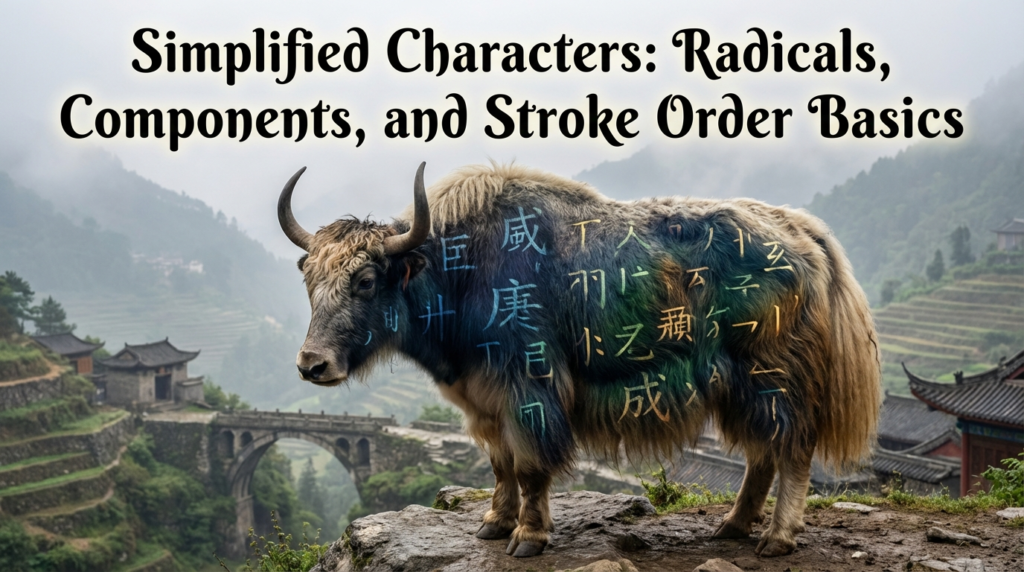
Learn how Chinese characters work through 部首 bùshǒu (radicals), 部件 bùjiàn (components), and 笔顺 bǐshùn (stroke order).
Chinese characters can look like a wall of tiny boxes plotting against your self-esteem. They are not. Most characters are built from reusable parts, and once you spot those parts, reading and writing starts to feel a lot less mysterious.
This guide breaks down the difference between a radical 部首 bùshǒu and a component 部件 bùjiàn, shows the most useful building blocks, and covers the basic stroke order rules that keep your handwriting from looking like it lost a fight.
Yak Snark Box
You do not need to memorize every character as one giant doodle. That is the slow, painful route. Learn the common parts first, and suddenly characters stop being chaos and start being patterns.
What Radicals And Components Actually Are
A radical 部首 bùshǒu is the part used to classify a character in a dictionary. A component 部件 bùjiàn is any building block inside a character. One part can be both a radical and a component, but not every component is the radical in that character.
| Term | Hanzi | Pinyin | Meaning | Example |
|---|---|---|---|---|
| Radical | 部首 | bùshǒu | Dictionary category part | 请 qǐng, “please,” uses 讠 yán as its radical. |
| Component | 部件 | bùjiàn | Any character building block | 请 qǐng has 讠 yán on the left and 青 qīng on the right. |
| Stroke Order | 笔顺 | bǐshùn | The order of writing strokes | 写 xiě, “to write,” is easier to remember when you follow the standard order. |
Example sentence: 我在学部首。
Wǒ zài xué bùshǒu.
I am learning radicals.
Example sentence: 这个字的部件很清楚。
Zhège zì de bùjiàn hěn qīngchu.
The components of this character are very clear.
Example sentence: 老师让我注意笔顺。
Lǎoshī ràng wǒ zhùyì bǐshùn.
The teacher told me to pay attention to stroke order.
High-Utility Character Parts You Will See Everywhere
These are not the only useful parts, but they show up so often that learning them early saves a lot of pain later.
氵 shuǐ
water
河 hé means river.
亻 rén
person
你 nǐ means you.
口 kǒu
mouth
吃 chī means eat.
扌 shǒu
hand
打 dǎ means hit or play.
讠 yán
speech
说 shuō means speak.
忄 xīn
heart
快 kuài means fast.
艹 cǎo
grass or plants
花 huā means flower.
宀 mián
roof
家 jiā means home.
Useful Building Blocks With Real Examples
| Hanzi | Pinyin | Meaning | Example Character | Example Sentence | English |
|---|---|---|---|---|---|
| 氵 | shuǐ | water | 洗 xǐ | 我洗手。 Wǒ xǐ shǒu. | I wash my hands. |
| 亻 | rén | person | 他 tā | 他是老师。 Tā shì lǎoshī. | He is a teacher. |
| 口 | kǒu | mouth | 喝 hē | 我喝水。 Wǒ hē shuǐ. | I drink water. |
| 扌 | shǒu | hand | 找 zhǎo | 我找手机。 Wǒ zhǎo shǒujī. | I am looking for my phone. |
| 讠 | yán | speech | 请 qǐng | 请坐。 Qǐng zuò. | Please sit. |
| 忄 | xīn | heart or feeling | 忙 máng | 我今天很忙。 Wǒ jīntiān hěn máng. | I am very busy today. |
| 女 | nǚ | woman | 妈 mā | 我妈妈来了。 Wǒ māma lái le. | My mother came. |
| 木 | mù | wood or tree | 杯 bēi | 桌上有一个杯子。 Zhuō shàng yǒu yí gè bēizi. | There is a cup on the table. |
| 日 | rì | sun or day | 明 míng | 明天见。 Míngtiān jiàn. | See you tomorrow. |
| 月 | yuè | moon or month | 期 qī | 这个月很忙。 Zhège yuè hěn máng. | This month is busy. |
| 艹 | cǎo | grass or plant | 菜 cài | 我喜欢中国菜。 Wǒ xǐhuan Zhōngguó cài. | I like Chinese food. |
| 辶 | chuò | walk or movement | 这 zhè | 这本书很好。 Zhè běn shū hěn hǎo. | This book is very good. |
| 宀 | mián | roof or house | 安 ān | 这里很安全。 Zhèlǐ hěn ānquán. | It is very safe here. |
| 心 | xīn | heart | 想 xiǎng | 我想回家。 Wǒ xiǎng huí jiā. | I want to go home. |
Stroke Order Rules That Actually Matter
You do not need to count every brush twitch like a calligraphy monk. You do need the basic rules, because they help you remember characters, use handwriting input, and write something that other humans can recognize.
| Rule | Hanzi | Pinyin | Meaning | Example |
|---|---|---|---|---|
| Top Before Bottom | 先上后下 | xiān shàng hòu xià | Write the top part first | 二 èr before writing the lower line last |
| Left Before Right | 先左后右 | xiān zuǒ hòu yòu | Write the left part first | 你 nǐ starts with 亻 rén |
| Horizontal Before Vertical | 先横后竖 | xiān héng hòu shù | Write horizontal strokes before vertical ones | 十 shí |
| Outside Before Inside | 先外后内 | xiān wài hòu nèi | Outer frame first, then inside | 同 tóng |
| Close The Frame Last | 最后封口 | zuìhòu fēngkǒu | Finish the enclosing stroke last | 国 guó |
| Center Before Sides | 先中间后两边 | xiān zhōngjiān hòu liǎngbiān | Write the middle first, then the side parts | 小 xiǎo |
Example sentence: 写字要先上后下。
Xiězì yào xiān shàng hòu xià.
When writing characters, you should go top before bottom.
Example sentence: 这个字要先左后右。
Zhège zì yào xiān zuǒ hòu yòu.
This character should be written left before right.
Example sentence: 老师说要先横后竖。
Lǎoshī shuō yào xiān héng hòu shù.
The teacher said to write the horizontal stroke before the vertical one.
Example sentence: 写国的时候要最后封口。
Xiě guó de shíhou yào zuìhòu fēngkǒu.
When writing 国 guó, you close the frame last.
Rule By Rule, With Friendly Examples
- 先上后下 xiān shàng hòu xià — top before bottom. In 苗 miáo, the 艹 cǎo part goes before the 田 tián part.
- 先左后右 xiān zuǒ hòu yòu — left before right. In 好 hǎo, the 女 nǚ side comes before 子 zǐ.
- 先横后竖 xiān héng hòu shù — horizontal before vertical. In 十 shí, write the horizontal line first.
- 先外后内 xiān wài hòu nèi — outside before inside. In 同 tóng, start the frame before the inside part.
- 最后封口 zuìhòu fēngkǒu — close the box last. In 日 rì and 国 guó, the final enclosing stroke comes late.
- 先中间后两边 xiān zhōngjiān hòu liǎngbiān — center before sides. In 小 xiǎo, the middle stroke comes before the two side dots.
Common Components That Help You Guess Meaning Or Sound
Many characters are built like this: one part hints at meaning, and another part hints at sound. It is not perfect, because Chinese enjoys keeping things interesting, but it works often enough to be useful.
| Character | Parts | Pinyin | Meaning | What The Parts Suggest |
|---|---|---|---|---|
| 妈 | 女 nǚ + 马 mǎ | mā | mother | 女 nǚ suggests meaning, 马 mǎ hints at sound. |
| 河 | 氵 shuǐ + 可 kě | hé | river | 氵 shuǐ suggests water-related meaning. |
| 请 | 讠 yán + 青 qīng | qǐng | please | 讠 yán suggests speech-related meaning. |
| 情 | 忄 xīn + 青 qīng | qíng | feeling | 忄 xīn suggests emotion-related meaning. |
| 清 | 氵 shuǐ + 青 qīng | qīng | clear | 氵 shuǐ suggests water-related meaning. |
Example sentence: 我会写妈这个字。
Wǒ huì xiě mā zhège zì.
I can write the character 妈 mā.
Example sentence: 清水很干净。
Qīngshuǐ hěn gānjìng.
Clean water is very pure.
Example sentence: 她的表情很开心。
Tā de biǎoqíng hěn kāixīn.
Her expression is very happy.
Practice Section
Try these before peeking at the answers. Yes, your brain may complain. It will survive.
Spot The Radical
- Which radical appears in 请 qǐng?
- Which radical appears in 花 huā?
- Which radical appears in 河 hé?
Choose The Stroke Rule
- For 你 nǐ, which rule helps first: 先左后右 xiān zuǒ hòu yòu or 先上后下 xiān shàng hòu xià?
- For 十 shí, which rule helps first: 先横后竖 xiān héng hòu shù or 最后封口 zuìhòu fēngkǒu?
- For 国 guó, which rule matters near the end: 先中间后两边 xiān zhōngjiān hòu liǎngbiān or 最后封口 zuìhòu fēngkǒu?
Answers
- 请 qǐng → 讠 yán
- 花 huā → 艹 cǎo
- 河 hé → 氵 shuǐ
- 你 nǐ → 先左后右 xiān zuǒ hòu yòu
- 十 shí → 先横后竖 xiān héng hòu shù
- 国 guó → 最后封口 zuìhòu fēngkǒu
Common Mistakes And Easy Fixes
- Mistake: Treating every part as a radical.
Fix: Remember that every radical is a component, but not every component is the radical. - Mistake: Ignoring stroke order because typing exists.
Fix: Stroke order helps memory, handwriting input, and cleaner writing. - Mistake: Guessing meaning too hard from one part.
Fix: Radicals give clues, not guarantees. Use them as hints, not magic. - Mistake: Writing the box first and closing it too early.
Fix: In characters like 国 guó, leave the final closing stroke for later. - Mistake: Memorizing characters with no internal structure.
Fix: Break them into smaller parts such as 氵 shuǐ, 讠 yán, and 宀 mián.
Quick Reference Summary
| Item | Hanzi | Pinyin | Meaning | Memory Hook |
|---|---|---|---|---|
| Radical | 部首 | bùshǒu | dictionary category part | Used to organize characters |
| Component | 部件 | bùjiàn | building block inside a character | Any useful chunk |
| Stroke Order | 笔顺 | bǐshùn | stroke sequence | Helps memory and handwriting |
| Water Radical | 氵 | shuǐ | water | Often appears in water-related words |
| Speech Radical | 讠 | yán | speech | Often appears in speaking-related words |
| Heart Radical | 忄 | xīn | heart or emotion | Often appears in feeling words |
| Top Before Bottom | 先上后下 | xiān shàng hòu xià | write top first | Start above, then go down |
| Left Before Right | 先左后右 | xiān zuǒ hòu yòu | write left first | Build from the left side |
| Horizontal Before Vertical | 先横后竖 | xiān héng hòu shù | write horizontal first | Useful for 十 shí |
| Close The Frame Last | 最后封口 | zuìhòu fēngkǒu | finish the box last | Very useful for 国 guó |
Final Yak Box
If a character looks scary, do three things: find the radical, spot the other components, and check the stroke order pattern. That tiny routine turns “nope” into “actually, I can work with this.”