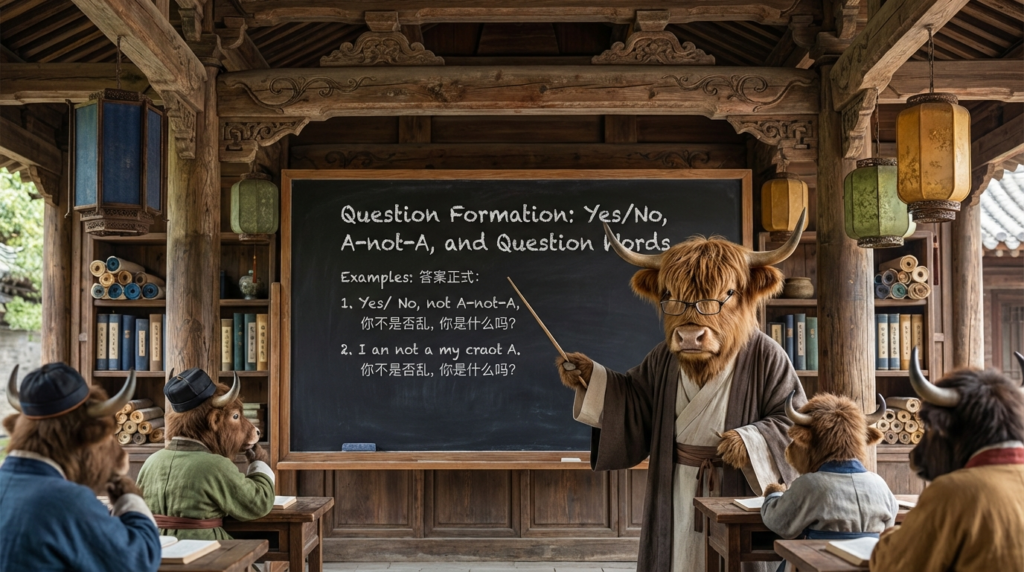
Simplified Chinese Question Formation: Yes/No, A-not-A, and Question Words
Learn how to ask questions in simplified Chinese using 问句 wènjù, from basic 吗 ma questions to neat little A-not-A 正反问句 zhèngfǎn wènjù patterns and the question words people actually use.
If you can make a statement in simplified Chinese, you are already annoyingly close to making a question. Chinese does not usually flip word order like English does. No “do,” no “does,” no dramatic grammar gymnastics. Nice.
There are three big tools beginners need: 吗 ma for simple yes/no questions, A-not-A 正反问句 zhèngfǎn wènjù for a natural “do or not do” pattern, and question words like 什么 shénme and 为什么 wèishénme. Once these click, your Chinese suddenly sounds a lot less like a vocabulary list and a lot more like a real conversation.
Yak Snark Box
English asks, “Do you like coffee?” Chinese often just asks, 你喜欢咖啡吗? nǐ xǐhuan kāfēi ma? Same idea, less clutter. Honestly, English could take notes.
How Chinese Questions Work
The easiest rule is this: Chinese usually keeps the same word order as a statement, then adds a question marker or swaps in a question word.
| Pattern | What It Does | Example In Chinese | Pinyin | English |
|---|---|---|---|---|
| Statement + 吗 ma | Turns a statement into a yes/no question | 你是老师吗? | nǐ shì lǎoshī ma? | Are you a teacher? |
| A-not-A | Asks whether something is true or not | 你是不是老师? | nǐ shì bu shì lǎoshī? | Are you a teacher? |
| Question Word | Asks for specific information | 你叫什么名字? | nǐ jiào shénme míngzi? | What is your name? |
Yes/No Questions With 吗 Ma
This is the beginner-friendly superstar. Take a normal statement and add 吗 ma at the end. That is it. Really.
Statement: 你喜欢茶。 Nǐ xǐhuan chá. — You like tea.
Question: 你喜欢茶吗? Nǐ xǐhuan chá ma? — Do you like tea?
Example 1
你忙吗? Nǐ máng ma?
Are you busy?
Example 2
他会说中文吗? Tā huì shuō Zhōngwén ma?
Can he speak Chinese?
Example 3
今天冷吗? Jīntiān lěng ma?
Is it cold today?
Answering a 吗 ma question:
- 是。 Shì. — Yes.
- 不是。 Bú shì. — No.
- 喜欢。 Xǐhuan. — Yes, I like it.
- 不喜欢。 Bù xǐhuan. — No, I do not like it.
Rule To Remember
Do not use 吗 ma together with another question word in the same sentence. Chinese does not need that extra garnish.
Correct: 你喜欢什么? Nǐ xǐhuan shénme? — What do you like?
Wrong: 你喜欢什么吗? Nǐ xǐhuan shénme ma?
A-not-A Questions: The Super Chinese Pattern
The A-not-A 正反问句 zhèngfǎn wènjù pattern asks whether something is true by saying it and then negating it. It sounds very natural in Chinese.
Basic shape: Verb + 不 bù + Verb or Adjective + 不 bù + Adjective
| Pattern | Example In Chinese | Pinyin | English |
|---|---|---|---|
| 是……不是…… | 你是不是学生? | nǐ shì bu shì xuésheng? | Are you a student? |
| 有……没有…… | 你有没有时间? | nǐ yǒu méi yǒu shíjiān? | Do you have time? |
| 去……不去…… | 你去不去北京? | nǐ qù bu qù Běijīng? | Are you going to Beijing? |
| 忙……不忙…… | 你忙不忙? | nǐ máng bu máng? | Are you busy? |
Important little wrinkle: with 有 yǒu, the negative part is usually 没 méi, not 不 bù. So you get 有没有 yǒu méi yǒu, not 有不有 yǒu bù yǒu. Chinese has rules. It just hides them until you feel confident.
Real-Life A-not-A Examples
- 你累不累? Nǐ lèi bu lèi? — Are you tired?
- 她高不高? Tā gāo bu gāo? — Is she tall?
- 你想不想吃饭? Nǐ xiǎng bu xiǎng chīfàn? — Do you want to eat?
- 他会不会开车? Tā huì bu huì kāichē? — Can he drive?
- 你能不能帮我? Nǐ néng bu néng bāng wǒ? — Can you help me?
Notice that Chinese often uses the same core sentence order. The question happens inside the verb or adjective itself. Efficient, elegant, slightly smug.
Question Words In Simplified Chinese
Question words stay in the place where the missing information would normally go. English moves things around. Chinese mostly does not. That is a gift. Accept it.
什么 Shénme
什么 shénme — what
你吃什么? Nǐ chī shénme?
What are you eating?
谁 Shéi
谁 shéi — who
他是谁? Tā shì shéi?
Who is he?
哪儿 Nǎr
哪儿 nǎr — where
你去哪儿? Nǐ qù nǎr?
Where are you going?
哪个 Nǎge
哪个 nǎge — which one
你喜欢哪个? Nǐ xǐhuan nǎge?
Which one do you like?
什么时候 Shénme Shíhou
什么时候 shénme shíhou — when
你什么时候下班? Nǐ shénme shíhou xiàbān?
When do you get off work?
为什么 Wèishénme
为什么 wèishénme — why
你为什么笑? Nǐ wèishénme xiào?
Why are you laughing?
怎么 Zěnme
怎么 zěnme — how
这个字怎么读? Zhège zì zěnme dú?
How do you read this character?
几 Jǐ
几 jǐ — how many, for small numbers
你有几个哥哥? Nǐ yǒu jǐ ge gēge?
How many older brothers do you have?
多少 Duōshao
多少 duōshao — how many or how much
这个多少钱? Zhège duōshao qián?
How much is this?
Useful Rule: The Question Word Stays Put
English says, “What do you want?” Chinese says 你想要什么? nǐ xiǎng yào shénme? The question word sits where the answer would go. No fronting, no inversion, no unnecessary drama.
| Question Word | Meaning | Example In Chinese | Pinyin | English |
|---|---|---|---|---|
| 什么 shénme | what | 你喝什么? | nǐ hē shénme? | What are you drinking? |
| 谁 shéi | who | 谁来了? | shéi lái le? | Who came? |
| 哪儿 nǎr | where | 洗手间在哪儿? | xǐshǒujiān zài nǎr? | Where is the restroom? |
| 什么时候 shénme shíhou | when | 你什么时候回家? | nǐ shénme shíhou huí jiā? | When are you going home? |
| 为什么 wèishénme | why | 他为什么不来? | tā wèishénme bù lái? | Why is he not coming? |
| 怎么 zěnme | how | 你怎么去学校? | nǐ zěnme qù xuéxiào? | How do you go to school? |
| 几 jǐ | how many | 现在几点? | xiànzài jǐ diǎn? | What time is it now? |
| 多少 duōshao | how many or how much | 你家有多少人? | nǐ jiā yǒu duōshao rén? | How many people are in your family? |
Useful Phrases And Real-Life Sentences
- 你好吗? Nǐ hǎo ma? — How are you?
- 你是不是中国人? Nǐ shì bu shì Zhōngguó rén? — Are you Chinese?
- 你有没有微信? Nǐ yǒu méi yǒu Wēixìn? — Do you have WeChat?
- 你去哪儿? Nǐ qù nǎr? — Where are you going?
- 你找谁? Nǐ zhǎo shéi? — Who are you looking for?
- 你要什么? Nǐ yào shénme? — What do you want?
- 你为什么学中文? Nǐ wèishénme xué Zhōngwén? — Why are you learning Chinese?
- 你怎么知道? Nǐ zěnme zhīdào? — How do you know?
- 你今天忙不忙? Nǐ jīntiān máng bu máng? — Are you busy today?
- 你会不会用筷子? Nǐ huì bu huì yòng kuàizi? — Can you use chopsticks?
- 这个怎么说? Zhège zěnme shuō? — How do you say this?
- 你喜欢哪个颜色? Nǐ xǐhuan nǎge yánsè? — Which color do you like?
- 现在几点? Xiànzài jǐ diǎn? — What time is it now?
- 这个多少钱? Zhège duōshao qián? — How much is this?
Mini Pattern Tables
Yes/No Patterns
| Hanzi | Pinyin | Meaning | Example In Chinese | Example Pinyin | English |
|---|---|---|---|---|---|
| 吗 | ma | yes or no question marker | 你是学生吗? | nǐ shì xuésheng ma? | Are you a student? |
| 是不是 | shì bu shì | is or is not | 他是不是老师? | tā shì bu shì lǎoshī? | Is he a teacher? |
| 有没有 | yǒu méi yǒu | have or not have | 你有没有钱? | nǐ yǒu méi yǒu qián? | Do you have money? |
| 能不能 | néng bu néng | can or cannot | 你能不能来? | nǐ néng bu néng lái? | Can you come? |
Question Words
| Hanzi | Pinyin | Meaning | Example In Chinese | Example Pinyin | English |
|---|---|---|---|---|---|
| 什么 | shénme | what | 你买什么? | nǐ mǎi shénme? | What are you buying? |
| 谁 | shéi | who | 谁会说法语? | shéi huì shuō Fǎyǔ? | Who can speak French? |
| 哪儿 | nǎr | where | 你的手机在哪儿? | nǐ de shǒujī zài nǎr? | Where is your phone? |
| 什么时候 | shénme shíhou | when | 我们什么时候开始? | wǒmen shénme shíhou kāishǐ? | When do we start? |
| 为什么 | wèishénme | why | 你为什么迟到? | nǐ wèishénme chídào? | Why are you late? |
| 怎么 | zěnme | how | 你怎么回家? | nǐ zěnme huí jiā? | How are you going home? |
| 几 | jǐ | how many, small number | 你们班有几个老师? | nǐmen bān yǒu jǐ ge lǎoshī? | How many teachers are in your class? |
| 多少 | duōshao | how many or how much | 这本书多少钱? | zhè běn shū duōshao qián? | How much is this book? |
Common Mistakes And Fixes
- Mistake: 你什么吗? Nǐ shénme ma?
Fix: 你要什么? Nǐ yào shénme? — What do you want? - Mistake: 你是不是吗? Nǐ shì bu shì ma?
Fix: 你是不是学生? Nǐ shì bu shì xuésheng? — Are you a student? - Mistake: 你有不有时间? Nǐ yǒu bù yǒu shíjiān?
Fix: 你有没有时间? Nǐ yǒu méi yǒu shíjiān? — Do you have time? - Mistake: 什么你喜欢? Shénme nǐ xǐhuan?
Fix: 你喜欢什么? Nǐ xǐhuan shénme? — What do you like? - Mistake: 你吗喜欢咖啡? Nǐ ma xǐhuan kāfēi?
Fix: 你喜欢咖啡吗? Nǐ xǐhuan kāfēi ma? — Do you like coffee?
Practice Time
Turn these statements into questions. Tiny brain workout. No flashcards harmed.
- 你喜欢猫。 Nǐ xǐhuan māo. — You like cats.
- 他是医生。 Tā shì yīshēng. — He is a doctor.
- 你有时间。 Nǐ yǒu shíjiān. — You have time.
- 你想吃饭。 Nǐ xiǎng chīfàn. — You want to eat.
- 她住在上海。 Tā zhù zài Shànghǎi. — She lives in Shanghai.
Check The Answers
- 你喜欢猫吗? Nǐ xǐhuan māo ma? — Do you like cats?
- 他是不是医生? Tā shì bu shì yīshēng? — Is he a doctor?
- 你有没有时间? Nǐ yǒu méi yǒu shíjiān? — Do you have time?
- 你想不想吃饭? Nǐ xiǎng bu xiǎng chīfàn? — Do you want to eat?
- 她住在哪儿? Tā zhù zài nǎr? — Where does she live?
Make Your Own Questions
Try building one question with each pattern:
- 吗 ma: 你喜欢……吗? Nǐ xǐhuan… ma?
- A-not-A: 你想不想……? Nǐ xiǎng bu xiǎng…?
- Question Word: 你为什么……? Nǐ wèishénme…?
Quick Reference Summary
- Add 吗 ma at the end of a statement to make a yes/no question.
- Use A-not-A 正反问句 zhèngfǎn wènjù for a natural “is or not,” “want or not,” or “can or not” question.
- Use 有没有 yǒu méi yǒu with 有 yǒu, not 有不有 yǒu bù yǒu.
- Put question words like 什么 shénme, 谁 shéi, and 哪儿 nǎr where the answer would normally go.
- Do not mix 吗 ma with another question word in the same sentence.
Final Yak Box
If you remember just one thing, remember this: Chinese question formation is mostly about adding the right tool, not rebuilding the whole sentence from scratch. Use 吗 ma for simple yes/no questions, use A-not-A 正反问句 zhèngfǎn wènjù when you want a very natural spoken feel, and drop in question words exactly where the missing information belongs. Suddenly, asking questions in simplified Chinese feels a lot less terrifying and a lot more useful.