Simplified Chinese Negation: The Difference Between Bu 不 bù And Mei 没 méi
Learn how to say not in simplified Chinese with 不 bù and 没 méi. This tiny pair causes a ridiculous amount of beginner pain, mostly because English uses one big lazy word: “not.” Chinese does not.
Topic Name: 否定 fǒudìng — negation
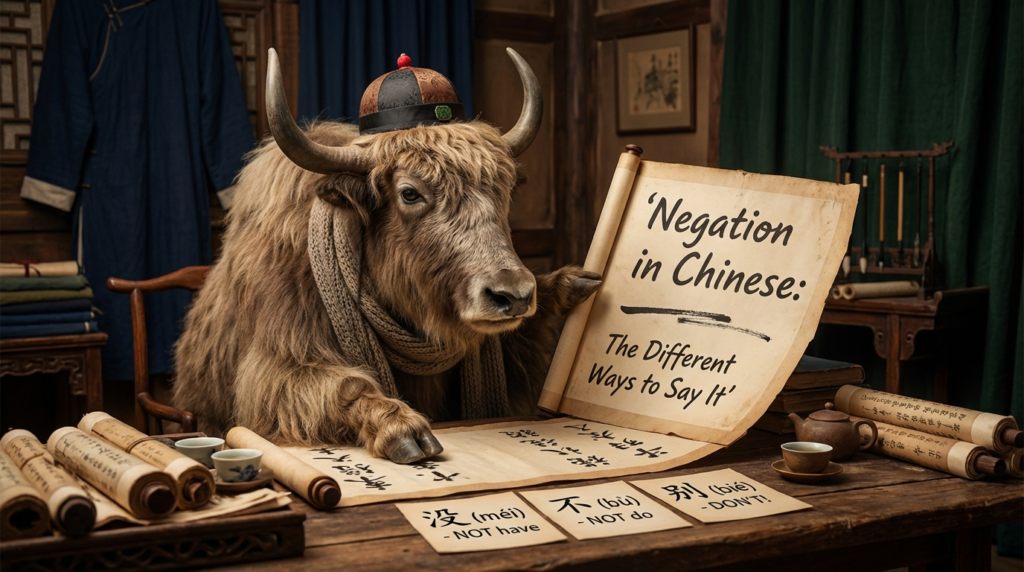
Here is the clean beginner rule: 不 bù usually negates things in the present, future, or general truth, while 没 méi usually negates things in the past or means do not have.
That is the short version. The useful version is this: use 不 bù for habits, preferences, plans, and descriptions. Use 没 méi for actions that did not happen and for 没有 méiyǒu, meaning do not have. Tiny words, huge consequences.
Yak Snark Box
If you translate English word by word, you will say things like 我不有 wǒ bù yǒu. That is not brave. That is not innovative. That is just wrong. With 有 yǒu, use 没有 méiyǒu.
The Fast Rule
| Word | Pinyin | Main Use | Easy Meaning |
|---|---|---|---|
| 不 | bù | present, future, habits, descriptions | not / do not / will not |
| 没 | méi | past actions, non-existence with 有 yǒu | did not / have not / do not have |
| 没有 | méiyǒu | full form with 有 yǒu | do not have / there is not |
Core Rule One: Use 不 bù For Present, Future, And Habit
不 bù is the default negation for things that are generally true, true right now, or expected in the future.
不喜欢 bù xǐhuan
Meaning: do not like
Example: 我不喜欢咖啡。
Wǒ bù xǐhuan kāfēi.
I do not like coffee.
不去 bù qù
Meaning: not go / will not go
Example: 我今天不去公司。
Wǒ jīntiān bù qù gōngsī.
I am not going to the office today.
不忙 bù máng
Meaning: not busy
Example: 我现在不忙。
Wǒ xiànzài bù máng.
I am not busy now.
Useful Patterns With 不 bù
| Pattern | Meaning | Example (ZH) | Example (Pinyin) | Translation |
|---|---|---|---|---|
| 不 + verb | do not / will not | 我不吃肉。 | Wǒ bù chī ròu. | I do not eat meat. |
| 不 + adjective | not + description | 这个不贵。 | Zhège bù guì. | This is not expensive. |
| 不 + like / want | do not want / do not like | 我不想等。 | Wǒ bù xiǎng děng. | I do not want to wait. |
| 不 + future action | will not | 明天我不出门。 | Míngtiān wǒ bù chūmén. | I will not go out tomorrow. |
Core Rule Two: Use 没 méi For Past Actions That Did Not Happen
If an action did not happen, use 没 méi. This is the beginner shortcut that saves lives. Or at least conversations.
没去 méi qù
Meaning: did not go
Example: 我昨天没去学校。
Wǒ zuótiān méi qù xuéxiào.
I did not go to school yesterday.
没吃 méi chī
Meaning: did not eat
Example: 我早上没吃早饭。
Wǒ zǎoshang méi chī zǎofàn.
I did not eat breakfast this morning.
没看见 méi kànjiàn
Meaning: did not see
Example: 我没看见你的消息。
Wǒ méi kànjiàn nǐ de xiāoxi.
I did not see your message.
You will often hear 没 méi before a verb without any extra grammar clutter. Nice and efficient.
| Pattern | Meaning | Example (ZH) | Example (Pinyin) | Translation |
|---|---|---|---|---|
| 没 + verb | did not do | 我没买。 | Wǒ méi mǎi. | I did not buy it. |
| 没 + verb + object | did not do something | 他没写作业。 | Tā méi xiě zuòyè. | He did not do homework. |
| 还没 + verb | have not yet | 我还没下班。 | Wǒ hái méi xiàbān. | I have not gotten off work yet. |
| 从来没 + verb | have never | 我从来没去过北京。 | Wǒ cónglái méi qùguo Běijīng. | I have never been to Beijing. |
Core Rule Three: Use 没有 méiyǒu With 有 yǒu
When the verb is 有 yǒu, meaning to have, the negative is usually 没有 méiyǒu, not 不有 bù yǒu.
没有钱 méiyǒu qián
Meaning: do not have money
Example: 我现在没有钱。
Wǒ xiànzài méiyǒu qián.
I do not have money right now.
没有时间 méiyǒu shíjiān
Meaning: do not have time
Example: 我今天没有时间。
Wǒ jīntiān méiyǒu shíjiān.
I do not have time today.
没有人 méiyǒu rén
Meaning: there is nobody / no one
Example: 教室里没有人。
Jiàoshì lǐ méiyǒu rén.
There is nobody in the classroom.
Useful Patterns With 没有 méiyǒu
| Pattern | Meaning | Example (ZH) | Example (Pinyin) | Translation |
|---|---|---|---|---|
| 没有 + noun | do not have | 我没有车。 | Wǒ méiyǒu chē. | I do not have a car. |
| 没有 + person | there is no one | 这里没有老师。 | Zhèlǐ méiyǒu lǎoshī. | There is no teacher here. |
| 没有 + time / chance | do not have time / chance | 我没有机会。 | Wǒ méiyǒu jīhuì. | I do not have a chance. |
| 没有 + verb? no | usually use 没 méi before the verb instead | 我没去。 | Wǒ méi qù. | I did not go. |
Rule Four: Adjectives Usually Take 不 bù, Not 没 méi
When you want to say something is not big, not expensive, not happy, not easy, use 不 bù.
- 不大 bù dà — not big
这个房间不大。
Zhège fángjiān bù dà.
This room is not big. - 不贵 bù guì — not expensive
这个不贵。
Zhège bù guì.
This is not expensive. - 不高兴 bù gāoxìng — not happy
他今天不高兴。
Tā jīntiān bù gāoxìng.
He is not happy today. - 不难 bù nán — not difficult
这个问题不难。
Zhège wèntí bù nán.
This question is not difficult.
Beginners often say 没贵 méi guì or 没高兴 méi gāoxìng. That sounds off. Stick with 不 bù for adjectives.
Rule Five: Future Refusal Uses 不 bù, Not 没 méi
If you are refusing something, declining a plan, or saying what you will not do, use 不 bù.
- 我不去。 Wǒ bù qù. — I am not going.
- 我不买。 Wǒ bù mǎi. — I will not buy it.
- 我不想吃。 Wǒ bù xiǎng chī. — I do not want to eat.
- 他不来。 Tā bù lái. — He is not coming.
Compare that with past time:
- 我没去。 Wǒ méi qù. — I did not go.
- 我没买。 Wǒ méi mǎi. — I did not buy it.
- 我没吃。 Wǒ méi chī. — I did not eat.
- 他没来。 Tā méi lái. — He did not come.
Bu 不 bù Vs Mei 没 méi In Real-Life Pairs
| With 不 bù | Meaning | With 没 méi | Meaning |
|---|---|---|---|
| 我不去。 Wǒ bù qù. | I am not going / I will not go. | 我没去。 Wǒ méi qù. | I did not go. |
| 我不吃。 Wǒ bù chī. | I do not eat it / I will not eat it. | 我没吃。 Wǒ méi chī. | I did not eat. |
| 他不忙。 Tā bù máng. | He is not busy. | 他没来。 Tā méi lái. | He did not come. |
| 我不喜欢茶。 Wǒ bù xǐhuan chá. | I do not like tea. | 我没喝茶。 Wǒ méi hē chá. | I did not drink tea. |
| 我不买。 Wǒ bù mǎi. | I will not buy it. | 我没买。 Wǒ méi mǎi. | I did not buy it. |
Mini Word Bank You Will Actually Use
- 不是 bú shì — is not
这不是我的。
Zhè bú shì wǒ de.
This is not mine. - 不想 bù xiǎng — do not want to
我不想出门。
Wǒ bù xiǎng chūmén.
I do not want to go out. - 不能 bù néng — cannot
我今天不能来。
Wǒ jīntiān bù néng lái.
I cannot come today. - 不会 bú huì — cannot / do not know how to
我不会开车。
Wǒ bú huì kāichē.
I cannot drive.
- 没事 méi shì — it is okay / no problem
没事,我可以等。
Méi shì, wǒ kěyǐ děng.
No problem, I can wait. - 没空 méi kòng — not free / no time
我下午没空。
Wǒ xiàwǔ méi kòng.
I am not free this afternoon. - 还没 hái méi — not yet
我还没准备好。
Wǒ hái méi zhǔnbèi hǎo.
I am not ready yet. - 没有问题 méiyǒu wèntí — no problem
这个没有问题。
Zhège méiyǒu wèntí.
This is not a problem.
Common Mistakes And Fixes
Wrong: 我不有时间。
Wǒ bù yǒu shíjiān.
Right: 我没有时间。
Wǒ méiyǒu shíjiān.
I do not have time.
Wrong: 我昨天不去。
Wǒ zuótiān bù qù.
Right: 我昨天没去。
Wǒ zuótiān méi qù.
I did not go yesterday.
Wrong: 这个没贵。
Zhège méi guì.
Right: 这个不贵。
Zhège bù guì.
This is not expensive.
Wrong: 我明天没去。
Wǒ míngtiān méi qù.
Right: 我明天不去。
Wǒ míngtiān bù qù.
I am not going tomorrow.
Practice Section
Pick 不 bù or 没 méi.
- 我昨天 ___ 看电影。
Wǒ zuótiān ___ kàn diànyǐng.
I did not watch a movie yesterday. - 我 ___ 喜欢辣的。
Wǒ ___ xǐhuan là de.
I do not like spicy food. - 他今天 ___ 来。
Tā jīntiān ___ lái.
He is not coming today. - 我们还 ___ 吃饭。
Wǒmen hái ___ chīfàn.
We have not eaten yet. - 我 ___ 有车。
Wǒ ___ yǒu chē.
I do not have a car.
Show Answers
- 我昨天没 méi看电影。
Wǒ zuótiān méi kàn diànyǐng. - 我不 bù喜欢辣的。
Wǒ bù xǐhuan là de. - 他今天不 bù来。
Tā jīntiān bù lái. - 我们还没 méi吃饭。
Wǒmen hái méi chīfàn. - 我没 méi有车。
Wǒ méiyǒu chē.
Quick Reference Summary
- Use 不 bù for present facts, future plans, habits, preferences, and adjectives.
- Use 没 méi for past actions that did not happen.
- Use 没有 méiyǒu with 有 yǒu to mean do not have.
- Use 还没 hái méi for not yet.
- Do not use 不 bù with 有 yǒu.
- Do not usually use 没 méi with adjectives like 贵 guì or 忙 máng.
Final Yak Box
Think of it like this: 不 bù blocks a door before you walk through it. 没 méi tells you the walk never happened. One is about not doing; the other is often about did not do or do not have. Keep that image, and your Chinese gets much less chaotic.
FAQ
Can 没 méi mean “not” in the present?
Yes, sometimes. In everyday speech, 没空 méi kòng means not free, and 没事 méi shì means it is okay or no problem. But for beginners, the safer core rule is still: 没 méi for past actions and 没有 méiyǒu for do not have.
Why does 不 become bú in 不是 bú shì?
The tone changes before another fourth-tone syllable. So 不 bù becomes bú in words like 不是 bú shì. Same word, smoother pronunciation, less mouth drama.
Is 没有 méiyǒu always better than 没 méi?
Not always. Use 没有 méiyǒu with 有 yǒu and nouns, such as 我没有时间 Wǒ méiyǒu shíjiān. For past actions, simple 没 méi is usually enough, such as 我没去 Wǒ méi qù.