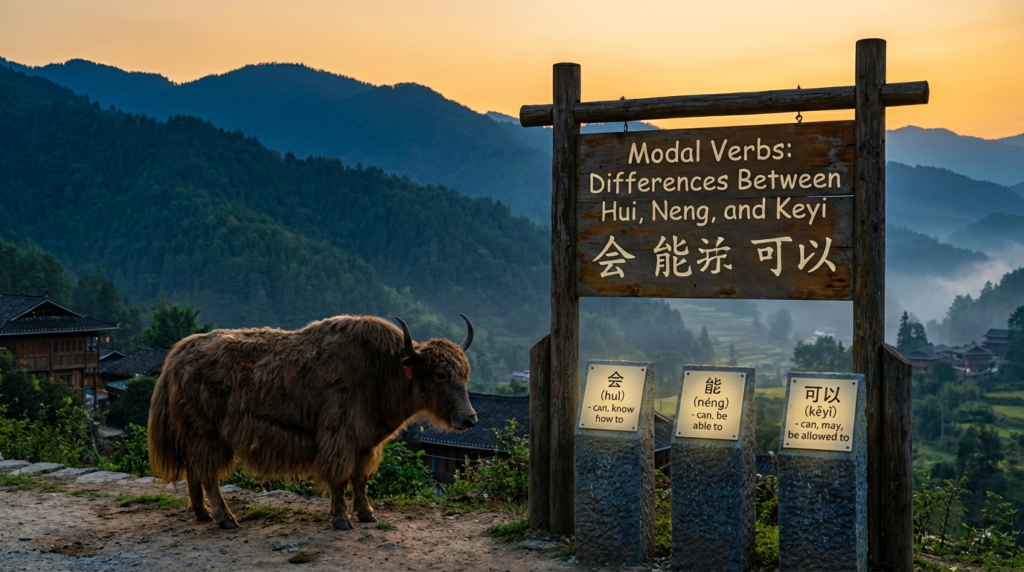
Hui, Neng, And Keyi In Simplified Chinese
Three tiny verbs, three very different jobs: 会 huì, 能 néng, and 可以 kěyǐ.
Get these right, and your Chinese sounds clear instead of “I learned a skill, I got permission, and I predicted the weather” all at the same time. That is a rough look in any language.
English uses can for a lot of things. Simplified Chinese is pickier. 会 huì usually talks about learned skills or future likelihood, 能 néng is about real ability or whether conditions allow something, and 可以 kěyǐ is about permission or what is acceptable.
Once you see the logic, the three words stop feeling random. They start feeling useful, which is much nicer than memorizing a messy rule and hoping for the best.
会
huì
learned skill
future likelihood
能
néng
real ability
conditions allow
可以
kěyǐ
permission
okay to do
Yak Tip
Think of it like this: 会 huì lives in your brain, 能 néng lives in the real situation, and 可以 kěyǐ lives in the rules. Dramatic, yes. Useful, also yes.
The Fast Difference
| Word | Main Idea | Easy Meaning | Sample Sentence | Pinyin | English |
|---|---|---|---|---|---|
| 会 | learned skill / future likelihood | know how to / will | 我会游泳。 | Wǒ huì yóuyǒng. | I can swim. |
| 能 | real ability / conditions | be able to | 我今天不能来。 | Wǒ jīntiān bù néng lái. | I can’t come today. |
| 可以 | permission / acceptable choice | may / it’s okay to | 我可以进去吗? | Wǒ kěyǐ jìnqù ma? | May I go in? |
What 会 huì Really Means
会 huì usually does two jobs.
- Learned skill: something you picked up through study or practice.
- Future likelihood: something that will happen or is likely to happen.
That is why 我会说中文。Wǒ huì shuō Zhōngwén. I can speak Chinese. sounds natural when you mean you learned the skill. It is not about permission. Nobody handed you an official “yes, you may speak Chinese now” badge.
| Use | Sentence | Pinyin | English |
|---|---|---|---|
| learned skill | 我会开车。 | Wǒ huì kāichē. | I can drive. |
| learned skill | 她会做饭。 | Tā huì zuòfàn. | She knows how to cook. |
| future likelihood | 明天会下雨。 | Míngtiān huì xiàyǔ. | It will rain tomorrow. |
| future likelihood | 他会来。 | Tā huì lái. | He will come / He is likely to come. |
A useful warning: 会 huì is usually not the best choice for permission. 我会进去吗?Wǒ huì jìnqù ma? sounds odd if you mean “May I go in?” Use 我可以进去吗?Wǒ kěyǐ jìnqù ma? instead.
What 能 néng Really Means
能 néng is about whether something is actually possible in real life. Maybe your body allows it. Maybe the schedule allows it. Maybe the conditions allow it. Maybe they do not, and life says no.
That is why 我今天能来。Wǒ jīntiān néng lái. I can come today. means the situation works. The door is open, the timing is fine, the train has not betrayed you, and your boss has not dropped a surprise meeting on your head.
| Use | Sentence | Pinyin | English |
|---|---|---|---|
| physical ability | 她腿疼,不能跑。 | Tā tuǐ téng, bù néng pǎo. | Her leg hurts, so she can’t run. |
| conditions allow | 我今天能早点走。 | Wǒ jīntiān néng zǎodiǎn zǒu. | I can leave a little early today. |
| practical possibility | 这里能停车吗? | Zhèlǐ néng tíngchē ma? | Can you park here? |
| blocked by conditions | 我的手机没电了,不能打电话。 | Wǒ de shǒujī méi diàn le, bù néng dǎ diànhuà. | My phone is out of battery, so I can’t make a call. |
能 néng can sometimes overlap with 可以 kěyǐ in daily speech, especially in questions. You may hear 我能进去吗?Wǒ néng jìnqù ma? in conversation. It is understandable. Still, if you want the clean beginner rule, use 可以 kěyǐ for permission and keep 能 néng for ability or conditions.
What 可以 kěyǐ Really Means
可以 kěyǐ is the permission and acceptability word. It often means may, are allowed to, or it is okay to.
Use it when you ask whether something is allowed, when you give permission, or when you say an option is acceptable.
| Use | Sentence | Pinyin | English |
|---|---|---|---|
| asking permission | 我可以坐这里吗? | Wǒ kěyǐ zuò zhèlǐ ma? | May I sit here? |
| giving permission | 你可以先走。 | Nǐ kěyǐ xiān zǒu. | You can leave first. |
| acceptable option | 晚一点也可以。 | Wǎn yìdiǎn yě kěyǐ. | A little later is also okay. |
| okay to do | 现在可以开始了。 | Xiànzài kěyǐ kāishǐ le. | We can start now. |
One nice bonus: 可以 kěyǐ is polite and very useful in real conversations. When in doubt about permission, this is usually your safest pick.
Same English, Different Chinese
English loves the word can. Chinese makes you choose. Here is where the meaning changes fast.
| Chinese | Pinyin | What It Means |
|---|---|---|
| 我会开车。 | Wǒ huì kāichē. | I know how to drive. |
| 我能开车。 | Wǒ néng kāichē. | I am able to drive now / conditions allow me to drive. |
| 我可以开车。 | Wǒ kěyǐ kāichē. | I am allowed to drive / it is okay for me to drive. |
| 他会来。 | Tā huì lái. | He will come / He is likely to come. |
| 他能来。 | Tā néng lái. | He is able to come. |
| 他可以来。 | Tā kěyǐ lái. | He may come / He is allowed or welcome to come. |
This is the heart of the whole topic. The verb changes because the reason changes.
A Simple Rule Pattern
| Pattern | Meaning | Example | Pinyin | English |
|---|---|---|---|---|
| Subject + 会 + Verb | know how to do | 我会写汉字。 | Wǒ huì xiě Hànzì. | I can write Chinese characters. |
| Subject + 会 + Verb / Adjective | will / likely to | 她会很高兴。 | Tā huì hěn gāoxìng. | She will be very happy. |
| Subject + 能 + Verb | be able to because conditions allow | 我明天能去。 | Wǒ míngtiān néng qù. | I can go tomorrow. |
| Subject + 可以 + Verb | may / be allowed to | 你可以问。 | Nǐ kěyǐ wèn. | You may ask. |
| Verb + 可以 | acceptable / okay | 这样说可以。 | Zhèyàng shuō kěyǐ. | Saying it this way is okay. |
Practice Section
Pick the best word: 会 huì, 能 néng, or 可以 kěyǐ.
- You learned to swim.
我___游泳。 - You want to ask, “May I ask a question?”
我___问一个问题吗? - Your train is delayed, so you cannot come today.
我今天___来。 - You want to say, “It will be cold tomorrow.”
明天___很冷。 - Your teacher says it is fine to hand in the homework tomorrow.
明天交作业也___。
Answers
- 我会游泳。Wǒ huì yóuyǒng. I can swim.
- 我可以问一个问题吗?Wǒ kěyǐ wèn yí ge wèntí ma? May I ask a question?
- 我今天不能来。Wǒ jīntiān bù néng lái. I can’t come today.
- 明天会很冷。Míngtiān huì hěn lěng. It will be cold tomorrow.
- 明天交作业也可以。Míngtiān jiāo zuòyè yě kěyǐ. Handing in the homework tomorrow is also okay.
Common Mistakes And Fixes
- Mistake: 我可以说中文。Wǒ kěyǐ shuō Zhōngwén. when you mean you learned the language.
Better: 我会说中文。Wǒ huì shuō Zhōngwén. I can speak Chinese. - Mistake: 明天能下雨。Míngtiān néng xiàyǔ. when you mean a prediction.
Better: 明天会下雨。Míngtiān huì xiàyǔ. It will rain tomorrow. - Mistake: 我会进去吗?Wǒ huì jìnqù ma? when asking permission.
Better: 我可以进去吗?Wǒ kěyǐ jìnqù ma? May I go in? - Mistake: using 会 huì when the problem is just today’s condition.
Better: 我今天不能开车。Wǒ jīntiān bù néng kāichē. I can’t drive today. That is about today, not about whether you ever learned.
Quick Reference Summary
| Situation | Best Choice | Sentence | Pinyin | English |
|---|---|---|---|---|
| learned skill | 会 | 我会做饭。 | Wǒ huì zuòfàn. | I can cook. |
| future prediction | 会 | 他会很忙。 | Tā huì hěn máng. | He will be busy. |
| physical or practical ability | 能 | 我现在能走。 | Wǒ xiànzài néng zǒu. | I can walk now. |
| blocked by conditions | 不能 | 今天太晚了,我不能去。 | Jīntiān tài wǎn le, wǒ bù néng qù. | It’s too late today, so I can’t go. |
| permission | 可以 | 我可以看一下吗? | Wǒ kěyǐ kàn yíxià ma? | May I take a look? |
| acceptable option | 可以 | 周末见也可以。 | Zhōumò jiàn yě kěyǐ. | Meeting on the weekend is also okay. |
Final Yak Box
Use this memory line: 会 huì = learned or likely, 能 néng = actually able, 可以 kěyǐ = allowed or okay. If your reason is skill, pick 会 huì. If your reason is the real-world situation, pick 能 néng. If your reason is permission, pick 可以 kěyǐ.