HSK Levels Explained: What Each Level Means (With CEFR Comparison)
HSK = 汉语水平考试 Hànyǔ Shuǐpíng Kǎoshì (Chinese Proficiency Test). CEFR = 欧洲语言共同参考框架 Ōuzhōu Yǔyán Gòngtóng Cānkǎo Kuāngjià (the A1–C2 scale used a lot in Europe).
This guide tells you what each HSK level really “means” in daily life, plus a practical HSK ↔ CEFR comparison chart you can use when schools or employers ask for “A2/B1/B2…” vibes.
HSK levels are often treated like a neat ladder: climb from 1 to 6, then become a mysterious China wizard. Real life is messier. HSK measures a mix of vocabulary (词汇 cíhuì), reading (阅读 yuèdú), listening (听力 tīnglì), writing (写作 xiězuò), and—at advanced levels—translation (翻译 fānyì) and speaking (口语 kǒuyǔ).
CEFR is different: it’s skill-based “can-do” descriptions. So the comparison is useful, but never perfect. Still, it’s way better than guessing and hoping nobody asks follow-up questions.
Yak Box: If someone says “I’m HSK 4,” that could mean “I passed once,” “I’m studying for it,” or “I own an HSK 4 vocabulary book and feelings.” Ask what they can do: talk, read, write, work, study, survive a phone call.
What HSK Measures (In Plain English)
HSK (汉语水平考试 Hànyǔ Shuǐpíng Kǎoshì) is a standardized test for non-native learners. Depending on the level, it checks things like:
- Understanding everyday speech (听力 tīnglì)
- Reading signs, messages, articles (阅读 yuèdú)
- Writing sentences and short texts (写作 xiězuò)
- Speaking and explaining ideas (口语 kǒuyǔ)
- At the top: translating and interpreting (翻译 fānyì)
One important detail: HSK is strongly tied to word lists (词汇表 cíhuì biǎo). CEFR is not. That’s why “HSK 5 = C1” is an approximation, not a magical law of the universe.
HSK 1–6: What Each Level Means
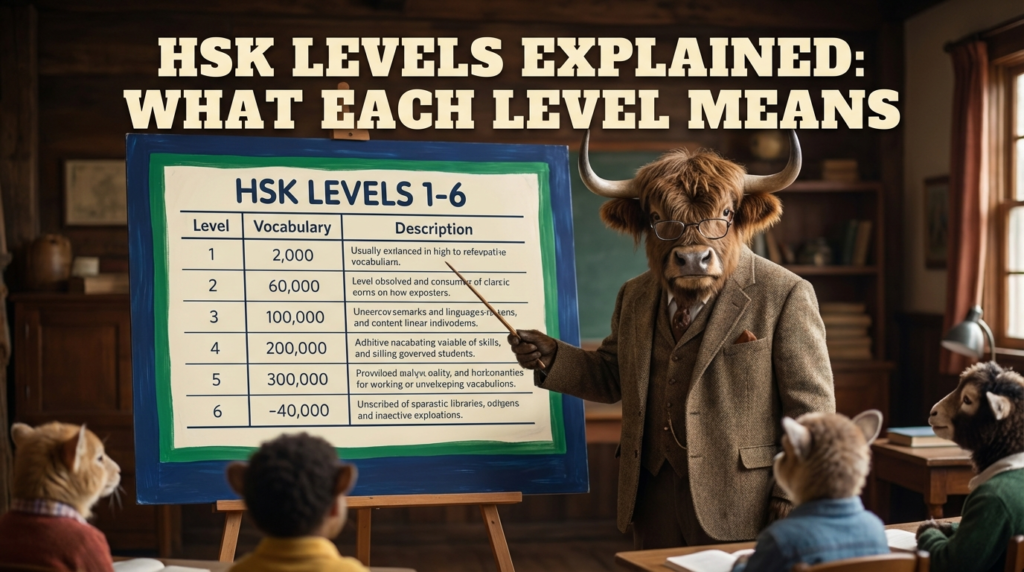
These are the widely used HSK 1–6 levels most learners encounter first. Vocabulary counts are the classic targets many programs still use (150 → 5000), and the CEFR column is the commonly published comparison for HSK 1–6.
| HSK | Typical Vocabulary Target (词汇 cíhuì) | What You Can Do | Approx. CEFR |
|---|---|---|---|
| HSK 1 | 150 words | Basic survival: greetings, numbers, simple needs | A1 |
| HSK 2 | 300 words | Routine daily tasks: shopping, directions, simple plans | A2 |
| HSK 3 | 600 words | Handle common situations; talk about work/study basics | B1 |
| HSK 4 | 1200 words | Discuss familiar topics with more detail; read simpler articles | B2 |
| HSK 5 | 2500 words | Read news/magazines with support; write longer opinions | C1 |
| HSK 6 | 5000+ words | Understand complex content; express yourself smoothly | C2 |
Micro “Can-Do” Snapshots (With Real Chinese)
HSK 1: 你好!Nǐ hǎo! — Hi!
我想喝水。Wǒ xiǎng hē shuǐ. — I want to drink water.
HSK 2: 这个多少钱?Zhège duōshǎo qián? — How much is this?
我们明天见。Wǒmen míngtiān jiàn. — See you tomorrow.
HSK 3: 我在上海工作。Wǒ zài Shànghǎi gōngzuò. — I work in Shanghai.
我可以用微信联系你吗?Wǒ kěyǐ yòng Wēixìn liánxì nǐ ma? — Can I contact you on WeChat?
HSK 4: 我觉得这个计划比较合理。Wǒ juéde zhège jìhuà bǐjiào hélǐ. — I think this plan is fairly reasonable.
如果你有时间,我们可以聊一聊。Rúguǒ nǐ yǒu shíjiān, wǒmen kěyǐ liáo yì liáo. — If you have time, we can chat.
HSK 5: 这篇文章讨论了教育问题。Zhè piān wénzhāng tǎolùn le jiàoyù wèntí. — This article discusses education issues.
我同意你的观点,但我也有一点担心。Wǒ tóngyì nǐ de guāndiǎn, dàn wǒ yě yǒu yìdiǎn dānxīn. — I agree with you, but I’m also a bit worried.
HSK 6: 这项政策对经济的影响非常复杂。Zhè xiàng zhèngcè duì jīngjì de yǐngxiǎng fēicháng fùzá. — The policy’s impact on the economy is very complex.
他讲得很有逻辑,而且表达得很自然。Tā jiǎng de hěn yǒu luójí, érqiě biǎodá de hěn zìrán. — He’s logical and expresses himself naturally.
HSK 7–9: The New Advanced Test (And Why It Feels Different)
HSK (七到九级 qī dào jiǔ jí) is aimed at advanced learners—think academic Chinese, professional discussions, and high-level comprehension. It’s also built differently: it includes listening, reading, writing, translation, and speaking in one long, serious exam.
Official details live here: HSK (Levels 7–9) on ChineseTest.cn.
Important CEFR note: CEFR ends at C2. So HSK 7–9 doesn’t map neatly to “C3.” Instead, think of it as “advanced beyond HSK 6, with heavier academic + translation demands.”
HSK 2.0 Vs. New HSK 3.0 (Three Stages, Nine Levels)
You’ll see people say “New HSK 3.0” and “three stages, nine levels” (三阶段九级 sān jiēduàn jiǔ jí). This refers to a newer framework that expands the system and puts more emphasis on characters (汉字 hànzì), grammar (语法 yǔfǎ), and real tasks (任务 rènwù)—not just a word list.
Official overview language is on ChineseTest.cn’s HSK page under “About the New HSK.” Translation: the direction is broader and more skill-focused, even if learners still talk about “HSK 1–6” a lot in daily life.
Practical takeaway: When someone asks for “HSK level,” clarify whether they mean the widely used HSK 1–6 ladder, or the newer nine-level framework. Same letters, different expectations.
Key Test Words (Visual Mini-Cards)
考试 kǎoshì
Meaning: exam, test
Sample Sentence: 今天我有考试。Jīntiān wǒ yǒu kǎoshì. — I have an exam today.
等级 děngjí
Meaning: level, grade
Sample Sentence: 你的中文等级是多少?Nǐ de Zhōngwén děngjí shì duōshǎo? — What’s your Chinese level?
词汇 cíhuì
Meaning: vocabulary
Sample Sentence: 我每天背二十个词汇。Wǒ měitiān bèi èrshí gè cíhuì. — I memorize 20 vocab words every day.
听力 tīnglì
Meaning: listening (skill)
Sample Sentence: 我的听力不太好。Wǒ de tīnglì bú tài hǎo. — My listening isn’t very good.
阅读 yuèdú
Meaning: reading (skill)
Sample Sentence: 我想提高阅读速度。Wǒ xiǎng tígāo yuèdú sùdù. — I want to improve my reading speed.
写作 xiězuò
Meaning: writing (skill)
Sample Sentence: 这周我练习写作。Zhè zhōu wǒ liànxí xiězuò. — This week I’m practicing writing.
口语 kǒuyǔ
Meaning: speaking (skill)
Sample Sentence: 我想多练口语。Wǒ xiǎng duō liàn kǒuyǔ. — I want to practice speaking more.
翻译 fānyì
Meaning: translation
Sample Sentence: 这个句子怎么翻译?Zhège jùzi zěnme fānyì? — How do you translate this sentence?
Useful Phrases For Tests, Levels, And Real Life
These are high-utility phrases you’ll use when registering, planning, and explaining your level. Each one comes with a ready-to-steal sentence.
- 我想报名。Wǒ xiǎng bàomíng. — I want to register.
我想报名HSK四级。Wǒ xiǎng bàomíng HSK sì jí. — I want to register for HSK Level 4. - 考试时间是什么时候?Kǎoshì shíjiān shì shénme shíhou? — When is the exam?
考试时间是什么时候?我需要请假。Kǎoshì shíjiān shì shénme shíhou? Wǒ xūyào qǐngjià. — When is the exam? I need to request leave. - 我在准备HSK。Wǒ zài zhǔnbèi HSK. — I’m preparing for HSK.
我在准备HSK五级。Wǒ zài zhǔnbèi HSK wǔ jí. — I’m preparing for HSK 5. - 我的目标是……Wǒ de mùbiāo shì… — My goal is…
我的目标是今年通过HSK六级。Wǒ de mùbiāo shì jīnnián tōngguò HSK liù jí. — My goal is to pass HSK 6 this year. - 我想提高听力。Wǒ xiǎng tígāo tīnglì. — I want to improve listening.
我想提高听力,所以每天听播客。Wǒ xiǎng tígāo tīnglì, suǒyǐ měitiān tīng bōkè. — I want to improve listening, so I listen to podcasts daily. - 我看得懂,但说不出来。Wǒ kàn de dǒng, dàn shuō bù chūlái. — I can understand when reading, but can’t say it.
我看得懂新闻标题,但说不出来自己的观点。Wǒ kàn de dǒng xīnwén biāotí, dàn shuō bù chūlái zìjǐ de guāndiǎn. — I understand headlines, but can’t express my opinion. - 我需要练习写作。Wǒ xūyào liànxí xiězuò. — I need to practice writing.
我需要练习写作,每周写两篇短文。Wǒ xūyào liànxí xiězuò, měi zhōu xiě liǎng piān duǎnwén. — I practice writing: two short essays weekly. - 我能听懂大概。Wǒ néng tīng dǒng dàgài. — I can understand the general idea.
他说得太快了,但我能听懂大概。Tā shuō de tài kuài le, dàn wǒ néng tīng dǒng dàgài. — He talks too fast, but I get the gist. - 我需要成绩单。Wǒ xūyào chéngjì dān. — I need a score report.
申请学校的时候,我需要成绩单。Shēnqǐng xuéxiào de shíhou, wǒ xūyào chéngjì dān. — When applying to school, I need a score report. - 我想申请奖学金。Wǒ xiǎng shēnqǐng jiǎngxuéjīn. — I want to apply for a scholarship.
我想申请奖学金,所以要考HSK。Wǒ xiǎng shēnqǐng jiǎngxuéjīn, suǒyǐ yào kǎo HSK. — I want to apply for a scholarship, so I need to take HSK. - 我通过了!Wǒ tōngguò le! — I passed!
太好了,我通过了HSK四级!Tài hǎo le, wǒ tōngguò le HSK sì jí! — Awesome, I passed HSK 4! - 我还差一点。Wǒ hái chà yìdiǎn. — I was just a bit short.
我还差一点就能通过,下次再考。Wǒ hái chà yìdiǎn jiù néng tōngguò, xià cì zài kǎo. — I was just short of passing; I’ll take it again next time.
CEFR Refresher (Why People Keep Mentioning A1–C2)
CEFR (欧洲语言共同参考框架 Ōuzhōu Yǔyán Gòngtóng Cānkǎo Kuāngjià) is a framework that describes what a learner can do at six levels: A1, A2, B1, B2, C1, C2. It’s widely used for course placement and job requirements.
If you want the official “can-do” descriptions, the Council of Europe’s page is the cleanest reference: CEFR Level Descriptions.
HSK ↔ CEFR Comparison Chart (Practical, Not Magical)
This chart is most useful when you need to translate “HSK level” into a CEFR label for a form. Keep in mind: speaking ability varies a lot, and HSK is more vocabulary-and-test-structure driven than CEFR.
| CEFR | Rough HSK Match | Simple “Can-Do” Translation |
|---|---|---|
| A1 | HSK 1 | Very basic phrases, slow speech, simple needs |
| A2 | HSK 2 | Everyday routines: shopping, directions, basic plans |
| B1 | HSK 3 | Handle common situations; describe experiences and plans |
| B2 | HSK 4 | Discuss familiar topics with detail; read/understand more complex input |
| C1 | HSK 5 | Understand demanding texts with support; express opinions clearly |
| C2 | HSK 6 | High comprehension and expression across many contexts |
| (Top) | HSK 7–9 | Advanced academic/professional Chinese; includes translation and higher-level speaking |
If you want a nerdy deep-dive on how imperfect these comparisons are (and why), the perspective from AllSet Learning’s CEFR and HSK comparison is refreshingly honest.
Pick Your Target Level In 10 Minutes
Use this quick self-check. Don’t overthink it. Choose the level that matches what you need to do in the next 3–6 months.
| Your Real-Life Need | Likely HSK Target | One-Week Proof Task |
|---|---|---|
| Travel basics | HSK 2 | Order food + ask directions for 20 minutes |
| Daily life + simple work/study | HSK 3 | Hold a 5–8 minute chat about your week |
| Work meetings on familiar topics | HSK 4 | Explain a problem and propose a solution |
| University entry / reading articles | HSK 5 | Summarize a short article in 8–10 sentences |
| Professional fluency goals | HSK 6+ | Discuss pros/cons of a topic without switching to English |
Mini Practice (Steal These Patterns)
Pattern: 我的目标是 + 级。Wǒ de mùbiāo shì + jí. — My goal is level + …
我的目标是HSK四级。Wǒ de mùbiāo shì HSK sì jí. — My goal is HSK 4.
Pattern: 我需要 + 技能。Wǒ xūyào + jìnéng. — I need + a skill.
我需要提高口语。Wǒ xūyào tígāo kǒuyǔ. — I need to improve speaking.
Pattern: 我每周 + 练习。Wǒ měi zhōu + liànxí. — Each week I + practice.
我每周练习写作三次。Wǒ měi zhōu liànxí xiězuò sān cì. — I practice writing three times a week.
Common Mistakes (And Fast Fixes)
- Mistake: Only chasing word count (词汇 cíhuì). Fix: Build “usable sentences” (句子 jùzi) daily: one sentence per new word.
- Mistake: Ignoring characters (汉字 hànzì) until “later.” Fix: Start now with tiny, high-frequency characters in context: 我 wǒ, 你 nǐ, 是 shì, 有 yǒu.
- Mistake: Confusing HSK with speaking tests. Fix: Know the label: HSKK = 汉语水平口语考试 Hànyǔ Shuǐpíng Kǒuyǔ Kǎoshì (spoken test).
- Mistake: Treating HSK ↔ CEFR like official math. Fix: Use it as a translation for forms, then describe what you can do (能做什么 néng zuò shénme).
Quick Reference Summary
- HSK 1–2: survival + daily routines (生存 shēngcún, 日常 rìcháng)
- HSK 3: independent daily life and common situations (常见情况 chángjiàn qíngkuàng)
- HSK 4: solid intermediate; real conversations on familiar topics (熟悉话题 shúxī huàtí)
- HSK 5–6: higher reading/writing + nuanced expression (细微差别 xìwēi chābié)
- HSK 7–9: advanced academic/professional + translation (学术 xuéshù, 专业 zhuānyè, 翻译 fānyì)
Final Yak Box: Choose the level that matches your life, not your ego. 目标 mùbiāo (goal) beats 面子 miànzi (saving face) every single time.
FAQ
Is HSK The Same As HSKK?
No. HSK is the general proficiency test (汉语水平考试 Hànyǔ Shuǐpíng Kǎoshì). HSKK is the speaking test (汉语水平口语考试 Hànyǔ Shuǐpíng Kǒuyǔ Kǎoshì). Many learners can read well but struggle to speak, so the speaking score can matter separately.
Do I Need To Learn Characters For HSK 1–2?
Even if your early materials lean heavily on pinyin (拼音 pīnyīn), learning basic characters (汉字 hànzì) early makes reading easier later. Start with everyday words you already say: 我 wǒ (I), 你 nǐ (you), 是 shì (to be), 有 yǒu (to have).
Which HSK Level Is “Good Enough” For Studying In China?
Requirements vary by school and program, but many degree programs look for higher levels (often around HSK 5 or above). Always check the exact admission rule (入学要求 rùxué yāoqiú) for your target university or scholarship (奖学金 jiǎngxuéjīn).
Why Does My CEFR Level Not “Match” My HSK Level?
Because the tests emphasize different things. CEFR is skill-based “can-do.” HSK is more tied to specific content and vocabulary (词汇 cíhuì), plus specific test tasks. Your listening might be B2-ish while your writing is B1-ish. That’s normal—and honestly, more realistic.