HSK Books Guide: Every Series, Every Level, No Guessing
Your no-drama roadmap to HSK books—plus the real-life Chinese you’ll actually say while using them.
Topic Name In Chinese: HSK 书籍指南 (HSK shūjí zhǐnán)
Walk into any bookstore (or online shop) and you’ll see a chaotic pile of “official,” “new,” “standard,” “mock,” “past papers,” and “totally-not-a-scam” HSK books.
This guide fixes that. You’ll learn which series matches which exam version, what to buy for every level, and the key Chinese words (with pinyin) you’ll see on every cover.
The Yak Rule: Pick The Exam First, Then Buy Books
Most “wrong book” mistakes happen because people buy for the level number (like HSK 4) without checking the exam version (old 1–6 system vs the newer 1–9 framework). That’s like buying a phone case before you know the phone.
Pick The Exam Version First
HSK 1–6 (Classic Track)
If your test center lists levels 1–6 only, you’re usually on the classic track. The most common “official-feeling” series here is 《HSK标准教程》(HSK biāozhǔn jiàochéng).
The publisher page for HSK Standard Course spells out the structure (Levels 1–3: one volume each; Levels 4–6: two volumes each). See BLCUP’s HSK Standard Course overview.
New HSK 1–9 (HSK 3.0 Era)
HSK 3.0 was officially released in November 2025, and a new official series was launched to match it: 《新HSK教程》(xīn HSK jiàochéng).
FLTRP describes the new series as covering “three stages and nine levels,” with Levels 1–6 using textbooks + practice books and Levels 7–9 using skill-focused volumes. See FLTRP’s announcement about HSK 3.0 and the New HSK Coursebook.
Still unsure? Check the exact exam name on your registration page (考试 (kǎoshì) — exam). If you’re registering via ChineseTest.cn, match the level system shown there before you buy anything.
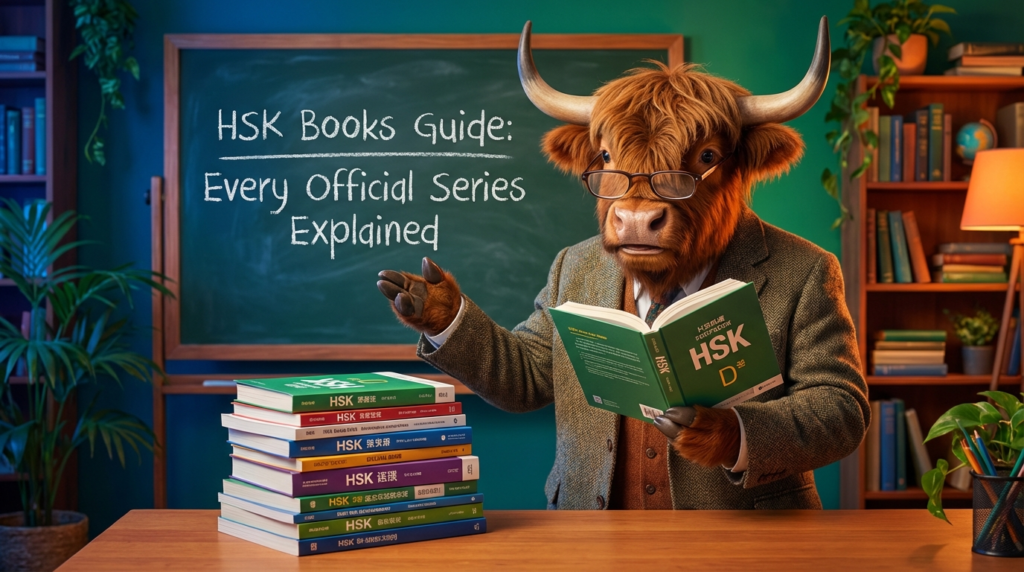
Every Major HSK Book Series You’ll See
- 《HSK标准教程》(HSK biāozhǔn jiàochéng) — “HSK Standard Course” (classic 1–6 track)
- 《新HSK教程》(xīn HSK jiàochéng) — “New HSK Coursebook” (new 1–9 framework / HSK 3.0)
- 《HSK考试大纲》(HSK kǎoshì dàgāng) — HSK syllabus (useful when you want to check what’s tested)
- 《HSK真题解析》(HSK zhēntí jiěxī) — past-paper style explanations (best after you finish a core coursebook)
- 《模拟题》(mónǐ tí) — mock tests (great for timing, terrible as your only “teacher”)
No-Guessing Buying Checklist
- Confirm your level system: 1–6 or 1–9.
- Buy the core coursebook first: 《HSK标准教程》(HSK biāozhǔn jiàochéng) or 《新HSK教程》(xīn HSK jiàochéng).
- Add the workbook/practice book next: 练习册 (liànxícè) / 学练手册 (xué liàn shǒucè).
- Only then add 真题 (zhēntí) and 模拟题 (mónǐ tí) for score-polishing.
No-Guessing Shopping List By Level
Classic HSK 1–3
- Core: 《HSK标准教程》(HSK biāozhǔn jiàochéng) — Textbook (课本 (kèběn))
- Must-have: Workbook 练习册 (liànxícè)
- Nice: Audio 音频 (yīnpín) for listening habits
- Optional: Mock tests 模拟题 (mónǐ tí) after Unit 6–8
Classic HSK 4–6
- Core: 《HSK标准教程》(HSK biāozhǔn jiàochéng) — often split as 上册 (shàngcè) / 下册 (xiàcè)
- Must-have: Workbook 练习册 (liànxícè)
- Score booster: 真题 (zhēntí) + 解析 (jiěxī) to learn your “favorite mistakes”
- Timing training: Full-length 模拟题 (mónǐ tí) in the final month
New HSK 1–6 (HSK 3.0 Framework)
- Core: 《新HSK教程》(xīn HSK jiàochéng) — Textbook
- Must-have: Practice book / 学练手册 (xué liàn shǒucè)
- Focus: 汉字 (hànzì) character work + skills practice (听力 (tīnglì), 阅读 (yuèdú), 写作 (xiězuò), 口语 (kǒuyǔ))
New HSK 7–9
- Core: Skill-based volumes (听力 (tīnglì), 口语 (kǒuyǔ), 阅读 (yuèdú), 写作 (xiězuò))
- Must-have: Real reading + real writing (not just endless multiple choice)
- Smart add-on: A curated 错题 (cuòtí) “mistake notebook” + weekly timed sets
Visual Cards: The 8 Cover Words You Must Recognize
教材 (jiàocái)
textbook materials
练习册 (liànxícè)
workbook
真题 (zhēntí)
real past exam questions
模拟题 (mónǐ tí)
mock tests
级别 (jíbié)
level / grade
听力 (tīnglì)
listening
口语 (kǒuyǔ)
speaking
阅读 (yuèdú)
reading
Useful Phrases For Choosing And Using HSK Books
- 我准备考HSK四级。
Wǒ zhǔnbèi kǎo HSK sì jí.
I’m preparing to take HSK Level 4. - 我用这套教材备考。
Wǒ yòng zhè tào jiàocái bèikǎo.
I use this set of materials to prep. - 这本练习册有答案。
Zhè běn liànxícè yǒu dá’àn.
This workbook has answers. - 我先做模拟题,再做真题。
Wǒ xiān zuò mónǐ tí, zài zuò zhēntí.
I do mock tests first, then past papers. - 这个单元的生词太多了。
Zhè gè dānyuán de shēngcí tài duō le.
There are too many new words in this unit. - 我每天听音频二十分钟。
Wǒ měitiān tīng yīnpín èrshí fēnzhōng.
I listen to audio for 20 minutes a day. - 我需要语法解释和例句。
Wǒ xūyào yǔfǎ jiěshì hé lìjù.
I need grammar explanations and example sentences. - 我按照片尾的计划复习。
Wǒ ànzhào piānwěi de jìhuà fùxí.
I review according to the plan at the back. - 这本书更适合自学。
Zhè běn shū gèng shìhé zìxué.
This book is more suitable for self-study. - 我把错题写在笔记里。
Wǒ bǎ cuòtí xiě zài bǐjì lǐ.
I write my mistakes in my notes. - 这套书有课文、练习和解析。
Zhè tào shū yǒu kèwén, liànxí hé jiěxī.
This set has texts, exercises, and explanations. - 报名之前,我先确认级别。
Bàomíng zhīqián, wǒ xiān quèrèn jíbié.
Before registering, I confirm the level.
Tables Of Words: Book And Exam Vocabulary You’ll Keep Seeing
Book Parts And Materials
| Hanzi | Pinyin | Meaning | Example (ZH) | Example (Pinyin) | Translation (EN) |
|---|---|---|---|---|---|
| 教材 | jiàocái | teaching materials | 我买了教材和练习册。 | Wǒ mǎi le jiàocái hé liànxícè. | I bought the materials and the workbook. |
| 课本 | kèběn | textbook | 这本课本很清楚。 | Zhè běn kèběn hěn qīngchu. | This textbook is very clear. |
| 练习册 | liànxícè | workbook | 练习册里有很多题。 | Liànxícè lǐ yǒu hěn duō tí. | There are lots of questions in the workbook. |
| 学练手册 | xué liàn shǒucè | study + practice booklet | 我每天做学练手册两页。 | Wǒ měitiān zuò xué liàn shǒucè liǎng yè. | I do two pages of the practice booklet every day. |
| 教师用书 | jiàoshī yòng shū | teacher’s book | 教师用书有课堂建议。 | Jiàoshī yòng shū yǒu kètáng jiànyì. | The teacher’s book has classroom tips. |
| 音频 | yīnpín | audio | 音频的语速有点快。 | Yīnpín de yǔsù yǒudiǎn kuài. | The audio speed is a bit fast. |
| 配套 | pèitào | companion / matching set | 我想买配套的练习册。 | Wǒ xiǎng mǎi pèitào de liànxícè. | I want to buy the matching workbook. |
| 目录 | mùlù | table of contents | 先看目录再开始。 | Xiān kàn mùlù zài kāishǐ. | Look at the contents first, then start. |
| 单元 | dānyuán | unit | 今天我们学第三单元。 | Jīntiān wǒmen xué dì sān dānyuán. | Today we study Unit 3. |
| 课文 | kèwén | text / lesson passage | 我先听课文,再做题。 | Wǒ xiān tīng kèwén, zài zuò tí. | I listen to the lesson text first, then do questions. |
| 生词 | shēngcí | new vocabulary | 这课的生词不难。 | Zhè kè de shēngcí bù nán. | The new words in this lesson aren’t hard. |
| 词汇表 | cíhuì biǎo | vocab list | 词汇表在书的后面。 | Cíhuì biǎo zài shū de hòumiàn. | The vocabulary list is at the back of the book. |
| 语法 | yǔfǎ | grammar | 我需要语法解释。 | Wǒ xūyào yǔfǎ jiěshì. | I need grammar explanations. |
| 答案 | dá’àn | answers | 做完以后再对答案。 | Zuò wán yǐhòu zài duì dá’àn. | Check the answers after you finish. |
Exam And Level Words
| Hanzi | Pinyin | Meaning | Example (ZH) | Example (Pinyin) | Translation (EN) |
|---|---|---|---|---|---|
| 考试 | kǎoshì | exam | 下个月我有考试。 | Xià gè yuè wǒ yǒu kǎoshì. | I have an exam next month. |
| 级别 | jíbié | level | 你考哪个级别? | Nǐ kǎo nǎ gè jíbié? | Which level are you taking? |
| 一级 | yī jí | Level 1 | 我从一级开始学。 | Wǒ cóng yī jí kāishǐ xué. | I start from Level 1. |
| 二级 | èr jí | Level 2 | 二级需要多听音频。 | Èr jí xūyào duō tīng yīnpín. | Level 2 needs more listening. |
| 三级 | sān jí | Level 3 | 三级的阅读更长。 | Sān jí de yuèdú gèng cháng. | Level 3 reading is longer. |
| 四级 | sì jí | Level 4 | 我准备考四级。 | Wǒ zhǔnbèi kǎo sì jí. | I’m preparing for Level 4. |
| 五级 | wǔ jí | Level 5 | 五级需要稳定复习。 | Wǔ jí xūyào wěndìng fùxí. | Level 5 needs steady review. |
| 六级 | liù jí | Level 6 | 六级的时间很紧。 | Liù jí de shíjiān hěn jǐn. | Level 6 timing is tight. |
| 七级 | qī jí | Level 7 | 七级更强调写作。 | Qī jí gèng qiángdiào xiězuò. | Level 7 emphasizes writing more. |
| 八级 | bā jí | Level 8 | 八级要读很多文章。 | Bā jí yào dú hěn duō wénzhāng. | Level 8 requires lots of reading. |
| 九级 | jiǔ jí | Level 9 | 九级需要高水平表达。 | Jiǔ jí xūyào gāo shuǐpíng biǎodá. | Level 9 needs high-level expression. |
| 口试 | kǒushì | speaking test | 我也要报名口试。 | Wǒ yě yào bàomíng kǒushì. | I also need to register for the speaking test. |
| 题型 | tíxíng | question type | 先熟悉题型。 | Xiān shúxī tíxíng. | Get familiar with the question types first. |
| 成绩 | chéngjì | score | 我希望成绩更高。 | Wǒ xīwàng chéngjì gèng gāo. | I hope my score is higher. |
Study Action Words
| Hanzi | Pinyin | Meaning | Example (ZH) | Example (Pinyin) | Translation (EN) |
|---|---|---|---|---|---|
| 备考 | bèikǎo | prepare for an exam | 我现在开始备考。 | Wǒ xiànzài kāishǐ bèikǎo. | I’m starting exam prep now. |
| 报名 | bàomíng | register (for a test) | 我今天去报名。 | Wǒ jīntiān qù bàomíng. | I’m going to register today. |
| 复习 | fùxí | review | 晚上我复习一小时。 | Wǎnshang wǒ fùxí yì xiǎoshí. | I review for one hour at night. |
| 预习 | yùxí | preview / prepare | 上课前先预习。 | Shàngkè qián xiān yùxí. | Preview before class. |
| 练习 | liànxí | practice | 每天都要练习。 | Měitiān dōu yào liànxí. | You need to practice every day. |
| 听写 | tīngxiě | dictation | 老师让我们做听写。 | Lǎoshī ràng wǒmen zuò tīngxiě. | The teacher has us do dictation. |
| 朗读 | lǎngdú | read aloud | 我朗读课文三遍。 | Wǒ lǎngdú kèwén sān biàn. | I read the text aloud three times. |
| 默写 | mòxiě | write from memory | 我用默写练汉字。 | Wǒ yòng mòxiě liàn hànzì. | I practice characters by writing from memory. |
| 错题 | cuòtí | wrong questions | 错题要重复做。 | Cuòtí yào chóngfù zuò. | Redo the questions you got wrong. |
| 笔记 | bǐjì | notes | 我把重点写在笔记里。 | Wǒ bǎ zhòngdiǎn xiě zài bǐjì lǐ. | I write the key points in my notes. |
| 计划 | jìhuà | plan | 我有一个复习计划。 | Wǒ yǒu yí gè fùxí jìhuà. | I have a review plan. |
| 每天 | měitiān | every day | 我每天学三十分钟。 | Wǒ měitiān xué sānshí fēnzhōng. | I study 30 minutes every day. |
| 按照 | ànzhào | according to | 我按照老师的建议学习。 | Wǒ ànzhào lǎoshī de jiànyì xuéxí. | I study according to the teacher’s advice. |
| 推荐 | tuījiàn | recommend | 你推荐哪套书? | Nǐ tuījiàn nǎ tào shū? | Which set of books do you recommend? |
Skills, Timing, And Test-Polish Words
| Hanzi | Pinyin | Meaning | Example (ZH) | Example (Pinyin) | Translation (EN) |
|---|---|---|---|---|---|
| 听力 | tīnglì | listening | 听力要每天练。 | Tīnglì yào měitiān liàn. | Listening needs daily practice. |
| 口语 | kǒuyǔ | speaking | 我用录音练口语。 | Wǒ yòng lùyīn liàn kǒuyǔ. | I practice speaking by recording myself. |
| 阅读 | yuèdú | reading | 阅读先找关键词。 | Yuèdú xiān zhǎo guānjiàn cí. | In reading, find keywords first. |
| 写作 | xiězuò | writing | 写作要注意结构。 | Xiězuò yào zhùyì jiégòu. | Writing needs attention to structure. |
| 汉字 | hànzì | Chinese characters | 我每天写十个汉字。 | Wǒ měitiān xiě shí gè hànzì. | I write ten characters every day. |
| 拼音 | pīnyīn | pinyin | 先用拼音查这个词。 | Xiān yòng pīnyīn chá zhè gè cí. | Use pinyin to look up this word first. |
| 发音 | fāyīn | pronunciation | 我的发音需要改。 | Wǒ de fāyīn xūyào gǎi. | My pronunciation needs improvement. |
| 语速 | yǔsù | speech speed | 考试时语速别太快。 | Kǎoshì shí yǔsù bié tài kuài. | Don’t speak too fast in the exam. |
| 时间 | shíjiān | time | 我做题不够时间。 | Wǒ zuò tí bùgòu shíjiān. | I don’t have enough time to do the questions. |
| 解析 | jiěxī | explanations / analysis | 解析告诉我哪里错了。 | Jiěxī gàosu wǒ nǎlǐ cuò le. | The explanations tell me where I went wrong. |
| 真题 | zhēntí | past real tests | 真题最能练节奏。 | Zhēntí zuì néng liàn jiézòu. | Past papers best train test rhythm. |
| 模拟题 | mónǐ tí | mock tests | 模拟题用来练时间。 | Mónǐ tí yònglái liàn shíjiān. | Mock tests are for timing practice. |
| 翻译 | fānyì | translate | 先别翻译,先理解。 | Xiān bié fānyì, xiān lǐjiě. | Don’t translate first—understand first. |
| 适合 | shìhé | suitable | 这套书很适合初学者。 | Zhè tào shū hěn shìhé chūxuézhě. | This set is great for beginners. |
Mini Practice: Pick The Right Stack
Read the learner profile, then choose the “stack” (book combo). Answers are right below—no suspense, no suffering.
- Profile A: “I registered for HSK 五级 (wǔ jí), and I need structure.”
Pick: Core coursebook + workbook + 真题 (zhēntí) - Profile B: “I’m on the New HSK track and aiming for Level 3 first.”
Pick: 《新HSK教程》(xīn HSK jiàochéng) + 学练手册 (xué liàn shǒucè) - Profile C: “I’m taking a speaking test too.”
Pick: Add 口试 (kǒushì) / 口语 (kǒuyǔ) focused practice + recording drills
Final Yak Box: The 80/20 HSK Book Strategy
If you want the simplest system that works: one core book + one practice book. Add 真题 (zhēntí) only when you can finish a full paper without panicking. Add 模拟题 (mónǐ tí) when your score is fine but your 时间 (shíjiān) is not.
And yes: “buying more books” feels productive. So does “buying more gym shoes.” One of those actually makes you stronger.
Quick FAQs
Do I need both 课本 (kèběn) and 练习册 (liànxícè)?
Yes, if you want steady progress. 课本 (kèběn) gives you the lesson path; 练习册 (liànxícè) exposes your weak spots fast. If you can only buy one, start with the coursebook and borrow or find extra practice later.
When should I start 真题 (zhēntí) and 解析 (jiěxī)?
When you can finish a full unit without guessing every other question. 真题 (zhēntí) is for calibration; 解析 (jiěxī) is for fixing patterns—especially your most common 错题 (cuòtí).
What does 上册 (shàngcè) / 下册 (xiàcè) mean?
It’s “Volume 1 / Volume 2.” Higher levels often split one level into two books. Make sure you’re buying the correct half for your current 单元 (dānyuán) progress.
What if my goal is real-life Chinese, not just test scores?
Use the HSK books as your backbone, but add real input: short videos, graded readers, and daily speaking practice. In other words: pass the 考试 (kǎoshì) and become someone who can actually order food without sweating.