The Four Tones Explained
Master simplified Chinese tones, or 声调 shēngdiào, without turning every syllable into one long confused noodle.
If you are learning Mandarin, tones are not decoration. They are part of the word. Change the tone, and you often change the meaning. That is why 妈 mā means “mom,” but 骂 mà means “to scold.” Same basic sound, wildly different result.
The good news is that tones are learnable. You do not need perfect musical talent, a radio announcer voice, or mystical mountain wisdom. You need clear patterns, lots of listening, and a few reliable examples that your mouth can actually remember.
Yak Reality Check
If you skip tones because they feel awkward, Mandarin will cheerfully skip understanding you back. That is not rude. That is just how 声调 shēngdiào works.
What A Tone Actually Is
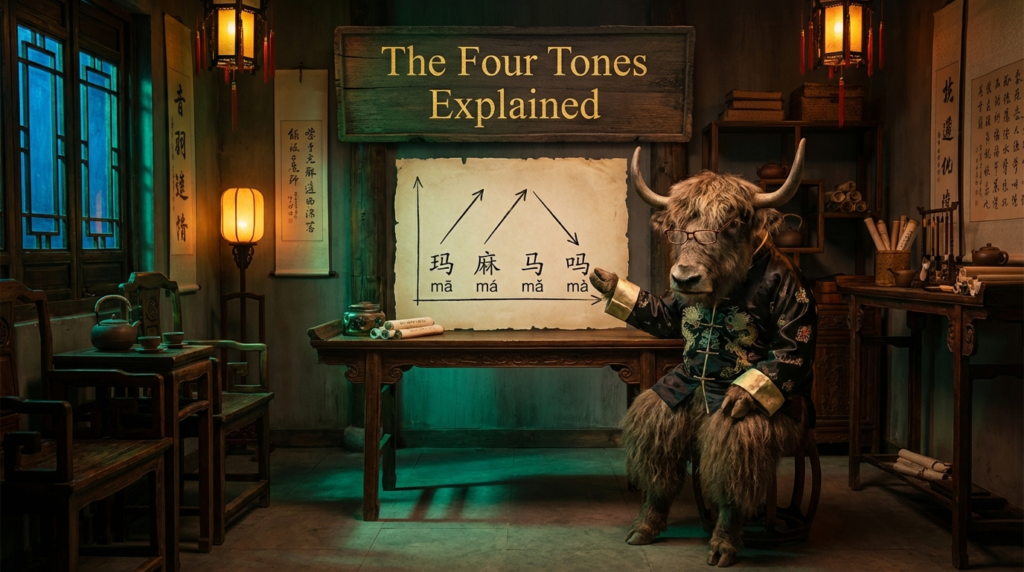
A tone is the pitch shape of a syllable. In standard Mandarin, there are four main tones, plus a neutral tone that is light and short. You can think of them like mini melodies attached to each syllable.
| Tone | Chinese | Pitch Shape | Memory Trick | Example |
|---|---|---|---|---|
| First Tone | 第一声 dì yī shēng | High and level | Hold it steady | 妈 mā = mom |
| Second Tone | 第二声 dì èr shēng | Rising | Sounds like “huh?” | 麻 má = hemp |
| Third Tone | 第三声 dì sān shēng | Low dipping | Drop low, then rise | 马 mǎ = horse |
| Fourth Tone | 第四声 dì sì shēng | Sharp falling | Sounds firm | 骂 mà = to scold |
| Neutral Tone | 轻声 qīngshēng | Light and short | Do not stress it | 吗 ma = question particle |
Four Tone Cards You Can Actually Use
First Tone
妈 mā
Meaning: mom
How it sounds: high and flat, like you are holding one musical note.
Example: 妈妈好。Māma hǎo. Hello, Mom.
Second Tone
麻 má
Meaning: hemp; numb
How it sounds: it rises, a bit like asking “really?”
Example: 手麻了。Shǒu má le. My hand is numb.
Third Tone
马 mǎ
Meaning: horse
How it sounds: low and dipping. In real speech, it often stays low instead of doing a full dip-rise.
Example: 那是马。Nà shì mǎ. That is a horse.
Fourth Tone
骂 mà
Meaning: to scold
How it sounds: sharp and falling, like giving a firm command.
Example: 别骂我。Bié mà wǒ. Do not scold me.
Neutral Tone
吗 ma
Meaning: question particle
How it sounds: light, quick, and unstressed. It borrows some of its feel from the syllable before it.
Example: 你好吗?Nǐ hǎo ma? How are you?
How To Hear Each Tone
Do not try to hear tones as abstract symbols first. Hear them as voice movement. Your ears will learn faster if you connect each tone to a physical motion.
- First tone 第一声 dì yī shēng: keep your hand flat in the air.
- Second tone 第二声 dì èr shēng: move your hand upward.
- Third tone 第三声 dì sān shēng: dip your hand low, then let it rise.
- Fourth tone 第四声 dì sì shēng: chop your hand downward.
- Neutral tone 轻声 qīngshēng: use a small quick tap.
Yes, hand gestures can feel silly. So does mispronouncing every coffee order in a new language. Choose your awkward wisely.
Rule By Rule: What Each Tone Does In Real Speech
First Tone Stays High And Calm
The first tone is steady. Do not let it drift upward or fall off at the end.
| Word | Pinyin | Meaning | Example (ZH) | Example (Pinyin) | Translation |
|---|---|---|---|---|---|
| 高 gāo | gāo | high | 山很高。Shān hěn gāo. | Shān hěn gāo. | The mountain is tall. |
| 天 tiān | tiān | sky; day | 今天天蓝。Jīntiān tiān lán. | Jīntiān tiān lán. | The sky is blue today. |
| 杯 bēi | bēi | cup | 这是我的杯子。Zhè shì wǒ de bēizi. | Zhè shì wǒ de bēizi. | This is my cup. |
Second Tone Rises Like A Question
The second tone starts lower and rises. It should feel alive, not flat.
| Word | Pinyin | Meaning | Example (ZH) | Example (Pinyin) | Translation |
|---|---|---|---|---|---|
| 谁 shéi | shéi | who | 他是谁?Tā shì shéi? | Tā shì shéi? | Who is he? |
| 来 lái | lái | to come | 你什么时候来?Nǐ shénme shíhou lái? | Nǐ shénme shíhou lái? | When are you coming? |
| 钱 qián | qián | money | 我没带钱。Wǒ méi dài qián. | Wǒ méi dài qián. | I did not bring money. |
Third Tone Is Usually Low Before It Is Fancy
Textbooks often draw the third tone as a full dip and rise. In careful speech, that can happen. In normal fast speech, it is often just low. This matters a lot, because many learners dramatically scoop every third tone and end up sounding theatrical in the wrong way.
| Word | Pinyin | Meaning | Example (ZH) | Example (Pinyin) | Translation |
|---|---|---|---|---|---|
| 好 hǎo | hǎo | good | 我很好。Wǒ hěn hǎo. | Wǒ hěn hǎo. | I am very well. |
| 水 shuǐ | shuǐ | water | 我想喝水。Wǒ xiǎng hē shuǐ. | Wǒ xiǎng hē shuǐ. | I want to drink water. |
| 买 mǎi | mǎi | to buy | 我想买书。Wǒ xiǎng mǎi shū. | Wǒ xiǎng mǎi shū. | I want to buy a book. |
Fourth Tone Falls Hard And Fast
The fourth tone is crisp and decisive. Let it fall. Do not drag it out into sadness. Mandarin is not asking you to act in a tragic opera every time you say 不 bù.
| Word | Pinyin | Meaning | Example (ZH) | Example (Pinyin) | Translation |
|---|---|---|---|---|---|
| 不 bù | bù | not; no | 我不知道。Wǒ bù zhīdào. | Wǒ bù zhīdào. | I do not know. |
| 看 kàn | kàn | to look; to watch | 我想看电影。Wǒ xiǎng kàn diànyǐng. | Wǒ xiǎng kàn diànyǐng. | I want to watch a movie. |
| 去 qù | qù | to go | 我们去学校。Wǒmen qù xuéxiào. | Wǒmen qù xuéxiào. | We are going to school. |
Neutral Tone Is Weak On Purpose
The neutral tone is not “missing.” It is unstressed. It often appears in particles and the second syllable of common words.
| Word | Pinyin | Meaning | Example (ZH) | Example (Pinyin) | Translation |
|---|---|---|---|---|---|
| 吗 ma | ma | question particle | 你忙吗?Nǐ máng ma? | Nǐ máng ma? | Are you busy? |
| 呢 ne | ne | topic particle | 你呢?Nǐ ne? | Nǐ ne? | And you? |
| 妈妈 māma | māma | mom | 我妈妈来了。Wǒ māma lái le. | Wǒ māma lái le. | My mom came. |
The Tone Change That Trips Up Almost Everyone
When two third tones appear together, the first one usually changes and sounds like a second tone. This is called 变调 biàndiào, or tone change.
Classic example: 你好 nǐ hǎo = hello
On paper, both syllables are third tone: 你 nǐ + 好 hǎo.
In speech, it sounds more like ní hǎo.
Sentence: 你好!Nǐ hǎo! Hello!
Another useful one is 很好 hěn hǎo, meaning “very good” or “quite well.” It is commonly pronounced more like hén hǎo in connected speech.
Sentence: 我很好。Wǒ hěn hǎo. I am very well.
Useful Phrases With Real-Life Tone Practice
| Phrase | Pinyin | Meaning | Example (ZH) | Example (Pinyin) | Translation |
|---|---|---|---|---|---|
| 你好 nǐ hǎo | nǐ hǎo | hello | 老师你好。Lǎoshī nǐ hǎo. | Lǎoshī nǐ hǎo. | Hello, teacher. |
| 谢谢 xièxie | xièxie | thank you | 谢谢你。Xièxie nǐ. | Xièxie nǐ. | Thank you. |
| 不客气 bú kèqi | bú kèqi | you are welcome | 不用谢,不客气。Bú yòng xiè, bú kèqi. | Bú yòng xiè, bú kèqi. | No need to thank me, you are welcome. |
| 我很好 wǒ hěn hǎo | wǒ hěn hǎo | I am very well | 今天我很好。Jīntiān wǒ hěn hǎo. | Jīntiān wǒ hěn hǎo. | I am very well today. |
| 你好吗 nǐ hǎo ma | nǐ hǎo ma | how are you? | 朋友见面会说:你好吗?Péngyou jiànmiàn huì shuō: nǐ hǎo ma? | Péngyou jiànmiàn huì shuō: nǐ hǎo ma? | Friends meeting may say: How are you? |
| 我不知道 wǒ bù zhīdào | wǒ bù zhīdào | I do not know | 这个问题我不知道。Zhège wèntí wǒ bù zhīdào. | Zhège wèntí wǒ bù zhīdào. | I do not know this question. |
| 我想买水 wǒ xiǎng mǎi shuǐ | wǒ xiǎng mǎi shuǐ | I want to buy water | 太热了,我想买水。Tài rè le, wǒ xiǎng mǎi shuǐ. | Tài rè le, wǒ xiǎng mǎi shuǐ. | It is too hot, I want to buy water. |
| 你去吗 nǐ qù ma | nǐ qù ma | are you going? | 我们晚上看电影,你去吗?Wǒmen wǎnshang kàn diànyǐng, nǐ qù ma? | Wǒmen wǎnshang kàn diànyǐng, nǐ qù ma? | We are watching a movie tonight, are you going? |
| 谁来了 shéi lái le | shéi lái le | who came? | 外面是谁来了?Wàimiàn shì shéi lái le? | Wàimiàn shì shéi lái le? | Who came outside? |
| 别骂我 bié mà wǒ | bié mà wǒ | do not scold me | 我只是迟到了,别骂我。Wǒ zhǐshì chídào le, bié mà wǒ. | Wǒ zhǐshì chídào le, bié mà wǒ. | I was only late, do not scold me. |
Practice Section
Try these out loud. Go slowly first, then more naturally.
Drill 1: Say The Same Sound With Four Tones
- 妈 mā = mom
- 麻 má = hemp; numb
- 马 mǎ = horse
- 骂 mà = to scold
Mini sentence set:
- 我爱妈妈。Wǒ ài māma. I love Mom.
- 手麻了。Shǒu má le. My hand is numb.
- 我看见马了。Wǒ kànjiàn mǎ le. I saw a horse.
- 他在骂人。Tā zài mà rén. He is scolding someone.
Drill 2: Spot The Tone Difference
- 买 mǎi = to buy / 卖 mài = to sell
- 请 qǐng = please / 青 qīng = green-blue
- 来 lái = to come / 累 lèi = tired
- 水 shuǐ = water / 谁 shéi = who
Practice sentence: 我买水,不卖水。Wǒ mǎi shuǐ, bù mài shuǐ. I buy water, not sell water.
Drill 3: Tone Pair Workout
- 你好 nǐ hǎo = hello
- 很好 hěn hǎo = very good
- 学习 xuéxí = to study
- 看见 kànjiàn = to see
- 不去 bú qù = not go
Repeat each phrase five times, but keep it natural. Clear beats dramatic every single time.
Common Mistakes And Fast Fixes
| Mistake | What Happens | Fix |
|---|---|---|
| Making every tone flat | Words sound blurred together | Exaggerate each pitch shape during practice |
| Overacting the third tone | Speech sounds slow and unnatural | Use a low tone in running speech unless you need a full careful pronunciation |
| Ignoring neutral tone | Common words sound too heavy | Shorten particles like 吗 ma and 呢 ne |
| Forgetting tone change | Pairs like 你好 nǐ hǎo sound stiff | Learn common patterns as chunks |
| Reading tone marks but not listening | Your mouth learns symbols, not sound | Shadow native audio and copy rhythm |
Quick Reference Summary
- First tone 第一声 dì yī shēng: high and level. Example: 妈 mā = mom.
- Second tone 第二声 dì èr shēng: rising. Example: 谁 shéi = who.
- Third tone 第三声 dì sān shēng: low dipping, often just low in real speech. Example: 好 hǎo = good.
- Fourth tone 第四声 dì sì shēng: sharp falling. Example: 去 qù = to go.
- Neutral tone 轻声 qīngshēng: light and unstressed. Example: 吗 ma = question particle.
- Important pattern: when two third tones meet, the first often sounds like second tone. Example: 你好 nǐ hǎo.
Final Yak Box
Tones feel brutal at the beginning because your brain is trying to juggle sound, meaning, and panic all at once. That is normal. Start with a few clear words, repeat them in short phrases, and listen more than you guess. Mandarin tones reward consistency, not drama.
FAQ About Mandarin Tones
Do I Need Perfect Tones To Be Understood?
No, not perfect. But you do need tones that are clear enough to separate common words. Good-enough tones beat flat guesswork very quickly.
Is The Third Tone Always A Full Dip?
No. In careful isolation, yes, you may hear the full dip-rise shape. In connected speech, it is often just low.
What Is The Best Way To Practice Tones?
Practice short high-frequency words, then short phrases, then whole sentences. Copy native audio out loud. Hearing and repeating beats silent memorizing every time.