
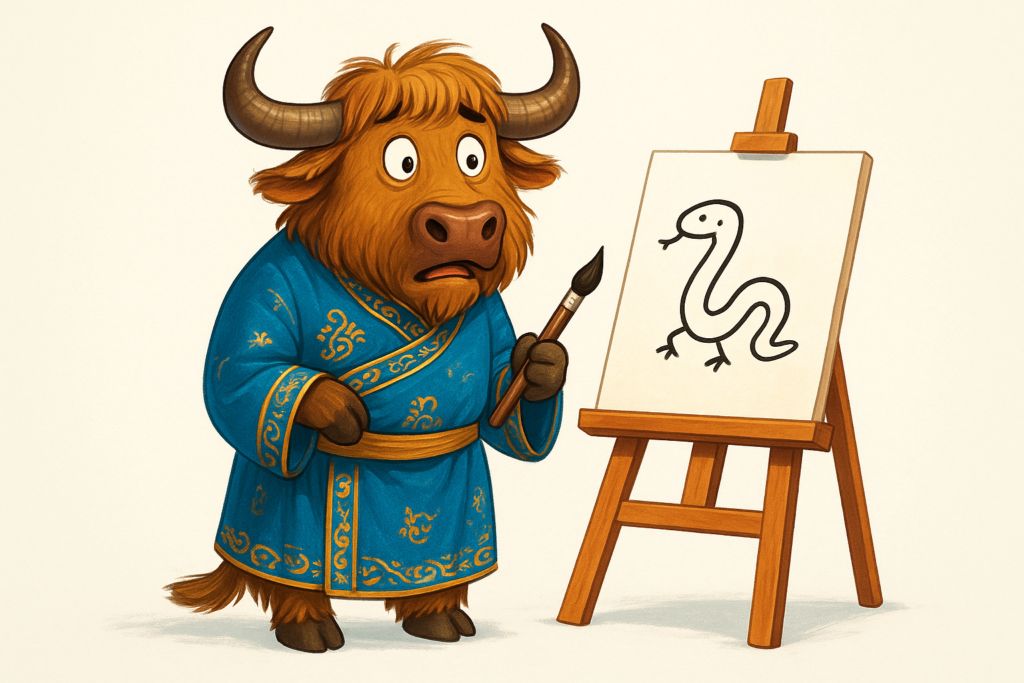
This A1 Beginner retelling of 画蛇添足 keeps the plot clear for learners while still giving the story some atmosphere and momentum.
This version teaches Simplified Chinese through English and includes clickable word help inside the story, full story audio, and lesson notes after the reading. It is free to use on Yak Yacker and is designed to feel natural, readable, and manageable for learners.
从前,有几个朋友。他们有一瓶酒。
他们说:"我们画蛇吧!谁画得快,谁喝酒。"
一个人。他。他看看别人,。
他很,说:"我!"然后他。
另一个人。他!你,这。"
那个人。第一个画的人。
Once upon a time, there were a few friends. They had a bottle of wine.
They said, 'Let's draw snakes! Whoever draws fastest drinks the wine.'
One person drew very fast. He drew a very good snake. He looked at the others; they were still drawing.
Feeling proud, he said, 'I'll add some feet to the snake!' Then he drew feet on the snake.
Another person finished drawing. He said, 'Snakes don't have feet! You drew feet, so this is not a snake.'
That person drank the wine. The first drawer regretted it deeply.
Let's pick out some simple but useful words from the tale. You'll see these again and again in everyday Chinese.
Here are the key words, with how they sound (pinyin) and what they mean.
- 蛇 (shé) - snake
- 酒 (jiǔ) - alcohol (wine or liquor)
- 画 (huà) - to draw or paint
- 脚 (jiǎo) - feet
- 快 (kuài) - fast
- 得意 (déyì) - smug or proud (of oneself)
- 后悔 (hòuhuǐ) - regret
The story uses a handy structure to say 'whoever does A, gets B'. Look at this line: 谁画得快,谁喝酒 (Shéi huà de kuài, shéi hē jiǔ). That means, 'Whoever draws fastest, drinks the wine.'
We also see a way to describe how an action is done - using 得 (de). 画得快 (huà de kuài) literally says 'draw - de - fast', i.e., 'draw fast'.
- Pattern 1: 谁 + action A, 谁 + action B = 'whoever does A, does B'.
- Example: 谁先到,谁吃糖 (Shéi xiān dào, shéi chī táng) - 'Whoever arrives first, eats the candy.'
- Pattern 2: Verb + 得 + adjective = 'do something in a certain way'.
- Example: 说得好 (shuō de hǎo) - 'speak well'; 唱得快 (chàng de kuài) - 'sing fast'.
The story is so famous that the phrase 画蛇添足 (huà shé tiān zú) became a four-character idiom (成语 chéngyǔ). Literally it is 'draw snake add feet'.
Figuratively, it means ruining something by adding unnecessary extras. When you overdo a good thing and make it worse, you're 'drawing legs on a snake'.
- Literal: draw a snake and give it feet.
- Real meaning: spoil something by adding too much.
- Example in English: You baked a perfect cake, then covered it in six kinds of frosting - that's 画蛇添足!
Now that you've met the story and the language, the most helpful thing you can do is make it your own.
- Read the story aloud, slowly. You'll absorb the rhythm of Chinese sentences.
- Try retelling the story in your own words - even mixing Chinese and English is fine.
- Watch for 画蛇添足 in real life or in other stories. When you notice it, you really know it!
画蛇添足 comes from the Chinese / idiom story tradition and is best known as a idiom/fable. This Yak Yacker article is an original learner retelling based on Ancient Chinese idiom story; public domain, so the wording here is simplified for modern learners rather than copied from one old edition.
Older printings, translations, and retellings of this story can vary quite a bit. The original audience was usually kids/general, but this version is adapted for A1 Beginner learners studying Simplified Chinese. Great for “too much” lesson; very short.
If you want to look into the source tradition, start with Wikisource.
If you want to keep going, browse more in our Simplified Chinese section and review the HSK Level 1 Chinese Vocabulary. After that, try Essential Chinese Grammar Words for another useful next step.