Simplified Chinese De Particles: How to Use 的, 得, and 地 Without Mixing Them Up
The three “de” particles in Chinese: 的 de, 得 de, 地 de — same sound, very different jobs, and yes, they love confusing beginners.
If all three particles sound like de, that is not your fault. Chinese decided one sound was enough chaos for three grammar words. The good news is that each one has a clear job once you stop treating them like identical little troublemakers.
In this guide, you will learn when to use 的 de, 得 de, and 地 de, how to spot the pattern quickly, and how to build real sentences without guessing and hoping for the best.
Yak Snark Box
Here is the shortcut: 的 de links nouns, 得 de describes how well an action happens, and 地 de describes how an action is done. Memorize that first. Your future self will complain less.
The Fast Meaning Of Each De
的 de
Meaning: links a description or owner to a noun
Easy idea: “of” or the English adjective position before a noun
Example: 我的书 wǒ de shū — my book
得 de
Meaning: shows the result, degree, or manner after a verb
Easy idea: how well, how much, or to what degree an action happens
Example: 他跑得很快 tā pǎo de hěn kuài — he runs very fast
地 de
Meaning: turns a description into an adverb before a verb
Easy idea: “-ly” in many cases, like “carefully” or “happily”
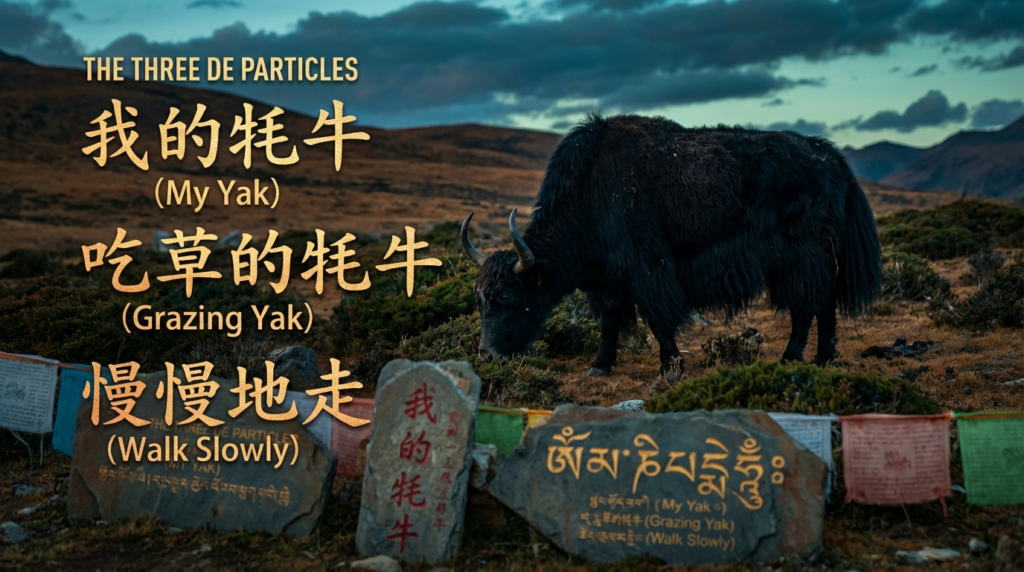
Example: 他慢慢地说 tā mànmàn de shuō — he speaks slowly
How To Use 的 De
的 de comes before a noun. It connects a person, noun, pronoun, or description to that noun.
Basic pattern: description + 的 de + noun
Key phrase: 我的书 wǒ de shū — my book
Sentence: 这是我的书。zhè shì wǒ de shū. — This is my book.
Key phrase: 漂亮的衣服 piàoliang de yīfu — beautiful clothes
Sentence: 她买了漂亮的衣服。tā mǎi le piàoliang de yīfu. — She bought beautiful clothes.
Key phrase: 中国的文化 Zhōngguó de wénhuà — Chinese culture / the culture of China
Sentence: 我很喜欢中国的文化。wǒ hěn xǐhuan Zhōngguó de wénhuà. — I really like Chinese culture.
Key phrase: 老师的学生 lǎoshī de xuésheng — the teacher’s student(s)
Sentence: 老师的学生很多。lǎoshī de xuésheng hěn duō. — The teacher has many students.
Quick tip: If the word after de is a thing or person, 的 de is usually the one you want.
How To Use 得 De
得 de comes after a verb. It tells you how well, how fast, how clearly, or how intensely the action happens.
Basic pattern: verb + 得 de + description
Key phrase: 说得很清楚 shuō de hěn qīngchu — speak very clearly
Sentence: 她中文说得很清楚。tā Zhōngwén shuō de hěn qīngchu. — She speaks Chinese very clearly.
Key phrase: 写得很好 xiě de hěn hǎo — write very well
Sentence: 你汉字写得很好。nǐ Hànzì xiě de hěn hǎo. — You write Chinese characters very well.
Key phrase: 跑得很快 pǎo de hěn kuài — run very fast
Sentence: 他跑得很快。tā pǎo de hěn kuài. — He runs very fast.
Key phrase: 睡得不好 shuì de bù hǎo — sleep badly / not sleep well
Sentence: 我昨天睡得不好。wǒ zuótiān shuì de bù hǎo. — I did not sleep well yesterday.
Quick tip: If de comes after the action word and before a description, you almost always need 得 de.
How To Use 地 De
地 de comes before a verb. It turns a descriptive word or phrase into the way the action is done.
Basic pattern: description + 地 de + verb
Key phrase: 慢慢地说 mànmàn de shuō — speak slowly
Sentence: 老师慢慢地说。lǎoshī mànmàn de shuō. — The teacher speaks slowly.
Key phrase: 高兴地笑 gāoxìng de xiào — smile happily
Sentence: 孩子们高兴地笑了。háizimen gāoxìng de xiào le. — The children smiled happily.
Key phrase: 认真地学习 rènzhēn de xuéxí — study seriously
Sentence: 她每天认真地学习中文。tā měitiān rènzhēn de xuéxí Zhōngwén. — She studies Chinese seriously every day.
Key phrase: 安静地听 ānjìng de tīng — listen quietly
Sentence: 请大家安静地听。qǐng dàjiā ānjìng de tīng. — Please listen quietly, everyone.
Quick tip: If the description comes before the action and feels like an English “-ly” word, 地 de is the usual choice.
The Easiest Way To Tell Them Apart
| Particle | Position | Job | Mini Example | Meaning |
|---|---|---|---|---|
| 的 de | Before a noun | Connects owner or description to a noun | 好吃的菜 hǎochī de cài | delicious dishes |
| 得 de | After a verb | Describes the result or degree of an action | 做得很好 zuò de hěn hǎo | do very well |
| 地 de | Before a verb | Describes how an action is done | 开心地唱 kāixīn de chàng | sing happily |
One tiny memory trick helps a lot:
- 的 de points to a noun: 红色的车 hóngsè de chē — red car
- 得 de follows a verb: 开得很快 kāi de hěn kuài — drive very fast
- 地 de comes before a verb: 小心地开 xiǎoxīn de kāi — drive carefully
Useful Real-Life Sentences
| Type | Sentence | Pinyin | English |
|---|---|---|---|
| 的 de | 这是我朋友的猫。 | zhè shì wǒ péngyou de māo. | This is my friend’s cat. |
| 的 de | 我们去了很有意思的地方。 | wǒmen qù le hěn yǒu yìsi de dìfang. | We went to a very interesting place. |
| 的 de | 她喜欢辣的食物。 | tā xǐhuan là de shíwù. | She likes spicy food. |
| 得 de | 你说得太快了。 | nǐ shuō de tài kuài le. | You spoke too fast. |
| 得 de | 他们唱得很好听。 | tāmen chàng de hěn hǎotīng. | They sing very nicely. |
| 得 de | 今天我累得不想动。 | jīntiān wǒ lèi de bù xiǎng dòng. | Today I’m so tired that I do not want to move. |
| 地 de | 他认真地回答问题。 | tā rènzhēn de huídá wèntí. | He answers questions seriously. |
| 地 de | 她轻轻地关上门。 | tā qīngqīng de guānshang mén. | She gently closed the door. |
| 地 de | 大家热情地欢迎他。 | dàjiā rèqíng de huānyíng tā. | Everyone welcomed him warmly. |
Mini Rule Patterns That Actually Help
| Pattern | Meaning | Example | Pinyin | English |
|---|---|---|---|---|
| A 的 de B | A describes or owns B | 新的手机 | xīn de shǒujī | new phone |
| Verb + 得 de + Adj | action happens to a certain degree | 看得很清楚 | kàn de hěn qīngchu | see very clearly |
| Adj + 地 de + Verb | action is done in a certain way | 开心地聊天 | kāixīn de liáotiān | chat happily |
| Verb + 得 de + Complement | result or state after the action | 忙得没时间 | máng de méi shíjiān | so busy there is no time |
| Phrase + 的 de + Noun | longer modifier before a noun | 我昨天买的书 | wǒ zuótiān mǎi de shū | the book I bought yesterday |
Practice Section
Pick the correct particle first, then check the answers below.
- 1. 她是我___老师。tā shì wǒ ___ lǎoshī. — She is my teacher.
- 2. 他说___很流利。tā shuō ___ hěn liúlì. — He speaks very fluently.
- 3. 她开心___跳舞。tā kāixīn ___ tiàowǔ. — She dances happily.
- 4. 这是很好吃___蛋糕。zhè shì hěn hǎochī ___ dàngāo. — This is very delicious cake.
- 5. 你写___太小了。nǐ xiě ___ tài xiǎo le. — You wrote too small.
- 6. 他慢慢___走进教室。tā mànmàn ___ zǒu jìn jiàoshì. — He slowly walked into the classroom.
Practice Answers
- 1. 的 de — 她是我的老师。tā shì wǒ de lǎoshī. — She is my teacher.
- 2. 得 de — 他说得很流利。tā shuō de hěn liúlì. — He speaks very fluently.
- 3. 地 de — 她开心地跳舞。tā kāixīn de tiàowǔ. — She dances happily.
- 4. 的 de — 这是很好吃的蛋糕。zhè shì hěn hǎochī de dàngāo. — This is very delicious cake.
- 5. 得 de — 你写得太小了。nǐ xiě de tài xiǎo le. — You wrote too small.
- 6. 地 de — 他慢慢地走进教室。tā mànmàn de zǒu jìn jiàoshì. — He slowly walked into the classroom.
Common Mistakes And Fast Fixes
- Mistake: 她高兴的笑。tā gāoxìng de xiào.
Fix: 她高兴地笑。tā gāoxìng de xiào. — She smiled happily.
Why: 笑 xiào is a verb, so use 地 de before it. - Mistake: 他跑地很快。tā pǎo de hěn kuài.
Fix: 他跑得很快。tā pǎo de hěn kuài. — He runs very fast.
Why: The description comes after the verb 跑 pǎo, so use 得 de. - Mistake: 这是我地书。zhè shì wǒ de shū.
Fix: 这是我的书。zhè shì wǒ de shū. — This is my book.
Why: 书 shū is a noun, so use 的 de. - Mistake: 我认真得学习。wǒ rènzhēn de xuéxí.
Fix: 我认真地学习。wǒ rènzhēn de xuéxí. — I study seriously.
Why: The description comes before the verb 学习 xuéxí.
Quick Reference Summary
- 的 de = before a noun
红色的包 hóngsè de bāo — red bag - 得 de = after a verb
做得不错 zuò de búcuò — do pretty well - 地 de = before a verb
努力地工作 nǔlì de gōngzuò — work hard
Final Yak Box
If you freeze every time you hear de, stop listening only to the sound. Look at the job in the sentence. Noun after it? 的 de. Verb before it? 得 de. Verb after it? 地 de. That tiny habit fixes a shocking amount of beginner pain.