Simplified Chinese “As For” Pattern: Topic-Comment Structure
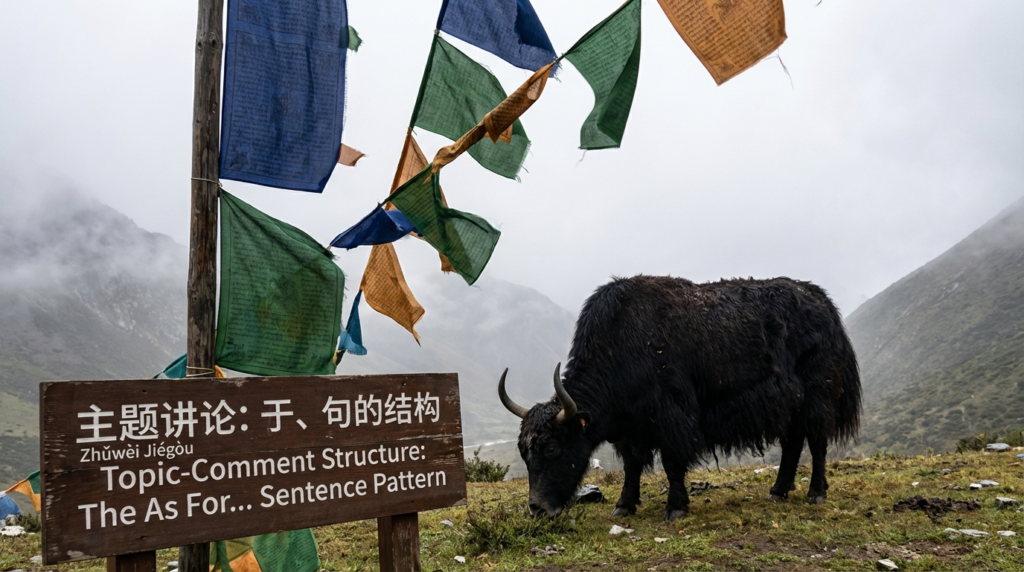
Learn how Chinese puts the topic first, then says something about it: 话题—评论 huàtí—pínglùn, “topic-comment.” It is the logic behind many natural “as for…” sentences in everyday Mandarin.
English often starts with the subject and marches forward like it has a meeting to attend. Chinese is more relaxed. It often starts with the thing everyone is already talking about, then adds the comment.
That means “as for…” in Chinese is not always one magic word. Very often, it is a sentence shape. You put the topic first, pause a little, and then say your point. Once this clicks, loads of Chinese sentences suddenly stop looking upside down.
Yak Snark Box
If you keep trying to force every Chinese sentence into perfect English subject-verb order, Chinese will keep smiling politely and ignoring you. Topic-comment is one of the big reasons native Chinese sounds natural and textbook Chinese sometimes sounds like it needs fresh air.
What Topic-Comment Means
In a topic-comment sentence, the first part is the topic: what the sentence is about. The second part is the comment: what you want to say about that topic.
Pattern:
话题 + 评论
huàtí + pínglùn
topic + comment
A very common English translation is “as for…” but that translation is only a helper. Chinese does not always need to literally say “as for.” It often just places the topic first.
The Basic Shape
这本书,我看过。
Zhè běn shū, wǒ kàn guo.
As for this book, I’ve read it.
北京,我没去过。
Běijīng, wǒ méi qù guo.
As for Beijing, I haven’t been there.
咖啡,我不喝。
Kāfēi, wǒ bù hē.
As for coffee, I don’t drink it.
In each sentence, the first noun is the topic. The second part tells you the speaker’s comment about it.
Three Ways Chinese Does “As For…”
1) Bare Topic First
Just put the topic first, then the comment. This is the most common and natural pattern.
天气,今天不错。
Tiānqì, jīntiān búcuò.
As for the weather, it’s nice today.
2) Topic + 呢 ne
呢 ne can mark the topic, especially in conversation and comparisons.
你呢?
Nǐ ne?
As for you? / What about you?
工作呢,我很满意。
Gōngzuò ne, wǒ hěn mǎnyì.
As for work, I’m quite satisfied.
3) 至于 zhìyú
至于 zhìyú is a more explicit “as for,” often used when switching topics or adding another point.
至于价格,我觉得还可以。
Zhìyú jiàgé, wǒ juéde hái kěyǐ.
As for the price, I think it’s okay.
The Core Rule: Put Known Information First
Chinese loves to start with what is already known, already visible, or already being discussed. Then it adds new information.
That is why topic-comment works so well with things like time, place, objects, and people already in the conversation.
| Pattern | Meaning | Example | Pinyin | English |
|---|---|---|---|---|
| 话题,评论 huàtí, pínglùn | Topic first, then comment | 这件事,我知道。 Zhè jiàn shì, wǒ zhīdào. | Zhè jiàn shì, wǒ zhīdào. | As for this matter, I know about it. |
| 话题呢,评论 huàtí ne, pínglùn | Topic marked with 呢 ne | 我弟弟呢,还在上学。 Wǒ dìdi ne, hái zài shàngxué. | Wǒ dìdi ne, hái zài shàngxué. | As for my younger brother, he’s still in school. |
| 至于 + 话题,评论 Zhìyú + huàtí, pínglùn | More explicit “as for” | 至于明天,我们再说。 Zhìyú míngtiān, wǒmen zài shuō. | Zhìyú míngtiān, wǒmen zài shuō. | As for tomorrow, we’ll talk about it later. |
Useful Topic Words You Will Actually Use
这件事
Zhè jiàn shì
this matter / this issue
这件事,我已经听说了。
Zhè jiàn shì, wǒ yǐjīng tīngshuō le.
As for this matter, I’ve already heard about it.
这个问题
Zhège wèntí
this question / this problem
这个问题,我还没想清楚。
Zhège wèntí, wǒ hái méi xiǎng qīngchu.
As for this question, I haven’t figured it out yet.
今天
Jīntiān
today
今天,我有点忙。
Jīntiān, wǒ yǒudiǎn máng.
As for today, I’m a bit busy.
北京
Běijīng
Beijing
北京,我特别想去。
Běijīng, wǒ tèbié xiǎng qù.
As for Beijing, I really want to go.
咖啡
Kāfēi
coffee
咖啡呢,我早上才喝。
Kāfēi ne, wǒ zǎoshang cái hē.
As for coffee, I only drink it in the morning.
价格
Jiàgé
price
至于价格,我觉得不贵。
Zhìyú jiàgé, wǒ juéde bú guì.
As for the price, I think it isn’t expensive.
Rule To Example: How To Build The Pattern
Rule 1: Start With The Topic, Not Necessarily The Subject
English learners often ask, “Where is the subject?” Fair question. Chinese sometimes cares less about grammar labels and more about information order.
这部电影,我看了两次。
Zhè bù diànyǐng, wǒ kàn le liǎng cì.
As for this movie, I watched it twice.
The topic is 这部电影 Zhè bù diànyǐng, “this movie.” The comment is 我看了两次 Wǒ kàn le liǎng cì, “I watched it twice.”
Rule 2: The Topic Is Often Something Already Known
门口那家店,我去过。
Ménkǒu nà jiā diàn, wǒ qù guo.
As for that shop by the entrance, I’ve been there.
The shop is already identifiable, so it works nicely as a topic.
Rule 3: Use 呢 ne For Contrast Or Follow-Up
我喜欢茶,你呢?
Wǒ xǐhuan chá, nǐ ne?
I like tea. What about you?
姐姐呢,在上海工作。
Jiějie ne, zài Shànghǎi gōngzuò.
As for my older sister, she works in Shanghai.
Here, 呢 ne gently points to the topic and keeps the conversation moving.
Rule 4: Use 至于 zhìyú When You Want A Clear Topic Shift
这个方案不错。至于时间,我们还要讨论。
Zhège fāng’àn búcuò. Zhìyú shíjiān, wǒmen hái yào tǎolùn.
This plan is not bad. As for the timing, we still need to discuss it.
至于 zhìyú sounds more formal and more deliberate than just moving the topic to the front.
Useful Phrases And Real-Life Sentences
- 这个人,我不认识。
Zhège rén, wǒ bù rènshi.
As for this person, I don’t know him. - 那家饭馆,我常去。
Nà jiā fànguǎn, wǒ cháng qù.
As for that restaurant, I go there often. - 中文语法,我还在学。
Zhōngwén yǔfǎ, wǒ hái zài xué.
As for Chinese grammar, I’m still learning it. - 周末呢,我想休息。
Zhōumò ne, wǒ xiǎng xiūxi.
As for the weekend, I want to rest. - 今天的会议,我不能参加。
Jīntiān de huìyì, wǒ bù néng cānjiā.
As for today’s meeting, I can’t attend. - 这个办法呢,我觉得可以试试。
Zhège bànfǎ ne, wǒ juéde kěyǐ shìshi.
As for this method, I think we can try it. - 至于结果,现在还不知道。
Zhìyú jiéguǒ, xiànzài hái bù zhīdào.
As for the result, we still don’t know yet. - 手机,我放在家里了。
Shǒujī, wǒ fàng zài jiālǐ le.
As for my phone, I left it at home. - 这个词,我以前没见过。
Zhège cí, wǒ yǐqián méi jiàn guo.
As for this word, I haven’t seen it before. - 你爸爸呢?
Nǐ bàba ne?
What about your dad? - 至于明年,我还没有计划。
Zhìyú míngnián, wǒ hái méiyǒu jìhuà.
As for next year, I still don’t have a plan. - 那本小说,我已经看完了。
Nà běn xiǎoshuō, wǒ yǐjīng kàn wán le.
As for that novel, I’ve already finished it.
Mini Tables You Can Steal Right Away
| Hanzi | Pinyin | Meaning | Example (ZH) | Example (Pinyin) | Translation |
|---|---|---|---|---|---|
| 呢 | ne | topic marker / what about | 你呢? | Nǐ ne? | What about you? |
| 至于 | zhìyú | as for / as to | 至于工作,我很满意。 | Zhìyú gōngzuò, wǒ hěn mǎnyì. | As for work, I’m very satisfied. |
| 这件事 | zhè jiàn shì | this matter | 这件事,我来处理。 | Zhè jiàn shì, wǒ lái chǔlǐ. | As for this matter, I’ll handle it. |
| 那个地方 | nàge dìfang | that place | 那个地方,我没去过。 | Nàge dìfang, wǒ méi qù guo. | As for that place, I haven’t been there. |
| 今天 | jīntiān | today | 今天,我不太舒服。 | Jīntiān, wǒ bú tài shūfu. | As for today, I’m not feeling very well. |
When Topic-Comment Sounds Most Natural
- When everyone already knows what thing you mean.
- When you want contrast: one topic, then another topic.
- When answering a question about a specific thing.
- When switching topics smoothly in conversation.
Small comparison:
A: 你喜欢上海吗?
Nǐ xǐhuan Shànghǎi ma?
Do you like Shanghai?
B: 上海,我很喜欢。
Shànghǎi, wǒ hěn xǐhuan.
As for Shanghai, I like it a lot.
That answer feels natural because 上海 Shànghǎi is already the shared topic.
Common Mistakes And Fixes
Mistake 1: Using 至于 zhìyú in every single sentence.
Too heavy: 至于咖啡,我喜欢。
Zhìyú kāfēi, wǒ xǐhuan.
As for coffee, I like it.
Better in casual speech: 咖啡,我喜欢。
Kāfēi, wǒ xǐhuan.
As for coffee, I like it.
Mistake 2: Fronting a completely random topic with no context.
If the listener has no idea why you suddenly said 这个地方 Zhège dìfang, “this place,” the topic may sound abrupt. Topic-comment works best when the topic is already clear.
Mistake 3: Forgetting that the comment still needs to be complete.
Wrong-ish: 这本书,我。
Zhè běn shū, wǒ.
As for this book, I… well, that went nowhere.
Better: 这本书,我很喜欢。
Zhè běn shū, wǒ hěn xǐhuan.
As for this book, I like it a lot.
Mistake 4: Assuming topic equals subject every time.
Not always. In 这本书,我看过。 Zhè běn shū, wǒ kàn guo. the topic is “this book,” but the subject of the action “read” is still 我 Wǒ, “I.”
Practice Section
Try reading the sentence, then notice the topic first.
- 我妈妈呢,很会做饭。
Wǒ māma ne, hěn huì zuòfàn.
As for my mom, she is very good at cooking. - 这道菜,我吃过很多次。
Zhè dào cài, wǒ chī guo hěn duō cì.
As for this dish, I’ve eaten it many times. - 至于汉字,我每天练一点。
Zhìyú Hànzì, wǒ měitiān liàn yìdiǎn.
As for Chinese characters, I practise a little every day.
Now try changing a plain sentence into topic-comment:
- 我很喜欢这首歌。
Wǒ hěn xǐhuan zhè shǒu gē.
I really like this song.
Topic-comment version:
这首歌,我很喜欢。
Zhè shǒu gē, wǒ hěn xǐhuan.
As for this song, I really like it.
- 我没去过那个城市。
Wǒ méi qù guo nàge chéngshì.
I haven’t been to that city.
Topic-comment version:
那个城市,我没去过。
Nàge chéngshì, wǒ méi qù guo.
As for that city, I haven’t been there.
Quick Reference Summary
- Chinese often starts with the topic, then adds the comment.
- The topic is usually known, visible, or already under discussion.
- Use bare topic first for the most natural everyday pattern.
- Use 呢 ne for follow-up, contrast, and “what about…” questions.
- Use 至于 zhìyú for a stronger or more formal “as for…” shift.
- The topic is not always the grammatical subject. Chinese is being practical, not rude.
Final Yak Box
When a Chinese sentence feels like it started in the middle, it probably did not. It probably started with the topic. Once you stop hunting for the English subject and start spotting the topic first, Mandarin becomes far less mysterious and far more logical.
So the next time you see something like 这个问题,我明白了。 Zhège wèntí, wǒ míngbai le. remember the pattern: “as for this question, I understand it now.” Clean, natural, and very Chinese.