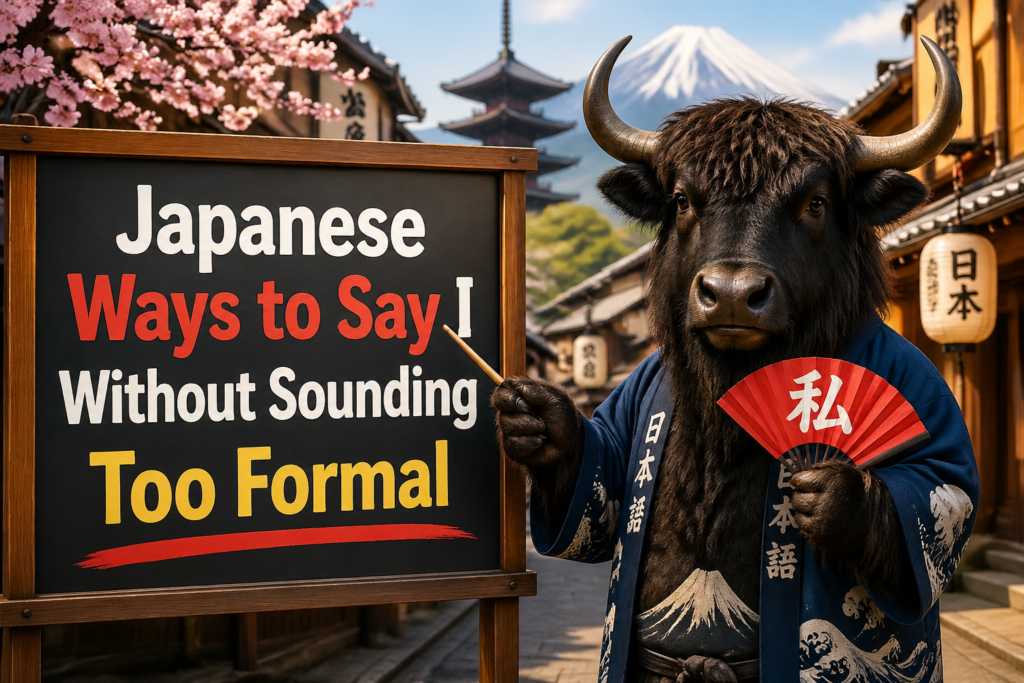
If you have ever heard anime characters switch from 僕 / ぼく / boku to 俺 / おれ / ore, you already know this is not just grammar. It is identity, tone, and social vibes packed into one tiny pronoun.
For a simple reference to the broader language system, this Japanese pronouns overview on Wikipedia is a useful boring source, which is exactly what a language learner sometimes needs.
The Core Idea: “I” Changes With Situation
In English, “I” is just “I.” Nice and easy. Japanese politely laughs and offers several options instead. The one you choose can sound formal, casual, masculine, feminine, blunt, soft, young, old, or just plain strange if you pick the wrong one for the moment.
The good news: you do not need every option on day one. Start with the safest ones, then learn the rest like you are collecting social timing tools, not random vocabulary.
Main Ways To Say “I”
Here is the short version: 私 / わたし / watashi is the default polite “I,” 僕 / ぼく / boku is common for boys and men in casual to polite speech, and 俺 / おれ / ore is more rough, casual, and masculine. Easy enough. Until real people enter the conversation and make it weird.
| Kanji | Rōmaji | English Meaning | Example Sentence | Rōmaji | English Translation |
|---|---|---|---|---|---|
| 私 | watashi | I; me; polite and neutral | 私は学生です。 | Watashi wa gakusei desu. | I am a student. |
| 僕 | boku | I; me; casual, usually masculine | 僕は日本語を勉強します。 | Boku wa Nihongo o benkyō shimasu. | I study Japanese. |
| 俺 | ore | I; me; casual, strong, masculine | 俺は行くよ。 | Ore wa iku yo. | I’m going. |
| 自分 | jibun | oneself; I/me in some contexts | 自分でやります。 | Jibun de yarimasu. | I’ll do it myself. |
| わたくし | watakushi | very polite “I” | わたくしがご案内します。 | Watakushi ga go-annai shimasu. | I will guide you. |
| あたし | atashi | casual feminine “I” | あたしは大丈夫。 | Atashi wa daijōbu. | I’m fine. |
| うち | uchi | I / me; casual, often feminine or Kansai usage | うちは行かない。 | Uchi wa ikanai. | I’m not going. |
| わし | washi | old-fashioned “I”; often used by older men | わしは知らん。 | Washi wa shiran. | I don’t know. |
| 拙者 | sessha | samurai-style “I”; historical or joking | 拙者は参る。 | Sessha wa mairu. | I shall come. |
Watashi: The Safe Default
私 / わたし / watashi is the easiest choice when you are unsure. It works in polite speech for everyone, and it is the usual “just do not make this awkward” option.
It is used by women and men, especially in formal situations. Men may still use it in daily life, but many switch to 僕 / ぼく / boku or another pronoun in casual settings.
私 / わたし / watashi
English meaning: I; me; polite, neutral personal pronoun
Example:
私は田中です。
Watashi wa Tanaka desu.
I am Tanaka.
Boku: Soft, Casual, and Very Common
僕 / ぼく / boku is a very common pronoun for boys and men. It sounds softer than 俺 / おれ / ore and less formal than 私 / わたし / watashi. If you have ever wondered why a character sounds kind, youthful, or a little gentle, this may be why.
It is often a good choice for men in everyday speech, especially when they want to sound approachable. It can also sound youthful. That is useful if you are young. Less useful if you are trying to sound like a battle-hardened action hero, obviously.
僕 / ぼく / boku
English meaning: I; me; casual masculine pronoun
Example:
僕はコーヒーが好きです。
Boku wa kōhī ga suki desu.
I like coffee.
Ore: Bold, Casual, and Strong
俺 / おれ / ore is casual and rougher. It often sounds more masculine and direct. Friends may use it with each other, but in the wrong setting it can sound too blunt or too confident for no reason.
Use 俺 / おれ / ore carefully. It can sound natural among close friends, but it is not the safest beginner choice. If watashi is the polite jacket, ore is the leather boots. Great when it fits. Slightly alarming when it does not.
俺 / おれ / ore
English meaning: I; me; casual masculine pronoun, often rough or strong
Example:
俺はもう食べた。
Ore wa mō tabeta.
I already ate.
Other Ways To Say “I”
Japanese has more options than most learners expect. Some are very formal. Some are old-fashioned. Some are regional. Some are basically “do not try this at work unless you are a samurai in a historical drama.”
| Kanji | Rōmaji | English Meaning | When To Use | Example Sentence | Rōmaji | English Translation |
|---|---|---|---|---|---|---|
| 私 | watashi | I; me | safe, polite, neutral | 私は忙しいです。 | Watashi wa isogashii desu. | I am busy. |
| わたくし | watakushi | very polite I | formal speech, business, announcements | わたくしが担当します。 | Watakushi ga tantō shimasu. | I will be in charge. |
| 僕 | boku | I; me | casual masculine, soft tone | 僕は元気です。 | Boku wa genki desu. | I’m fine. |
| 俺 | ore | I; me | casual masculine, stronger tone | 俺がやる。 | Ore ga yaru. | I’ll do it. |
| あたし | atashi | I; me | casual feminine speech | あたしは大丈夫だよ。 | Atashi wa daijōbu da yo. | I’m okay. |
| うち | uchi | I; me | informal, often feminine or Kansai dialect | うちは学生やで。 | Uchi wa gakusei ya de. | I’m a student. |
| 自分 | jibun | oneself; self | self-reference, discipline, some dialects | 自分で決めます。 | Jibun de kimemasu. | I’ll decide myself. |
| わし | washi | I; me | older men, old-fashioned speech | わしは知らん。 | Washi wa shiran. | I don’t know. |
| 拙者 | sessha | humble old-style I | historical, humorous, samurai style | 拙者は行くでござる。 | Sessha wa iku de gozaru. | I am going. |
Which One Should You Learn First?
If you are a beginner, start with these three:
- 私 / わたし / watashi — safe, polite, and usable almost everywhere
- 僕 / ぼく / boku — common for many men in casual speech
- 俺 / おれ / ore — casual and strong, but only when the tone fits
That is enough to understand a huge amount of real conversation. You do not need to chase every pronoun like it is a collectible card game.
Gender, Personality, And Style
Some textbooks make it sound like pronouns are neatly divided by gender. Real Japanese is messier. Yes, many of these forms have gendered associations. No, that does not mean every speaker must obey a strict rule book from the Pronoun Police.
A woman may use 私 / わたし / watashi in almost any formal setting. A man may use 私 / わたし / watashi too, especially in business or polite speech. A young man may prefer 僕 / ぼく / boku. A man among close friends may use 俺 / おれ / ore. A woman may use あたし / atashi casually. And some people choose based on personality, not just gender.
The key point is this: the pronoun says something about the speaker’s social style. It is not only about grammar. It is also about how the speaker wants to sound.
Useful Real-Life Sentences
| Kanji | Rōmaji | English Meaning | Example Sentence | Translation |
|---|---|---|---|---|
| 私は会社員です。 | Watashi wa kaishain desu. | I am a company employee. | Polite self-introduction | I am a company employee. |
| 僕は学生です。 | Boku wa gakusei desu. | I am a student. | Casual but polite | I am a student. |
| 俺は先に行く。 | Ore wa saki ni iku. | I’m going ahead. | Casual and direct | I’m going ahead. |
| わたくしは田中と申します。 | Watakushi wa Tanaka to mōshimasu. | My name is Tanaka. | Very formal introduction | My name is Tanaka. |
| あたしは甘いものが好き。 | Atashi wa amai mono ga suki. | I like sweet things. | Casual feminine tone | I like sweet things. |
| うちは京都出身やで。 | Uchi wa Kyōto shusshin ya de. | I’m from Kyoto. | Informal, Kansai flavor | I’m from Kyoto. |
| 自分でやってみます。 | Jibun de yatte mimasu. | I’ll try doing it myself. | Self-directed action | I’ll try doing it myself. |
| わしはもう年じゃ。 | Washi wa mō toshi ja. | I’m old now. | Old-fashioned speech | I’m old now. |
| 拙者は失礼する。 | Sessha wa shitsurei suru. | Excuse me, I’ll take my leave. | Historical / humorous style | Excuse me, I’ll take my leave. |
| 私は日本語を勉強しています。 | Watashi wa Nihongo o benkyō shite imasu. | I am studying Japanese. | Neutral and useful | I am studying Japanese. |
Common Mistakes And Easy Fixes
- Mistake: Using 俺 / おれ / ore in every situation.
Fix: Save it for casual, close, or masculine contexts. - Mistake: Thinking 僕 / ぼく / boku means “boy only.”
Fix: It is strongly associated with males, but style matters more than a strict rule. - Mistake: Using 私 / わたし / watashi and thinking it is always female.
Fix: It is polite and neutral, used by everyone. - Mistake: Overusing pronouns when Japanese often drops them.
Fix: If the subject is obvious, Japanese may leave it out completely. - Mistake: Picking a pronoun because it “sounds cool.”
Fix: Pick the one that fits the social setting first. Cool is optional. Awkward is forever.
Pronouns Often Get Dropped
Here is a very Japanese twist: people often do not say “I” at all. If the subject is obvious from context, the sentence can sound more natural without any pronoun.
行きます。
Ikimasu.
I will go.
食べました。
Tabemashita.
I ate.
This is why learners sometimes hear a sentence and wonder, “Who is doing the action?” The answer is often: everyone already knows, so Japanese does not bother repeating it.
Quick Comparison
| Form | Tone | Best Use | Simple Advice |
|---|---|---|---|
| 私 / watashi | polite, neutral | safe default | Use this first |
| 僕 / boku | soft, casual, masculine | daily speech, friendly tone | Good for many men |
| 俺 / ore | strong, casual, rough | close friends, masculine style | Use carefully |
| わたくし / watakushi | very formal | business, speeches | Too polite for casual talk |
| あたし / atashi | casual feminine | informal conversation | Natural in the right setting |
| うち / uchi | informal, regional | casual or Kansai speech | Learn it for listening |
Extra Notes On Nuance
If you want to sound natural, pay attention to three things: who you are speaking to, how formal the moment is, and what kind of personality the speaker wants to project. Japanese pronouns are not just labels. They are tiny social signals with attitude.
For example, if you hear someone introduce themselves with 僕 / ぼく / boku, they may sound relaxed and friendly. If they use わたくし / watakushi, they probably want to sound polished and professional. If they use 俺 / おれ / ore, the atmosphere is much more casual, and maybe a little louder.
Also, some expressions are more common in certain regions. うち / uchi is a good example. It can mean “I” in casual female speech or in Kansai-style speech, so hearing it in context matters a lot.
For related everyday phrases, you may also want to read about ways to say hello in Japanese and how to say please in Japanese, because pronouns become much easier once greetings and polite requests are already familiar.
In Japanese, “I” is not just one word. It is a choice about tone, distance, and personality.
Practice: Choose The Best “I”
Try matching the situation to the best pronoun. No need to overthink it like a final exam with dramatic music.
- You are in a job interview: 私 / わたし / watashi
- You are a teenage boy talking to a friend: 僕 / ぼく / boku
- You are joking around with close male friends: 俺 / おれ / ore
- You are giving a formal speech: わたくし / watakushi
- You are chatting casually with friends and want a feminine style: あたし / atashi
- You are hearing Kansai-style casual speech: うち / uchi
Quick Reference Summary
- 私 / わたし / watashi = polite, safe, neutral
- 僕 / ぼく / boku = soft, casual, commonly masculine
- 俺 / おれ / ore = casual, strong, masculine, more blunt
- わたくし / watakushi = very formal
- あたし / atashi = casual feminine
- うち / uchi = informal, regional, often feminine
- 自分 / じぶん / jibun = self / myself in certain contexts
- Japanese often skips “I” when the subject is already clear
If you want one simple rule, use 私 / わたし / watashi until you understand the social setting better. Then expand from there. That way, you sound natural without accidentally sounding like a samurai, a tough guy, or a business robot before lunch.
For more Japanese lessons, the main hub at Learn Japanese is a good place to keep going. And if you are curious about the more unusual side of pronouns and self-reference, this related lesson at Yak Yacker offers another angle to compare with what you learned here.