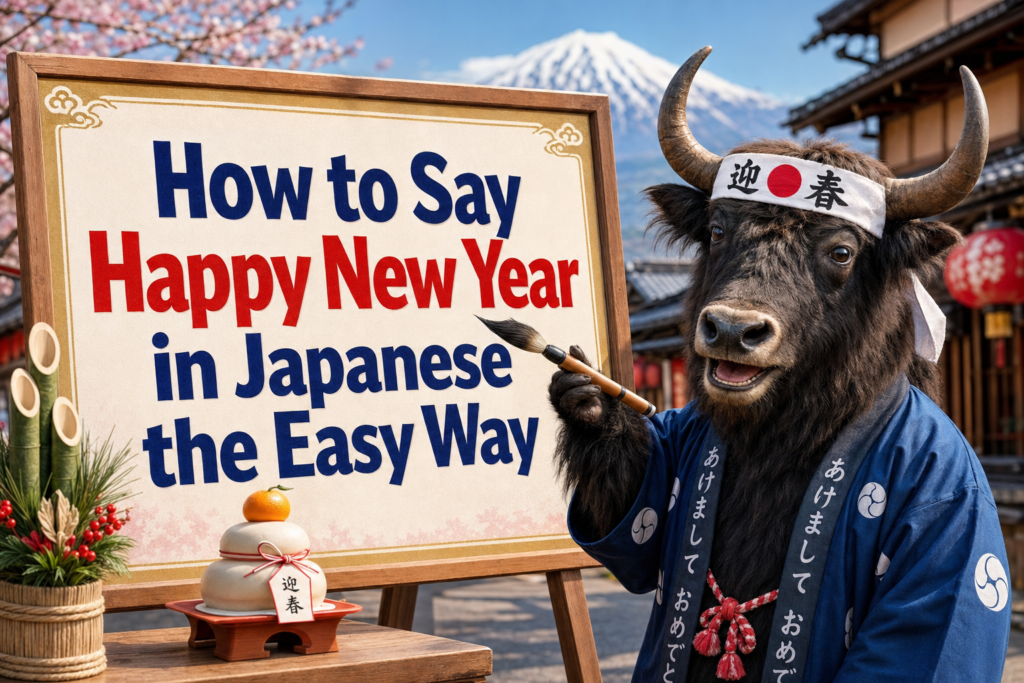
That is the big one. The classic one. The one you actually want when the clock flips and everyone starts sending messages like their thumbs are on a mission. If you learn only one New Year phrase in Japanese, make it this one.
New Year in Japan is a bigger family holiday than Christmas for many people, so these phrases get real use. You will hear them in homes, on TV, in texts, in shops, and from that one very polite person who somehow sounds elegant before breakfast. If you like seasonal language that instantly makes you sound more natural, this is a great place to start. And if you also enjoy learning greetings across languages, you can wander over to Spanish lessons later. No betrayal involved.
The Main Phrase You Need
明けましておめでとうございます
Akemashite omedetō gozaimasu
Happy New Year
This is the standard polite greeting for the New Year. Use it from January 1 onward. It sounds warm, normal, and respectful. Perfect for friends, coworkers, neighbors, teachers, in-laws, and basically anyone you do not want to accidentally sound weird with.
Example: 明けましておめでとうございます。今年もよろしくお願いします。
Akemashite omedetō gozaimasu. Kotoshi mo yoroshiku onegaishimasu.
Happy New Year. I look forward to your continued favor this year.
The Casual Version
明けましておめでとう
Akemashite omedetō
Happy New Year
This is the same greeting, just less formal. Use it with friends, close family, or people you are very comfortable with. It still sounds natural and kind. It just drops the extra politeness at the end.
Example: 明けましておめでとう!今年もいっぱい遊ぼう。
Akemashite omedetō! Kotoshi mo ippai asobō.
Happy New Year! Let’s hang out a lot this year too.
A Very Common New Year Add-On
今年もよろしくお願いします
Kotoshi mo yoroshiku onegaishimasu
Please treat me well this year too / I look forward to your continued support this year
This phrase is everywhere in Japanese New Year greetings. It does not translate neatly into one perfect English sentence, because Japanese loves social nuance and English often barges in wearing boots. The feeling is: “Let’s continue our good relationship this year.”
Example: 明けましておめでとうございます。今年もよろしくお願いします。
Akemashite omedetō gozaimasu. Kotoshi mo yoroshiku onegaishimasu.
Happy New Year. I look forward to your continued support this year.
Useful Phrases And Real-Life Sentences
Here are the most useful Japanese New Year phrases you will actually see and hear. Each one comes with an example, because vocabulary without context is just a fancy pile of ingredients.
新年
Shinnen
New Year
Example: 新年のご挨拶を申し上げます。
Shinnen no go-aisatsu o mōshiagemasu.
I offer my New Year greetings.
お正月
Oshōgatsu
New Year holiday / New Year period
Example: お正月は家族と過ごします。
Oshōgatsu wa kazoku to sugoshimasu.
I spend New Year with my family.
元日
Ganjitsu
New Year’s Day
Example: 元日に初詣に行きます。
Ganjitsu ni hatsumōde ni ikimasu.
I go for the first shrine visit on New Year’s Day.
大晦日
Ōmisoka
New Year’s Eve
Example: 大晦日にそばを食べました。
Ōmisoka ni soba o tabemashita.
I ate soba on New Year’s Eve.
良いお年を
Yoi otoshi o
Have a good New Year / Have a happy New Year
Example: それでは、良いお年を。
Soredewa, yoi otoshi o.
Well then, have a great New Year.
謹賀新年
Kinga shinnen
Happy New Year / Best wishes for the New Year
Example: 年賀状に「謹賀新年」と書きました。
Nengajō ni “Kinga shinnen” to kakimashita.
I wrote “Best wishes for the New Year” on the New Year’s card.
賀正
Gashō
Season’s greetings for the New Year
Example: そのポスターには「賀正」とありました。
Sono posutā ni wa “Gashō” to arimashita.
That poster said “New Year’s greetings.”
年賀状
Nengajō
New Year’s card
Example: 友達に年賀状を送りました。
Tomodachi ni nengajō o okurimashita.
I sent a New Year’s card to a friend.
初詣
Hatsumōde
First shrine or temple visit of the year
Example: 家族で初詣に行きました。
Kazoku de hatsumōde ni ikimashita.
I went for the first shrine visit of the year with my family.
お年玉
Otoshidama
New Year’s money gift for children
Example: 子どもたちはお年玉をもらって喜びました。
Kodomotachi wa otoshidama o moratte yorokobimashita.
The children were happy to receive New Year’s money.
今年
Kotoshi
This year
Example: 今年は日本語をもっと勉強したいです。
Kotoshi wa Nihongo o motto benkyō shitai desu.
This year I want to study more Japanese.
去年
Kyonen
Last year
Example: 去年は日本でお正月を過ごしました。
Kyonen wa Nihon de oshōgatsu o sugoshimashita.
Last year I spent New Year in Japan.
来年
Rainen
Next year
Example: 来年もよろしくお願いします。
Rainen mo yoroshiku onegaishimasu.
I look forward to your support next year too.
When To Use Which Phrase
- Before January 1: 良いお年を
Yoi otoshi o
Have a good New Year - On or after January 1: 明けましておめでとうございます
Akemashite omedetō gozaimasu
Happy New Year - With close friends: 明けましておめでとう
Akemashite omedetō
Happy New Year - In polite messages: 今年もよろしくお願いします
Kotoshi mo yoroshiku onegaishimasu
Please treat me well this year too
This timing matters. A lot. 良いお年を is said before the New Year arrives. Once it is already January 1, switch to 明けましておめでとうございます. Using the wrong one will not cause a national emergency, but it will sound off.
Before the New Year: 良いお年を. After the New Year starts: 明けましておめでとうございます. Tiny difference, huge usefulness.
Simple Patterns You Can Copy
These are easy message patterns for texting, cards, and social posts.
明けましておめでとうございます。今年もよろしくお願いします。
Akemashite omedetō gozaimasu. Kotoshi mo yoroshiku onegaishimasu.
Happy New Year. I look forward to your continued support this year.
明けましておめでとう!今年もよろしくね。
Akemashite omedetō! Kotoshi mo yoroshiku ne.
Happy New Year! Looking forward to another good year with you.
良いお年をお迎えください。
Yoi otoshi o omukae kudasai.
Please have a wonderful New Year.
Example: 皆さん、良いお年をお迎えください。
Minasan, yoi otoshi o omukae kudasai.
Everyone, please have a wonderful New Year.
新年おめでとうございます。
Shinnen omedetō gozaimasu.
Happy New Year
Example: 新年おめでとうございます。本年もどうぞよろしくお願いいたします。
Shinnen omedetō gozaimasu. Honnen mo dōzo yoroshiku onegai itashimasu.
Happy New Year. I humbly ask for your continued favor this year as well.
Polite And Casual Variants
| Kanji | Rōmaji | Meaning | Best Use |
|---|---|---|---|
| 明けましておめでとうございます | Akemashite omedetō gozaimasu | Happy New Year | Polite, standard |
| 明けましておめでとう | Akemashite omedetō | Happy New Year | Casual, friends |
| 今年もよろしくお願いします | Kotoshi mo yoroshiku onegaishimasu | Please treat me well this year too | Polite follow-up |
| 今年もよろしくね | Kotoshi mo yoroshiku ne | Looking forward to this year too | Casual follow-up |
| 良いお年を | Yoi otoshi o | Have a good New Year | Before January 1 |
Table Of Core New Year Words
| Kanji | Rōmaji | Meaning | Example (JP) | Example (Rōmaji) | Translation (EN) |
|---|---|---|---|---|---|
| 明けましておめでとうございます | Akemashite omedetō gozaimasu | Happy New Year | 明けましておめでとうございます。 | Akemashite omedetō gozaimasu. | Happy New Year. |
| 良いお年を | Yoi otoshi o | Have a good New Year | どうぞ良いお年を。 | Dōzo yoi otoshi o. | Please have a great New Year. |
| 今年もよろしくお願いします | Kotoshi mo yoroshiku onegaishimasu | Please treat me well this year too | 今年もよろしくお願いします。 | Kotoshi mo yoroshiku onegaishimasu. | I look forward to your continued support this year. |
| お正月 | Oshōgatsu | New Year holiday | お正月はのんびりします。 | Oshōgatsu wa nonbiri shimasu. | I will relax during the New Year holiday. |
| 大晦日 | Ōmisoka | New Year’s Eve | 大晦日はテレビを見ます。 | Ōmisoka wa terebi o mimasu. | I watch TV on New Year’s Eve. |
Table Of Holiday Culture Words
| Kanji | Rōmaji | Meaning | Example (JP) | Example (Rōmaji) | Translation (EN) |
|---|---|---|---|---|---|
| 初詣 | Hatsumōde | First shrine visit of the year | 初詣でおみくじを引きました。 | Hatsumōde de omikuji o hikimashita. | I drew a fortune at the first shrine visit of the year. |
| 年賀状 | Nengajō | New Year’s card | 祖母に年賀状を書きました。 | Sobo ni nengajō o kakimashita. | I wrote a New Year’s card to my grandmother. |
| お年玉 | Otoshidama | Money gift for children | お年玉を貯金します。 | Otoshidama o chokin shimasu. | I will save my New Year’s money gift. |
| 元日 | Ganjitsu | New Year’s Day | 元日は店が休みでした。 | Ganjitsu wa mise ga yasumi deshita. | The shop was closed on New Year’s Day. |
| 新年 | Shinnen | New Year | 新年の目標を立てました。 | Shinnen no mokuhyō o tatemashita. | I made New Year goals. |
Common Mistakes To Avoid
- Using 良いお年を after January 1
良いお年を
Yoi otoshi o
This is for before the New Year arrives. - Forgetting the polite ending in formal situations
明けましておめでとうございます
Akemashite omedetō gozaimasu
Safer for teachers, bosses, clients, and people you do not know well. - Thinking 今年もよろしくお願いします means exactly one thing
今年もよろしくお願いします
Kotoshi mo yoroshiku onegaishimasu
It is more about maintaining a good relationship than a literal English sentence. - Writing super-short card phrases in normal speech
謹賀新年
Kinga shinnen
Looks great on cards, sounds stiff in conversation.
A Curious Bit About New Year Cards
Japanese New Year cards, called 年賀状
Nengajō
New Year’s cards, have long been a major tradition. Short formal greetings like 謹賀新年
Kinga shinnen
Best wishes for the New Year, are common in writing. They look neat, tidy, and elegant. They also sound a bit too formal if you suddenly drop them into regular conversation like a walking greeting card.
Example: 年賀状には丁寧な表現がよく使われます。
Nengajō ni wa teinei na hyōgen ga yoku tsukawaremasu.
Polite expressions are often used on New Year’s cards.
If you want a quick cultural read on the holiday itself, the language learning trail is not exactly Japanese holiday history, but it is still a handy place to keep your study habit moving. Momentum counts.
Quick Practice
Try saying these aloud. Yes, aloud. Whispering to your coffee counts.
- 明けましておめでとうございます
Akemashite omedetō gozaimasu
Happy New Year - 明けましておめでとう!
Akemashite omedetō!
Happy New Year! - 今年もよろしくお願いします
Kotoshi mo yoroshiku onegaishimasu
Please treat me well this year too - 良いお年を
Yoi otoshi o
Have a good New Year
Now match them to the situation:
- Texting a close friend on January 1 → 明けましておめでとう!
Akemashite omedetō!
Happy New Year! - Emailing a coworker on January 2 → 明けましておめでとうございます。今年もよろしくお願いします。
Akemashite omedetō gozaimasu. Kotoshi mo yoroshiku onegaishimasu.
Happy New Year. I look forward to your continued support this year. - Saying goodbye to someone on December 30 → 良いお年を
Yoi otoshi o
Have a good New Year
Quick Reference Summary
- Main polite phrase: 明けましておめでとうございます
Akemashite omedetō gozaimasu
Happy New Year - Main casual phrase: 明けましておめでとう
Akemashite omedetō
Happy New Year - Common follow-up: 今年もよろしくお願いします
Kotoshi mo yoroshiku onegaishimasu
Please treat me well this year too - Before New Year only: 良いお年を
Yoi otoshi o
Have a good New Year - Writing style phrase: 謹賀新年
Kinga shinnen
Best wishes for the New Year
Yak Takeaway
If you remember just one phrase, make it 明けましておめでとうございます
Akemashite omedetō gozaimasu
Happy New Year. If you want to sound even more natural, add 今年もよろしくお願いします
Kotoshi mo yoroshiku onegaishimasu
Please treat me well this year too. And if it is still December, do not jump the gun with New Year greetings like an overeager firework. Use 良いお年を
Yoi otoshi o
Have a good New Year. That little timing switch is one of those small Japanese details that makes a surprisingly big difference.