
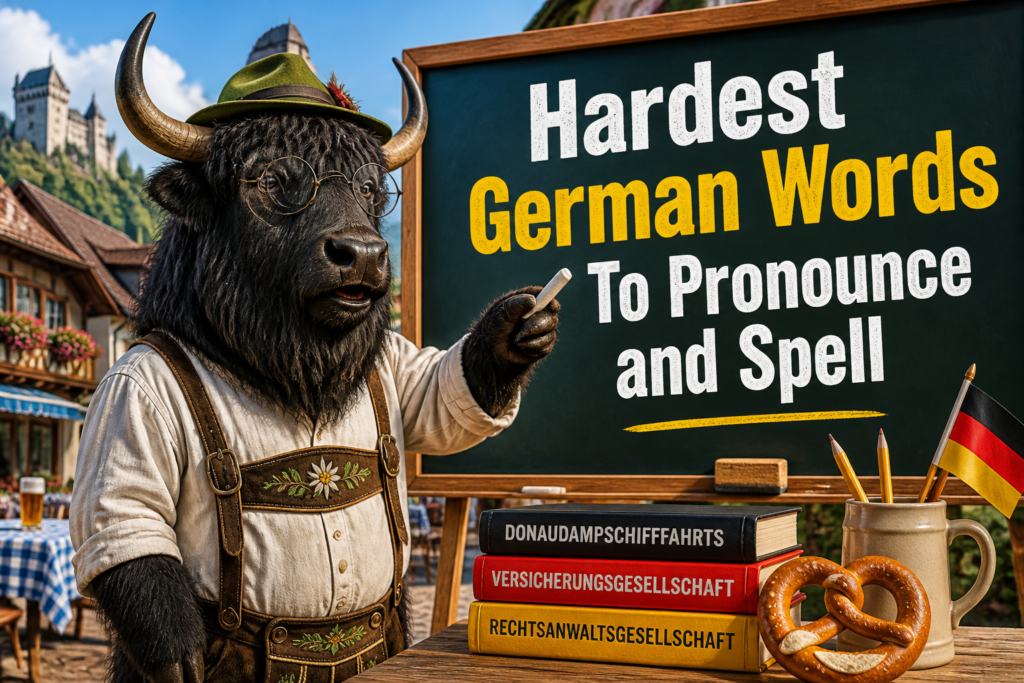
German has a funny way of looking innocent and then suddenly becoming a mouthful. You see a word on the page and think, “Fine, that’s manageable.” Then you try to say it out loud and your tongue files a formal complaint.
For the broader learning path, visit our parent guide.
This guide looks at some of the hardest German words to pronounce and spell, with practical pronunciation help, meaning, example sentences, and a few survival tips. By the end, you’ll know why some German words feel like tiny linguistic boss fights — and how to beat them without dramatic sighing.
One useful thing to remember: German spelling is often more logical than it first looks. The difficulty is usually not chaos. It’s just that German likes long compounds, sharp consonants, and vowel sounds that English doesn’t handle very gracefully. Rude, really. But consistent.
Why Some German Words Feel So Hard
For English speakers, the hardest parts are usually these: ch, r, umlauts like ä, ö, ü, final devoicing, and very long compound nouns. German also capitalizes all nouns, which is helpful once you know it, but a little dramatic at first.
If you want a boring but reliable spelling reference, Duden is the classic standard source. For pronunciation and learner-friendly explanations, DW Learn German is also excellent.
German rarely punishes you for being unclear on grammar. It does, however, absolutely enjoy making you say “Eichhörnchen” before coffee.
Hard German Words You’ll Actually Run Into
Below are some famously tricky words. A few are hard because of pronunciation. A few are hard because of spelling. A few are hard because German looked at a normal sentence and decided to weld it into one word.
| German | Pronunciation | Meaning | Example Sentence | Translation | Learner Note |
|---|---|---|---|---|---|
| Streichholzschächtelchen | SHTRYKH-holts-SHÄKH-tel-khen | little matchbox | Ich suche ein Streichholzschächtelchen. | I’m looking for a little matchbox. | Very long, but the parts are logical. Break it into chunks. |
| Rindfleischetikettierungsüberwachungsaufgabenübertragungsgesetz | RINT-flysh-eh-tee-kehr-TEER-oongs-OO-ber-vakh-oongs-owf-gah-ben-OO-ber-trah-goongs-geh-sets | cattle labeling supervision task transfer law | Dieses Wort ist ein berühmtes Beispiel für deutsche Komposita. | This word is a famous example of German compounds. | Mostly famous as a joke. You will not use it in daily life. Unless your life is weird. |
| Eichhörnchen | EYKH-hurn-khen | squirrel | Das Eichhörnchen sitzt auf dem Baum. | The squirrel is sitting on the tree. | The ch sound after i is the main obstacle. |
| Fischers Fritz fischt frische Fische | FISH-ers Frits fisht FRISH-eh FISH-eh | traditional tongue twister | Fischers Fritz fischt frische Fische. | Fisher’s Fritz fishes fresh fish. | Great for practicing sch, ch, and final consonants. |
| Quatsch | kvahch | nonsense | Das ist doch Quatsch. | That’s nonsense. | The qu sounds like kv, not “kw.” |
| Sprichst | SHPRIKHST | you speak | Sprichst du Deutsch? | Do you speak German? | Hard because of the consonant cluster at the end. |
| schließlich | SHLEES-likh | finally, after all | Ich habe es schließlich verstanden. | I finally understood it. | The ch is softer here than many learners expect. |
| Pflicht | pflikh t | duty, obligation | Das ist meine Pflicht. | That is my duty. | Initial pf is a classic English-speaker trap. |
| Rücksicht | ROOK-zikh t | consideration, thoughtfulness | Bitte nehmen Sie Rücksicht. | Please be considerate. | Watch the ü and the final cht sound. |
| unbedingt | OON-be-dingt | absolutely, definitely | Ich muss unbedingt schlafen. | I absolutely have to sleep. | The u is short and crisp. No drama, just urgency. |
| Gespräch | guh-SPRAYKH | conversation | Wir führen ein kurzes Gespräch. | We’re having a short conversation. | The sp after a prefix changes the sound feel. Listen carefully. |
| Verkehr | fer-KEYR | traffic | Der Verkehr ist heute schlecht. | Traffic is bad today. | The v sounds like f. |
| der Schlüssel | shloo-sel | key | Ich habe meinen Schlüssel verloren. | I lost my key. | Short ü plus sch. A very German combination. |
| Entschuldigung | ent-SHOOL-di-goong | excuse me / sorry | Entschuldigung, wo ist der Bahnhof? | Excuse me, where is the train station? | Long, useful, and worth mastering early. |
| Wahrscheinlichkeit | VAH-rsheen-likh-KYT | probability | Die Wahrscheinlichkeit ist hoch. | The probability is high. | Better for intermediate learners. Great stress practice. |
The Most Annoying Sounds For English Speakers
Some words are hard because of the sounds, not the spelling. Let’s look at the usual suspects.
| Sound | How It Feels | German Example | Quick Tip |
|---|---|---|---|
| ch | Two different sounds, depending on the vowel | ich, Buch | After i/e/ä/ö/ü, it’s softer. After a/o/u/au, it’s stronger and deeper. |
| r | Often a throat sound in standard German | rot, schreiben | Do not panic if your r sounds light. Clarity matters more than sounding like a newscaster. |
| ü | No direct English match | für, Rücksicht | Say “ee” with rounded lips. Yes, it feels silly. That’s normal. |
| ö | Also weird for English speakers | schön, können | Start with “eh” and round the lips. |
| pf | Two sounds pushed together at the start of a word | Pflicht, Pferd | Say the p and f almost at the same time. |
| sp / st | At the beginning of a syllable, often pronounced shp / sht | sprechen, Student | At the start of a word, sp and st usually shift to shp and sht. |
| z | Not “z” like in English “zoo” | Zeit, Zimmer | It sounds like ts. |
| v | Usually like f | Vater, Verkehr | German v is often f. English brain: please sit down. |
Tricky Words, Broken Down Simply
Here are some words with extra notes so they stop looking like spelling riddles.
| German | Pronunciation | Meaning | Example Sentence | Translation | Learner Note |
|---|---|---|---|---|---|
| ich | ikh | I | Ich komme gleich. | I’m coming in a moment. | The ch is soft here, not a harsh k. |
| auch | owkh | also, too | Ich komme auch mit. | I’m coming too. | The au is like the “ow” in “loud,” followed by a gentle ch. |
| euch | oykh | you all / you guys | Ich sehe euch morgen. | I’ll see you all tomorrow. | Useful plural you. The spelling can intimidate learners for no good reason. |
| nächstes | nekh-stes | next | Ich nehme den nächsten Zug. | I’m taking the next train. | ä often sounds like short e here. |
| schön | shurn | beautiful, nice | Das Wetter ist schön. | The weather is nice. | The ö is rounded. Don’t turn it into “shone.” |
| möglich | MUH-glikh | possible | Ist das möglich? | Is that possible? | Watch the ö and the soft ch. |
| Fröhlichkeit | FRURH-likh-kyt | cheerfulness | Ihre Fröhlichkeit ist ansteckend. | Her cheerfulness is contagious. | Longer word, but built from familiar parts. |
| Bequemlichkeit | buh-KVAYM-likh-kyt | convenience, comfort | Bequemlichkeit ist nicht immer das Beste. | Convenience is not always the best thing. | Very useful for reading and writing practice. |
| Verständnis | fer-SHTEN-dis | understanding | Danke für Ihr Verständnis. | Thank you for your understanding. | A common polite phrase in emails and service situations. |
| eigenständig | EYE-gen-shten-dikh | independent, self-reliant | Sie arbeitet sehr eigenständig. | She works very independently. | Notice the st sound in the middle of the word. |
Words That Are Hard Mainly Because Of Spelling
German spelling is not random, but it does expect you to care about details. Here are some words that often trip up learners on the page rather than in the mouth.
| German | Common Spelling Problem | Meaning | Example Sentence | Translation | Learner Note |
|---|---|---|---|---|---|
| Entschuldigung | Many letters, easy to miss sch and gu order | excuse me / sorry | Entschuldigung, ich habe Sie nicht gesehen. | Sorry, I didn’t see you. | Break it into ent-schul-di-gung. |
| wahrscheinlich | sch cluster and long word shape | probably | Es ist wahrscheinlich später. | It will probably be later. | Very common. Worth learning as a chunk. |
| tatsächlich | ä plus ch plus lich | actually, indeed | Das ist tatsächlich wahr. | That is actually true. | Useful in speech and writing; don’t let the spelling scare you away. |
| selbstverständlich | Very long; easy to forget parts | of course, self-evident | Das ist selbstverständlich. | That goes without saying. | Better learned in pieces: selbst-ver-ständ-lich. |
| Höchstgeschwindigkeit | Compound spelling and ö | maximum speed | Die Höchstgeschwindigkeit beträgt 50 km/h. | The maximum speed is 50 km/h. | Very common on road signs and in driving contexts. |
| Aufmerksamkeit | Long noun with predictable parts | attention | Bitte achten Sie auf Ihre Aufmerksamkeit. | Please pay attention. | Noun capitalization matters. German likes to announce nouns loudly. |
| Unabhängigkeit | ng, ä, long compound | independence | Unabhängigkeit ist wichtig. | Independence is important. | The ä often sounds like a short e. |
| Überraschung | ü and sch | surprise | Das war eine Überraschung. | That was a surprise. | Common everyday noun. Learn it before it surprises you. |
| Krankenversicherung | Very long compound noun | health insurance | Ich brauche eine Krankenversicherung. | I need health insurance. | Split it into Kranken + Versicherung. |
| Rückversicherung | Not the same as English “reinsurance” in learner intuition | reinsurance | Die Rückversicherung ist teuer. | The reinsurance is expensive. | More advanced vocabulary. Very useful in business contexts. |
How To Pronounce The Worst Offenders Without Crying
Here’s the practical method: stop trying to say the whole monster all at once. German compounds become much easier when you chunk them into parts and say each part cleanly.
- Break long words into pieces. Example: Ent-schul-di-gung, selbst-ver-ständ-lich, Kranken-ver-si-che-rung.
- Listen for the stressed syllable. In long words, stress usually falls on one main part, not every syllable at once.
- Practice the sounds separately. If ch is hard, work on ich, nicht, Buch, and doch before moving into long words.
- Don’t over-English the vowels. German vowels are often shorter and cleaner.
- Say final consonants clearly. German final devoicing means g can sound more like k, b like p, and d like t at the end of a word.
Example: Hund is not “hoond.” It sounds closer to hoont. A tiny sound change, a huge spelling clue.
If you want a friendly overview of German pronunciation patterns, the article at Hardest German Words To Pronounce is a good companion piece.
Words People Often Misread Because Of German Spelling Rules
| German | What Learners Often Guess | What It Really Means | Example Sentence | Translation | Learner Note |
|---|---|---|---|---|---|
| schon | “shone” | already, indeed | Ich bin schon da. | I’m already here. | Do not confuse it with schön. |
| schön | “shane” or “shown” | beautiful, nice | Das ist schön. | That is nice. | The umlaut changes everything. German loves that little wobble. |
| als | “alls” | than, when | Er ist älter als ich. | He is older than me. | Short, common, and easy to overlook. |
| auch | “awk” | also, too | Ich habe auch Hunger. | I’m hungry too. | The ending sound is not English “k” alone. Keep the ch light. |
| eilig | “ee-lee-g” with hard English g | urgent | Es ist sehr eilig. | It’s very urgent. | German final sounds can be softer or devoiced depending on position. |
| eigentlich | “ay-gent-lick” | actually, really, basically | Was willst du eigentlich sagen? | What do you actually want to say? | Extremely common in speech. Learn it as a phrase, not a puzzle. |
| Vorsicht | “for-sight” | caution | Vorsicht, nass! | Careful, wet! | v = f. A classic German quirk. |
| gewöhnlich | “go-VEHN-lich” | usual, ordinary | Das ist gewöhnlich nicht so. | That is usually not like that. | ö again. The umlaut is the boss level here. |
| Gefühl | “geh-fool” | feeling | Ich habe ein gutes Gefühl. | I have a good feeling. | Long ü sound. Rounded lips save the day. |
| Frühstück | “froo-stuck” | breakfast | Ich esse Frühstück um acht Uhr. | I eat breakfast at eight o’clock. | Common and useful. Practice the ü and st. |
Mini Spelling Survival Guide
If you keep making the same spelling mistakes, these are the usual rescue tactics.
- Capitalize nouns. der Tisch, die Schule, das Buch. Every noun gets a capital letter. German is not shy.
- Watch umlauts. a → ä, o → ö, u → ü. Those dots matter.
- Remember ß vs ss. In standard German, ß often appears after long vowels or diphthongs, while ss often follows short vowels.
- Learn compounds in chunks. German often joins words instead of using spaces.
- Check prefix spelling carefully. Small prefix mistakes can change meaning or make a word look broken.
If articles are part of your spelling headache too, the guide at German Articles Explained will help untangle der, die, and das without turning your brain into soup.
Germany, Austria, And Switzerland Differences Worth Noting
Most of the words in this article are standard German, but pronunciation and vocabulary can shift a little by region. That’s normal. Language is a living thing, not a museum label.
| Topic | Germany | Austria | Switzerland | Learner Note |
|---|---|---|---|---|
| Pronunciation of r | Often a uvular or softer throat sound in standard speech | Can sound a bit more rolled or regional in some areas | Often more rolled or regional depending on context | All are understandable. Aim for clear, not perfect. |
| ß | Common in standard spelling | Also used in standard German | Mostly replaced by ss in Swiss Standard German | Swiss writing often uses ss where Germany uses ß. |
| Vocabulary | Krankenversicherung, Vorsicht | Same standard forms, plus regional expressions | Standard forms plus local Swiss German differences in speech | Standard German remains the safest default for learners. |
If you like regional variation and slang, the guide at German Slang And Regional Dialects is a nice next step.
Practice: Say It, Spell It, Survive It
Try these quick drills. No one is judging except the vowels.
| Task | German | Pronunciation | Meaning | Answer / Hint |
|---|---|---|---|---|
| Split the word | Entschuldigung | ent-SHOOL-di-goong | excuse me / sorry | Think: ent + schul + di + gung. |
| Spot the umlaut | schon / schön | shon / shurn | already / beautiful | o and ö are not the same word. |
| Spot the sound | Vater | FAH-ter | father | The v sounds like f. |
| Fill in the blank | Ich habe ein gutes ___. | Gefühl | feeling | Gefühl |
| Fix the spelling | schone / schöne | shone / shurn-eh | depending on meaning | schöne is the adjective form; schone is a different form entirely. |
| Read aloud | Pflicht | pflikh t | duty | Start the word with a quick pf, not a plain p. |
| Choose the better meaning | wahrscheinlich | vah-SHINE-likh | probably / maybe / likely | Best English fit: probably or likely, depending on context. |
Try reading these out loud in one go: Ich spreche Deutsch. Entschuldigung, wo ist der Bahnhof? Das ist wahrscheinlich richtig. Ich habe ein gutes Gefühl.
Then say them again, slower, with clean consonants. German rewards clarity. It is a very no-nonsense language. A little emotionally unavailable, but efficient.
Common Mistakes And Easy Fixes
| Mistake | Better Version | Why It Helps |
|---|---|---|
| Saying ich like “ik” | ikh | The ch should be a soft friction sound, not a hard k. |
| Saying schön like “shown” | shurn | The umlaut changes the vowel. English spelling instincts are not your friend here. |
| Saying v like English v | f | Many German v words sound like f, especially common vocabulary. |
| Ignoring st and sp at the start of words | sht and shp | That shift matters a lot in standard pronunciation. |
| Trying to pronounce every German compound as one giant blur | Break into chunks | German compounds are long, but they are not meant to be swallowed whole. |
| Forgetting noun capitalization | Der Schlüssel, die Versicherung | Capitalization helps you spot nouns and keeps spelling correct. |
Quick Reference Summary
- Hardest pronunciation sounds: ch, r, ü, ö, pf, sp, st, and final devoicing.
- Hardest spelling habits: long compounds, umlauts, ß vs ss, and noun capitalization.
- Best strategy: learn words in chunks, not as one huge beast.
- Most useful survival word: Entschuldigung. It buys you time and politeness.
- Most important attitude: aim for clear and understandable, not robotically perfect.
If you want more surprisingly pretty vocabulary after all this tongue gymnastics, check out Beautiful Cool German Words. Your mouth deserves something nicer now.
Yak takeaway: the hardest German words look scary because they pack a lot into a small space, but they usually obey the rules. Break them into chunks, respect the umlauts, and don’t let ch act like it owns the place. It doesn’t.