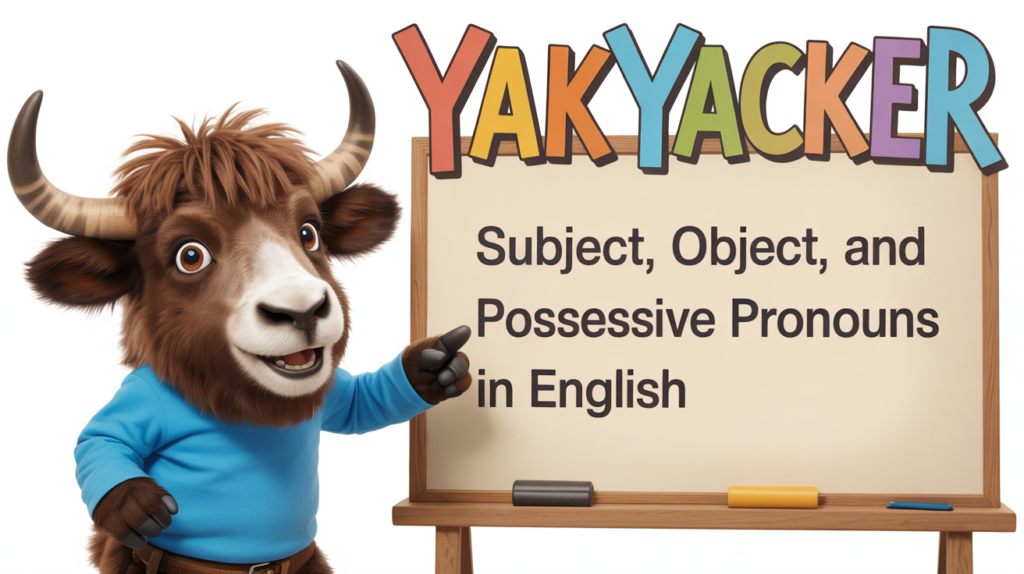
English Pronouns: Subject, Object, and Possessive
Stop guessing who did what to whom. Pronouns have jobs. Give them the right job.
Pronouns are tiny words with big responsibility. They replace nouns (people, things, ideas) so you do not repeat names all day. The tricky part is that English pronouns change form depending on where they appear in a sentence.
This guide gives you the complete, usable set: subject (the doer), object (the receiver), and possessive (the owner). Plus examples for each form, so your brain can finally relax.
“Me went to the store” is not a bold creative choice. It is just wrong. Use the right form and suddenly you sound fluent. Weird how that works.
They do the action. Think: “Who is doing it?”
Iyouhesheitwethey
They receive the action or come after a preposition (to, for, with, at).
meyouhimheritusthem
Possessive adjective goes before a noun. Possessive pronoun stands alone.
my / mineyour / yourstheir / theirs
Quick Pronoun Cards
Each card shows a full set, with example sentences for every form. Tap Hear to practice.
I / me / my / mine
First person singular
- Subject: I
- Object: me
- Possessive adjective: my
- Possessive pronoun: mine
- Reflexive: myself
- I work from home on Fridays.
- Please email me the details.
- That is my seat.
- This bag is mine.
- I taught myself to cook one good dish.
you / you / your / yours
Second person (singular or plural)
- Subject: you
- Object: you
- Possessive adjective: your
- Possessive pronoun: yours
- Reflexive: yourself / yourselves
- You look tired. Coffee?
- I can help you later.
- Is this your phone?
- This seat is yours.
- Please treat yourself kindly today.
he / him / his / his
Third person singular (male)
- Subject: he
- Object: him
- Possessive adjective: his
- Possessive pronoun: his
- Reflexive: himself
- He runs every morning.
- I saw him at the station.
- That is his jacket.
- The jacket is his.
- He fixed it himself.
she / her / her / hers
Third person singular (female)
- Subject: she
- Object: her
- Possessive adjective: her
- Possessive pronoun: hers
- Reflexive: herself
- She speaks three languages.
- I called her yesterday.
- This is her notebook.
- The notebook is hers.
- She made it herself.
it / it / its / its
Third person singular (thing, animal, idea)
- Subject: it
- Object: it
- Possessive adjective: its
- Possessive pronoun: its (rare)
- Reflexive: itself
- It is raining again.
- I found it under the sofa.
- The cat cleaned its paws.
- Possessive pronoun its is rare, so people often rewrite: The toy belongs to it.
- The robot shut itself down.
we / us / our / ours
First person plural
- Subject: we
- Object: us
- Possessive adjective: our
- Possessive pronoun: ours
- Reflexive: ourselves
- We are meeting at noon.
- Can you join us?
- This is our plan.
- The plan is ours.
- We surprised ourselves with how fast we finished.
they / them / their / theirs
Third person plural (also singular they)
- Subject: they
- Object: them
- Possessive adjective: their
- Possessive pronoun: theirs
- Reflexive: themselves
- They live nearby.
- I invited them to dinner.
- That is their decision.
- The decision is theirs.
- They (singular) said they would email later.
who / whom / whose
Question + relative pronouns
- Subject: who
- Object: whom (formal)
- Possessive: whose
- Who called you?
- Whom did you invite? (formal)
- Whose keys are these?
- That is the person who helped me.
- That is the person whom I met yesterday. (formal)
Table of Pronouns (Subject, Object, Possessive)
Use this as your quick reference. The example column includes sentences that match each form.
| Set | Subject | Object | Possessive adjective (before a noun) | Possessive pronoun (stands alone) | Reflexive | Examples |
|---|---|---|---|---|---|---|
| 1st person singular | I | me | my | mine | myself |
I am early. Please call me. My notebook is blue. The blue one is mine. I reminded myself to breathe. |
| 2nd person | you | you | your | yours | yourself / yourselves |
You are next. I trust you. Your idea is solid. The decision is yours. Please help yourself. |
| 3rd person singular (male) | he | him | his | his | himself |
He is busy. I messaged him. His phone is ringing. The phone is his. He did it himself. |
| 3rd person singular (female) | she | her | her | hers | herself |
She is here. I waited for her. Her coffee is iced. The iced one is hers. She cooked it herself. |
| 3rd person singular (thing) | it | it | its | its (rare) | itself |
It looks expensive. I found it outside. Its cover is torn. Possessive pronoun is rare, so rewrite: The cover belongs to it. The door closed itself. |
| 1st person plural | we | us | our | ours | ourselves |
We agree. They invited us. Our seats are near the front. The front row is ours. We challenged ourselves. |
| 3rd person plural | they | them | their | theirs | themselves |
They are ready. I emailed them. Their flight is delayed. The luggage is theirs. They blamed themselves. |
| Questions / relative | who | whom (formal) | whose (possessive) | — |
Who wrote this? Whom did you call? (formal) Whose jacket is this? That is the person who fixed it. That is the person whom I met. (formal) | |
Optional Variants and Common Traps
These show up a lot in real life. Handle them once, then move on with your day.
| Thing people mix up | Use this | Meaning | Examples |
|---|---|---|---|
| my vs mine | my + noun / mine alone | Possessive adjective vs possessive pronoun |
This is my seat. This seat is mine. That is my phone. The phone is mine. |
| their vs theirs | their + noun / theirs alone | Same pattern as my/mine |
Their plan is simple. The plan is theirs. I like their idea. The idea is theirs. |
| who vs whom | who (common) / whom (formal) | Subject vs object in questions |
Who is coming? (subject) Who did you invite? (common in speech) Whom did you invite? (formal) |
| singular they | they / them / their | Used for unknown person, or for someone who uses they/them |
Someone left their umbrella. Tell them I called. They said they will be late. |
| it is vs its | it is / its | Contraction vs possessive |
It is cold today. The dog wagged its tail. It is not my problem. The phone lost its signal. |
| Me and my friend | My friend and I / My friend and me | Subject needs subject form, object needs object form |
My friend and I went out. (subject) The coach praised my friend and me. (object) Please email my friend and me. (after a verb) |
If you say “This is mine book,” somewhere a grammar yak sheds one dramatic tear. Pick one: “my book” or “mine.”
Want a one-line cheat to remember this forever? Subject does it, object gets it, possessive owns it. Then practice out loud with the Hear buttons until your mouth stops arguing with your brain.