This A2 Elementary retelling of Rover's Picnic Adventure keeps the plot clear for learners while still giving the story some atmosphere and momentum. Mom, Dad, Emma, and Tom went to the park for a picnic. They found a nice place under a big tree.
This version is written for English-speaking learners and includes clickable word help inside the story, full story audio, and lesson notes after the reading. It is free to use on Yak Yacker and is designed to feel natural, readable, and manageable in English.
It was a sunny day. Mom, Dad, Emma, and Tom went to the park for a picnic. They took their dog, Rover.
They found a under a . Mom a red blanket on the grass. Dad put the food basket on the blanket. Rover sat and watched. He was hungry.
Mom said, "Don't give Rover human food." But Rover looked at Tom with big, sad eyes. Tom a small piece of bread. Rover . He was happy.
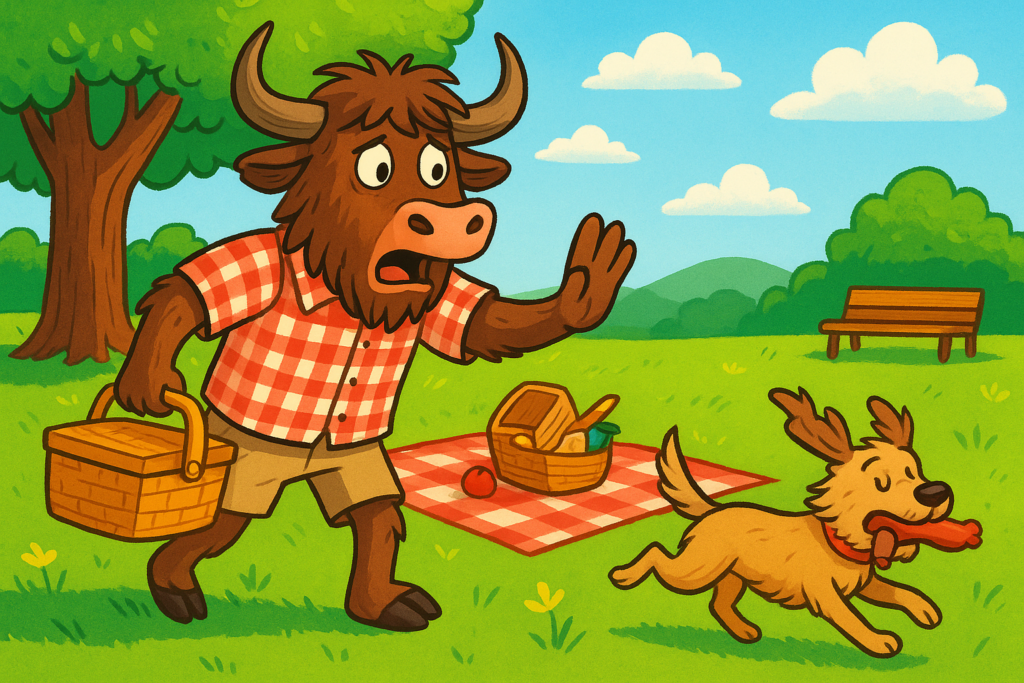
Dad the basket and took out some sausages. Rover them. He . "Rover, no!" shouted Dad. But Rover a sausage and ran away.
"Come back, Rover!" the children shouted. They him. Rover ran around the tree, behind a bench, and over a little hill. He was having a .
Then Rover . He ate the sausage. He walked back to the family with his . "Oh, Rover," said Mom. She tried not to laugh. Dad gave Rover a .
After that, everyone ate their picnic. Emma had a cheese sandwich. Tom had an apple. Mom and Dad had salad. Rover on the grass and .
Later, the children played with a ball. Rover and played, too. He ran and the ball. Everyone laughed. The sun was warm and the park was beautiful.
Soon it was time to go home. Rover was tired but very happy. The family walked home together. That night, Rover dreamed about his next picnic adventure.
The sun was shining. Mom, Dad, Emma, and Tom went to the park to eat outside. They brought their dog, Rover.
They found a good spot under a large tree. Mom put a red blanket on the grass. Dad placed the food basket on it. Rover sat watching because he was hungry.
Mom warned, 'Don't feed Rover people food.' But Rover stared at Tom with sad eyes. Tom gave him a little bread. Rover ate quickly and felt happy.
Dad opened the basket and got out sausages. Rover smelled them and jumped. Dad yelled, 'Rover, no!' But Rover took a sausage and ran.
The kids shouted, 'Come back!' and ran after him. Rover ran around the tree, behind a bench, and over a small hill. He was having fun.
Then Rover stopped. He ate the sausage and walked back with his tail down. Mom said, 'Oh, Rover,' and tried not to laugh. Dad gave him a dog treat.
Then everyone ate. Emma ate a cheese sandwich. Tom ate an apple. Mom and Dad had salad. Rover lay down and slept.
Later, the kids played ball. Rover woke up and joined in. He ran and caught the ball. Everyone laughed. The sun felt warm and the park looked nice.
Soon they had to leave. Rover was tired but happy. The family walked home. That night, Rover dreamed of his next picnic.
Picnics are full of tasty treats! In the story, you saw words like <em>bread</em>, <em>sausages</em>, <em>cheese sandwich</em>, <em>apple</em>, and <em>salad</em>. These are common picnic foods. Rover even got a <em>dog treat</em>.
You also found park items: a red <em>blanket</em>, a food <em>basket</em>, a <em>bench</em>, and a little <em>hill</em>. Remember, a <em>blanket</em> is what you sit on, and a <em>basket</em> carries the food.
- Bread / sausages / cheese sandwich / apple / salad - all yummy picnic foods!
- Blanket - a large piece of cloth for sitting on the grass.
- Basket - a container for carrying food and drinks.
- Dog treat - a special snack just for dogs.
The story uses the simple past tense to tell us what happened. Many verbs change their form. Regular verbs add <em>-ed</em>: <em>shouted</em>, <em>grabbed</em>, <em>chased</em>. But many common verbs are irregular.
Look at these irregular past forms from the story: <em>go → went</em>, <em>take → took</em>, <em>find → found</em>, <em>spread → spread</em> (no change!), <em>eat → ate</em>, <em>run → ran</em>, <em>give → gave</em>, <em>catch → caught</em>.
- Regular: play → played, shout → shouted, grab → grabbed
- Irregular: sit → sat, see → saw, have → had, say → said
- He ran around the tree. (run → ran)
- She spread the blanket on the grass. (spread → spread, same!)
When you tell a story, use words to show the order of events. The story used <em>first</em> (they found a nice place), <em>then</em> (Rover grabbed a sausage), <em>after that</em> (everyone ate), and <em>later</em> (the children played with a ball).
You can also use <em>finally</em> or <em>soon</em>. At the end, <em>soon it was time to go home</em>. These linkers make your story easy to follow.
- First, they spread the blanket.
- Then, Rover stole a sausage!
- After that, they ate lunch.
- Finally, they played with a ball and went home.
Can you tell a short story about a picnic? Use the past tense. Start with 'Last weekend, my family went to...' Remember the new food words and order words. What happened? Did you have a funny moment like Rover?
Try writing 3-4 sentences. For example: 'Last Sunday, we had a picnic in the garden. Mum made sandwiches. I ate an apple. Our cat tried to steal my sandwich!' Have fun with it.
Rover's Picnic Adventure comes from the American / public-domain screen or print culture tradition and is best known as a animated short film. This Yak Yacker article is an original learner retelling based on 1930 cartoon now public domain in U.S., so the wording here is simplified for modern learners rather than copied from one old edition.
Older printings, translations, and retellings of this story can vary quite a bit. The original audience was usually kids/general, but this version is adapted for A2 Elementary learners studying English. Only 1930 appearance; avoid later Pluto/Mickey branding.
If you want to look into the source tradition, start with Duke Center for the Study of the Public Domain.
If you want to keep going, browse more in our English section and review the A2 English Vocabulary List. After that, try 1,200 English Phrases and Expressions for another useful next step.