Orpheus, the greatest musician in Greek mythology, could make even trees and animals stop to listen. When his beloved wife Eurydice died, he decided to follow her to the underworld. His sad songs touched the cold heart of Hades, who agreed to let Eurydice return-on one condition. This classic love story of trust and loss has been retold for centuries, and now you can enjoy it in simple English at the A2 level.
In this interactive graded reader, you can click on any difficult word to see its definition instantly. Listen to the full story audio to practice your pronunciation and listening comprehension. After the story, check the lesson notes for key vocabulary, grammar structures, and helpful learning tips. Read for free, and discover how this ancient myth can help you build your English skills naturally.
Orpheus was a . He played the , a small harp. When he played, birds to listen. Trees and rocks .
Orpheus loved a called Eurydice. "You are my sunshine," he said. They got in a happy . Everyone danced and sang.
But soon after the wedding, something happened. Eurydice walked in a field and a snake her foot. She died. Orpheus . "I cannot live without her," he said.
Orpheus decided to go to the . He took his lyre. He walked into the . He came to a big river. The boatman, Charon, said, "Only dead people this river." Orpheus played his lyre. The music was so beautiful. Charon stopped. "Okay, you can cross," he said.
Then Orpheus saw a big dog with three heads. It was Cerberus, the . The dog , "Grrr!" Orpheus played his lyre. The music was . Cerberus lay down and went to sleep. Orpheus walked past.
Finally, Orpheus met Hades and Persephone, the king and queen of the dead. "Please, let me take Eurydice back," he . Then he sang a about love and death. Hades and Persephone had tears in their eyes. Persephone to Hades, "Let him try." Hades said, "You can take her, but there is one rule. She will walk behind you. You must not look back at her until you are both in the sunlight. If you look back, she will stay here forever." Orpheus agreed. "I will not look," he said.
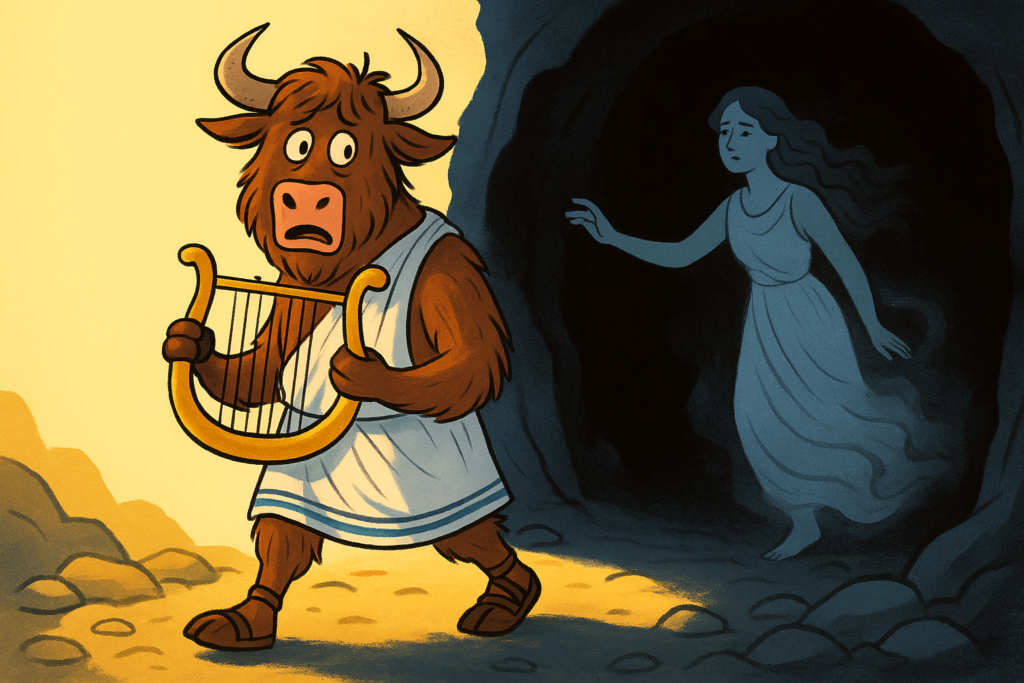
Orpheus started to walk back. Eurydice followed him. It was dark and quiet. He could not hear her . He wanted to so much. "Is she there?" he thought. But he remembered Hades' words: "Don't look back!" He walked and walked.
At last, Orpheus saw the . He stepped out into the sun. He was so happy! "We are safe, my love!" he cried. And he turned to look at her. But Eurydice was still in the dark. Just one more step… She was there for a second. Then she . "Goodbye, Orpheus," she whispered. And she was gone again.
Orpheus sat down and cried. He played his lyre. The music was full of and love. The whole world listened and felt his . Even today, people remember the story of Orpheus and his lost love.
This myth uses some beautiful vocabulary. Let's look at a few useful words so you can understand the story better and use them in your own English.
- wonderful: very good or amazing (e.g., "Orpheus was a wonderful musician.")
- ceremony: a special formal event like a wedding (e.g., "They got married in a happy ceremony.")
- whisper: to speak very quietly (e.g., "She whispered, 'Goodbye, Orpheus.'")
- fade away: to slowly disappear (e.g., "She faded away and was gone again.")
The whole story uses the past simple to narrate finished events. Many verbs are irregular, so learning their past forms is key.
- Regular verbs add -ed: play → played, walk → walked, stop → stopped.
- Irregular verbs change: see → saw, come → came, sing → sang, sit → sat, leave → left, bite → bit, go → went.
- Use the past simple for completed actions: "She died." "He played his lyre." "They got married."
The story also shows ability and states in the past. 'Could' means 'had the ability to' or 'it was possible to', while 'was' and 'were' describe situations.
- could / couldn't: "He could play the lyre beautifully." / "He couldn't hear her steps."
- was / were: "Orpheus was a musician." "They were in love."
- Combine them: "I could see the light. Eurydice was behind him. They were not safe yet."
Now you know the words and the past simple. Try retelling the myth in your own words. Use the new vocabulary and past tense verbs. You can even change the ending! Stories are a memorable way to practise grammar. Start with 'Orpheus was a wonderful musician…' and see where your English takes you.
Orpheus and Eurydice comes from the Greek / mythology tradition and is best known as a greek myth. This Yak Yacker article is an original learner retelling based on Ancient Greek myth; public domain, so the wording here is simplified for modern learners rather than copied from one old edition.
Older printings, translations, and retellings of this story can vary quite a bit. The original audience was usually general, but this version is adapted for A2 Elementary learners studying English. Sad romance; A2/B1 bridge.
If you want to look into the source tradition, start with Project Gutenberg.
If you want to keep going, browse more in our English section and review the A2 Vocabulary Builder. After that, try English Root Words and Prefixes for another useful next step.