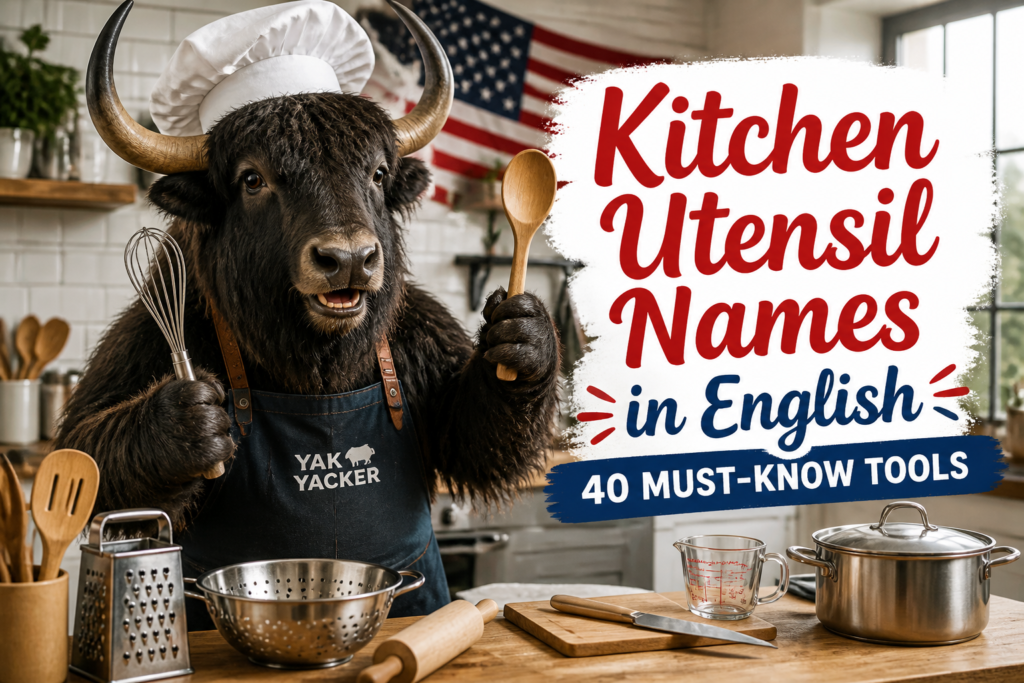
Cooking in English is full of tiny words that suddenly become very important when you are standing in a kitchen, hungry, and trying not to ask for “the round metal thingy.” That is not ideal vocabulary. Today you will learn 40 common kitchen utensil names in English, plus useful pronunciation help, meanings, and example sentences you can actually use.
For the broader learning path, visit our parent guide.
This guide focuses on the tools people use every day at home, in restaurants, and in cooking classes. If you know these words, you can follow recipes more easily, talk about kitchen jobs, and understand practical English without panic. Very modern. Very useful. Very fewer awkward hand gestures.
For extra practice later, you can also try the English Vocabulary Test or check your level with the English Placement Test CEFR.
Yak tip: In English, “utensils” is a general word, but many people also say “kitchen tools,” “cooking tools,” or just “things in the kitchen” when they are being vague on purpose.
Common Kitchen Utensils At A Glance
Here are 40 kitchen utensil names you will see again and again. The pronunciation is written in simple English, so you do not need to wrestle with IPA unless you want to.
| English | Pronunciation | Meaning | Example Sentence | Learner Note |
|---|---|---|---|---|
| spoon | spoon | A small tool for eating or stirring. | I need a spoon for my soup. | Very common in daily life. |
| fork | fork | A tool with points for eating food. | Can I have a fork, please? | Used at the table and in the kitchen. |
| knife | nyfe | A cutting tool with a blade. | Use a knife to cut the bread. | Sharp sound: /naɪf/. |
| plate | playt | A flat dish for serving food. | The salad is on a plate. | Common in homes and restaurants. |
| bowl | bohl | A round dish with deep sides. | Put the rice in a bowl. | Often used for soup, cereal, or salad. |
| cup | kup | A small container for drinks. | I drank two cups of tea. | Countable noun: one cup, two cups. |
| mug | mug | A large cup, often with a handle. | She likes a big mug of coffee. | More casual than “cup.” |
| glass | glas | A container made of glass for drinks. | Please bring me a glass of water. | Also means the material, so context matters. |
| plate rack | playt rak | A rack for holding plates. | Dry the plates on the plate rack. | Useful in kitchens with no dishwasher. |
| cutting board | KUT-ing bord | A board used for cutting food. | Chop the onions on the cutting board. | Also called a chopping board in British English. |
20 More Must-Know Kitchen Tools
| English | Pronunciation | Meaning | Example Sentence | Learner Note |
|---|---|---|---|---|
| spatula | SPACH-uh-luh | A tool used for flipping or mixing food. | Flip the pancakes with a spatula. | Very common in cooking. |
| ladle | LAY-dl | A large spoon for serving soup or sauce. | Use a ladle to serve the soup. | Big spoon, but not for cereal. |
| tongs | tongz | A tool for gripping and lifting food. | Grab the hot bread with tongs. | Plural form only in normal use. |
| whisk | wisk | A tool for beating eggs or mixing ingredients. | Whisk the eggs until they are smooth. | Useful for baking. |
| grater | GRAY-ter | A tool for shredding food into small pieces. | Grate the cheese with a grater. | Verb: grate. |
| peeler | PEE-ler | A tool for removing the skin from fruit or vegetables. | Use a peeler for the carrots. | Very handy for potatoes and apples. |
| can opener | kan OH-puh-ner | A tool for opening cans. | We need a can opener for the beans. | Sometimes written as one word in shops. |
| measuring cup | MEH-zhur-ing kup | A cup used to measure ingredients. | Add one cup of flour with a measuring cup. | Important in baking. |
| measuring spoon | MEH-zhur-ing spoon | A spoon used to measure small amounts. | Use a measuring spoon for the salt. | Usually sold in sets. |
| colander | KAH-lən-der | A bowl with holes for draining food. | Pour the pasta into a colander. | Common in American English. |
| sieve | siv | A tool with fine holes for separating small particles. | Sift the flour through a sieve. | More common in British English; also a noun and verb. |
| funnel | FUN-uhl | A tool shaped like a cone for pouring liquid. | Use a funnel to pour the sauce into the jar. | Stops spills. Very polite little object. |
| mixing bowl | MIKS-ing bohl | A bowl used for mixing ingredients. | Mix the batter in a large mixing bowl. | Common in cooking and baking. |
| rolling pin | ROH-ling pin | A tool used to flatten dough. | Roll the dough with a rolling pin. | Common in baking. |
| mortar and pestle | MOR-ter and PES-ul | A bowl and tool used to crush spices or herbs. | Crush the garlic in a mortar and pestle. | Traditional kitchen tool. |
| peel knife | peel nyfe | A small knife for peeling fruit and vegetables. | She used a peel knife to cut the apple skin. | Also called a paring knife in American English. |
| paring knife | PAIR-ing nyfe | A small knife for peeling and small cutting jobs. | A paring knife is useful for fruit. | Very common term in American English. |
| dish towel | dish towl | A towel used for drying dishes. | Dry the cups with a dish towel. | In British English, “tea towel” is common. |
| dish rack | dish rak | A rack for drying dishes. | Put the clean plates in the dish rack. | Useful if you wash dishes by hand. |
| oven mitt | UV-ən mit | A thick glove for protecting hands from heat. | Wear an oven mitt before touching the tray. | Also called an oven glove in British English. |
10 More Everyday Kitchen Words
| English | Pronunciation | Meaning | Example Sentence | Learner Note |
|---|---|---|---|---|
| tray | tray | A flat object for carrying or serving food. | Carry the drinks on a tray. | Used at home, cafes, and hospitals. |
| pan | pan | A metal container for cooking food on a stove. | Heat the oil in a pan. | Very general word. |
| frying pan | FRY-ing pan | A pan used for frying food. | Cook the eggs in a frying pan. | Also called a skillet in American English. |
| pot | pot | A deep container for cooking or storing food. | Boil the potatoes in a pot. | Common for soups and pasta. |
| saucepan | SAWS-pan | A deep pan with a long handle. | Warm the milk in a saucepan. | More common in British English. |
| lid | lid | A cover for a pot, pan, or container. | Put the lid on the pot. | Small word, big kitchen importance. |
| strainer | STRAY-ner | A tool used to separate liquid from solids. | Use a strainer for the pasta. | Similar to a sieve, but often larger. |
| table spoon | TAY-buhl spoon | A large spoon used for eating or measuring. | Add one tablespoon of sugar. | Often written as tablespoon in recipes. |
| teaspoon | TEE-spoon | A small spoon or a small measurement. | Add one teaspoon of vanilla. | Common in recipes. |
| knife block | nyfe blok | A holder for kitchen knives. | The knives are in the knife block. | Useful for storage and safety. |
Useful Kitchen Phrases
These phrases are especially useful when you are cooking, helping in the kitchen, or following a recipe. Many of them sound natural in everyday English.
| Phrase | Pronunciation | Meaning | Example Sentence | Learner Note |
|---|---|---|---|---|
| set the table | set thuh TAY-buhl | Put plates, forks, knives, and glasses on the table before eating. | Can you set the table for dinner? | Very common home phrase. |
| clear the table | kleer thuh TAY-buhl | Remove dishes and utensils after eating. | After lunch, please clear the table. | Used in homes and restaurants. |
| do the dishes | doo thuh DISH-iz | Wash the plates, cups, and utensils. | I’ll do the dishes tonight. | Very natural everyday English. |
| wash up | wosh up | Wash dishes or hands; in British English this often means wash the dishes. | We need to wash up after dinner. | More common in British English for dishes. |
| chop the vegetables | chop thuh VEJ-tuh-buhlz | Cut vegetables into smaller pieces. | Chop the vegetables for the soup. | Often used with a knife and cutting board. |
| stir the soup | stur thuh soop | Move the soup around with a spoon. | Stir the soup so it does not burn. | “Stir” is common with liquids and mixtures. |
| whisk the eggs | wisk thee egs | Beat eggs with a whisk. | Whisk the eggs before cooking them. | Common in breakfast recipes. |
| drain the pasta | drayn thuh PAS-tuh | Remove the water from cooked pasta. | Drain the pasta in a colander. | Very useful cooking verb. |
| grate the cheese | grayt thuh cheez | Make cheese into small pieces with a grater. | Grate the cheese on top of the pasta. | Common with cheese, carrots, and ginger. |
| measure the ingredients | MEH-zhur thee in-GREE-dee-ents | Check how much of each ingredient you need. | Measure the ingredients before baking. | Baking often needs careful measurement. |
| open a can | OH-pən uh kan | Take the lid off a can using a can opener. | Can you open a can of tomatoes? | Simple, practical, common. |
| use a peeler | yooz uh PEE-ler | Remove the skin from produce with a peeler. | Use a peeler for the potatoes. | “Peeler” is a tool, not a person here. |
Kitchen Utensil Words That Confuse Learners
Some kitchen words look simple, but they cause trouble because different countries use different terms. English enjoys doing this just to keep everyone humble.
| American English | British English | Meaning | Example | Note |
|---|---|---|---|---|
| cutting board | chopping board | A board for cutting food. | Put the onions on the cutting board. | Both are correct. |
| oven mitt | oven glove | A hand cover for hot dishes. | Use an oven mitt for the tray. | British English often uses “glove.” |
| frying pan / skillet | frying pan | A pan for frying food. | Cook the bacon in a frying pan. | “Skillet” is especially American. |
| spatula | spatula | A tool for flipping or scraping food. | Use a spatula to turn the pancake. | Meaning can vary a little by region. |
| colander | colander / sieve | A tool for draining liquid. | Drain the noodles in a colander. | “Sieve” is more common in British English. |
Quick Grammar And Usage Notes
Kitchen vocabulary often appears with articles, plural forms, and prepositions. Nothing scary. Just the usual little grammar gremlins.
- Use “a” or “an” for one item: a spoon, a fork, an oven mitt, a whisk.
- Use plural forms for more than one: two spoons, three knives, many plates.
- Some words are usually plural: tongs. You normally say “a tong” only in unusual contexts.
- Common prepositions: in a bowl, on a plate, with a knife, from a pot.
- Useful verb patterns: chop with, stir with, serve in, drain into, put on.
Practice Time
Try these quick exercises. Kitchens are great places for learning because everything has a job, unlike that one drawer full of random stuff nobody wants to admit exists.
- Fill in the blank: I need a ______ to flip the pancakes. (spatula)
- Fill in the blank: Please pass me a ______ for the soup. (ladle)
- Fill in the blank: We need a ______ to open this can. (can opener)
- Fill in the blank: Put the pasta in a ______ to drain it. (colander)
- Fill in the blank: Use a ______ to cut the bread. (knife)
- Choose the better word: “I stirred the soup with a fork / spoon.” (spoon)
- Choose the better word: “She used a whisk / plate to beat the eggs.” (whisk)
- Choose the better word: “He measured the flour with a measuring cup / dish towel.” (measuring cup)
- Swap the word: “pot” → say it in a sentence about soup.
- Swap the word: “peeler” → say it in a sentence about potatoes.
Common Mistakes And Fixes
- Mistake: “I need a spoon for cutting.” Fix: Use knife for cutting, spoon for eating or stirring.
- Mistake: “Put the pasta in a bowl to drain.” Fix: Use a colander or sieve to drain water.
- Mistake: “I used tongs to eat soup.” Fix: Tongs are for gripping food, not eating soup.
- Mistake: “Open the bottle with a can opener.” Fix: A can opener opens cans, not bottles.
- Mistake: “I need one scissors.” Fix: Say scissors for the tool, but it is not a kitchen utensil in most kitchens.
- Mistake: “The knife are on the table.” Fix: The knife is on the table. Singular subject, singular verb.
Memory Tips For Fast Learning
A few easy groups can help you remember the words faster:
- Eating tools: spoon, fork, knife, cup, mug, glass
- Cooking tools: spatula, ladle, whisk, tongs, grater, peeler
- Measuring tools: measuring cup, measuring spoon
- Cleaning tools: dish towel, dish rack, strainer, colander
- Baking tools: rolling pin, mixing bowl, sieve, funnel
If you learn the words in groups, your brain does less dramatic suffering. That is always a win.
Quick Reference Summary
- Everyday eating tools: spoon, fork, knife, plate, bowl, cup, mug, glass
- Common cooking tools: spatula, ladle, tongs, whisk, grater, peeler
- Useful kitchen containers: tray, pan, pot, saucepan, lid, mixing bowl
- Helpful prep tools: cutting board, rolling pin, can opener, measuring cup, measuring spoon
- Draining and straining tools: colander, sieve, strainer, funnel
- Important British vs American differences: chopping board vs cutting board, oven glove vs oven mitt, skillet vs frying pan
Kitchen English is practical English. Learn the common tools, use them in simple sentences, and suddenly recipes, cooking videos, and everyday conversation make a lot more sense. Yak takeaway: if you can name the spoon, the pan, and the colander, you are already doing better than half the kitchen drawer.