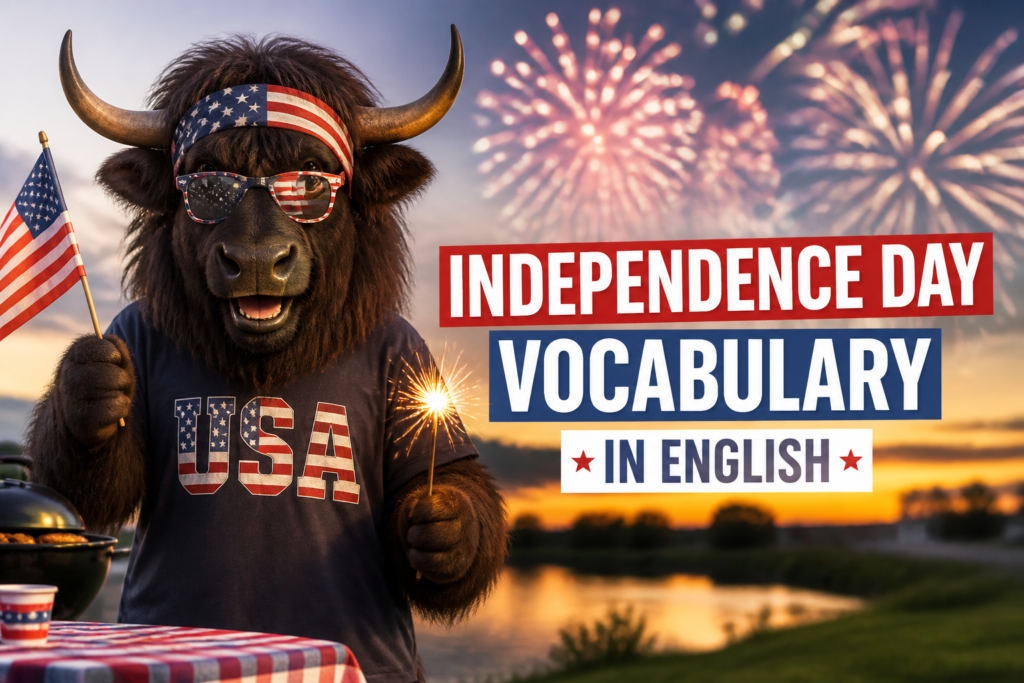
Independence Day is one of those topics where English gets loud, proud, and a little sparkly. Flags. Fireworks. Parades. Big speeches. And yes, a few words that show up every year like they own the place.
For the broader learning path, visit our parent guide.
This guide teaches practical Independence Day vocabulary in English so you can understand news, conversations, social posts, ceremonies, and celebrations. You will learn the most useful words, phrases, pronunciation help, and real example sentences. No dusty dictionary parade. Just the words people actually use.
In the United States, Independence Day is on July 4 and is often called the Fourth of July. Other countries celebrate their own independence days too, so some vocabulary here is useful globally. For a simple reference on levels and language goals, you can also check the English Placement Test CEFR and the English Vocabulary Test.
Core Independence Day Words
| English | Pronunciation | Meaning | Example Sentence | Learner Note |
|---|---|---|---|---|
| Independence Day | in-de-PEN-dens day | A holiday that celebrates a country becoming free | We celebrate Independence Day with fireworks and family gatherings. | Formal and common in news or history. |
| Fourth of July | forth uhv joo-LAI | The U.S. holiday on July 4 | The Fourth of July is a big summer holiday in the United States. | Very common American phrase. |
| independence | in-de-PEN-dens | Freedom from control by another country | The country gained independence after a long struggle. | Used in history, politics, and everyday speech. |
| freedom | FREE-dum | The state of being free | People often connect independence with freedom. | Very broad word. Also used for personal rights. |
| patriot | PAY-tree-ut | A person who loves and supports their country | Many patriots attend the parade every year. | Can sound serious or formal. |
| patriotic | pay-tree-OT-ik | Showing love for your country | Wearing red, white, and blue can feel patriotic. | Pronunciation stress is on the third syllable: o. |
| celebration | sel-uh-BRAY-shun | A happy event or activity for a special day | The city prepared a big celebration for the holiday. | Useful for many holidays, not just Independence Day. |
| commemoration | kuh-mem-uh-RAY-shun | An event that remembers an important person or event | The ceremony was a commemoration of the nation’s founding. | More formal than celebration. |
Useful Independence Day Phrases
| English Phrase | Pronunciation | Meaning | Example Sentence | Learner Note |
|---|---|---|---|---|
| Happy Fourth of July! | HAP-ee forth uhv joo-LAI | A greeting used on July 4 in the U.S. | Happy Fourth of July! Have fun at the barbecue. | Friendly and very common. |
| Happy Independence Day! | HAP-ee in-de-PEN-dens day | A greeting for an independence holiday | Happy Independence Day to everyone in the crowd. | Works for many countries, not just the U.S. |
| watch the fireworks | woch thuh FYR-wurks | Look at fireworks as they explode in the sky | We went to the river to watch the fireworks. | Very common holiday activity. |
| go to the parade | goh too thuh puh-RAYD | Attend a parade | Families go to the parade early to get a good seat. | Use go to, not go on, for most events. |
| have a barbecue | hav uh BAR-bee-kyoo | Eat grilled food outdoors | We usually have a barbecue on the Fourth of July. | In American English, barbecue can mean the event or the food. |
| fly the flag | flaai thuh flag | Display a flag outside or in a ceremony | Many families fly the flag in front of their house. | Common in formal and everyday contexts. |
| wear red, white, and blue | wair red, white, and bloo | Wear the colors of the U.S. flag | Kids often wear red, white, and blue to school. | Color words are usually lowercase unless part of a name. |
| celebrate with family and friends | SEL-uh-brayt with FAM-uh-lee and frendz | Spend time together for the holiday | People celebrate with family and friends all day long. | Warm, natural, and useful in many situations. |
| take a day off | tayk uh day off | Not go to work or school for one day | Many workers take a day off for Independence Day. | Useful for holiday plans. |
| honor the country’s history | ON-er thuh KUN-treez HIS-tuh-ree | Show respect for a country’s past | The ceremony honored the country’s history and leaders. | More formal, good for speeches or writing. |
More Word Power For Celebrations
| English | Pronunciation | Meaning | Example Sentence | Learner Note |
|---|---|---|---|---|
| parade | puh-RAYD | A public event with people, floats, music, or marching | The parade passed through downtown at noon. | Stress is on the second syllable. |
| fireworks | FYR-wurks | Explosive lights in the sky used for celebration | The fireworks started after dark. | Usually plural in English. |
| flag | flag | A piece of cloth that represents a country or group | The flag was hanging from the window. | Simple, high-frequency word. |
| ceremony | SER-uh-moh-nee | A formal event with special actions or words | The ceremony included a speech and a song. | Common in official celebrations. |
| speech | speech | A spoken message for an audience | The mayor gave a short speech. | Useful in formal events and politics. |
| anthem | AN-thum | A special song for a country or organization | The national anthem played before the fireworks. | Often in the phrase national anthem. |
| nation | NAY-shun | A country and its people | The nation celebrated together. | More formal than country. |
| nationhood | NAY-shun-hud | The state of being a nation | The speech discussed the country’s nationhood. | Formal and less common. |
| founding | FOWN-ding | The beginning or creation of a country or organization | The founding of the country is taught in school. | Often used in history. |
| liberty | LIB-er-tee | Freedom, especially in a legal or political sense | The statue stands for liberty and justice. | Formal, famous in patriotic language. |
Common Independence Day Expressions
- long weekend — a weekend with an extra day off. Example: Many people travel on the long weekend.
- holiday weekend — a weekend connected to a holiday. Example: Traffic gets heavy on holiday weekends.
- cookout — an outdoor meal, usually with grilled food. Example: We had a cookout with burgers and corn.
- picnic — a meal eaten outdoors. Example: The family brought sandwiches for a picnic in the park.
- gathering — a group of people meeting together. Example: It was a small gathering at my uncle’s house.
- public holiday — an official holiday when offices and schools may close. Example: It is a public holiday in many countries.
- day off work — a non-working day. Example: She took a day off work to spend time with her children.
- downtown — the center of a city. Example: The parade moves through downtown.
- crowd — a large group of people in one place. Example: The crowd cheered when the fireworks started.
- celebratory mood — a happy feeling for a special event. Example: The whole town was in a celebratory mood.
- national pride — strong positive feeling about one’s country. Example: The ceremony created a lot of national pride.
- re-enactment — a performance that copies a historical event. Example: The museum held a re-enactment of the founding event.
American English Vs British English
Most Independence Day vocabulary is the same in both varieties, but a few words can sound more American or more British.
| American English | British English | Note |
|---|---|---|
| fireworks | fireworks | Same word, same meaning. |
| barbecue / cookout | barbecue / BBQ | Cookout is especially common in American English. |
| vacation | holiday | Not specific to Independence Day, but useful for holiday plans. |
| holiday | bank holiday | In the UK, an official day off is often called a bank holiday. |
| Fourth of July | Not used | This is specifically American. |
Easy Pronunciation Notes
Some Independence Day words are easy to say, but a few like to be sneaky. Very rude of them.
- Independence = in-de-PEN-dens. Stress the third syllable.
- patriotic = pay-tree-OT-ik. Stress the OT sound.
- parade = puh-RAYD. Do not say PAR-ade.
- ceremony = SER-uh-moh-nee. The first syllable is strongest.
- fireworks = FYR-wurks. Many learners pronounce the middle too strongly; keep it smooth.
- liberty = LIB-er-tee. The first syllable gets the stress.
- celebration = sel-uh-BRAY-shun. Stress the middle part.
Yak wisdom: In English, stress matters. Say the right syllable loudly and the word suddenly stops looking like a puzzle.
Mini Practice
Try these quick exercises. Small practice beats big promises, as usual.
- Choose the best word: We went to the ______ to watch marching bands and floats. Answer: parade
- Choose the best word: The ______ lit up the sky at 9 p.m. Answer: fireworks
- Choose the best phrase: ______ to everyone celebrating today! Answer: Happy Fourth of July!
- Rewrite with a more natural phrase: We made food outside and ate together. → We had a barbecue.
- Fill in the blank: Many families ______ the flag on Independence Day. Answer: fly
- Fill in the blank: People often spend the holiday with family and ______. Answer: friends
Common Mistakes And Fixes
| Wrong | Better | Why |
|---|---|---|
| I go to the parade on July 4 night. | I go to the parade on the evening of July 4. | Night is possible, but evening sounds more natural for events before dark. |
| We celebrate with firework. | We celebrate with fireworks. | Fireworks is usually plural. |
| Happy Independence Day for you! | Happy Independence Day to you! | Use to after greetings. |
| We are making a barbecue. | We are having a barbecue. | Have a barbecue is the natural collocation. |
| The flag is flying in the house. | The flag is flying outside the house. | Flags are usually displayed outside. |
Quick Reference Summary
- Independence Day = a holiday celebrating freedom from another country
- Fourth of July = the U.S. Independence Day
- fireworks, parade, barbecue, flag = top celebration words
- patriotic, freedom, liberty = patriotic ideas
- Happy Fourth of July! = the most common greeting in the U.S.
- have a barbecue, watch fireworks, go to the parade = useful real-life phrases
If you want to keep building your holiday and celebration vocabulary, start with the words people say every year, then add the more formal ones for speeches and writing. That way, your English sounds natural instead of trying too hard, which English can sense from a mile away.
Yak takeaway: Learn the everyday words first—fireworks, parade, barbecue, flag, and Happy Fourth of July!—and you will understand most Independence Day conversations without breaking a sweat.