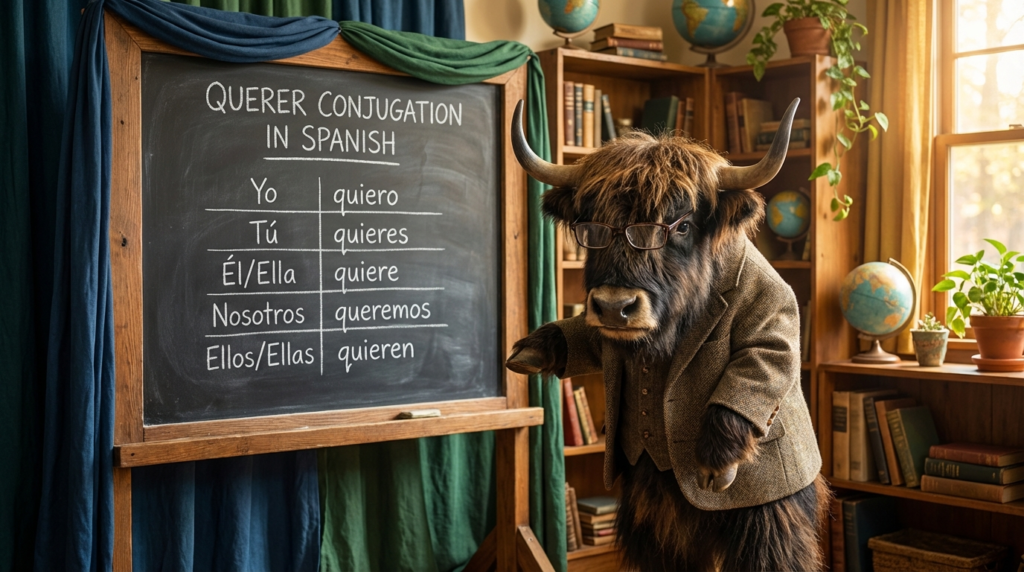
Querer Conjugation In Spanish
Learn how to use quiero, quise, quería, querría, quisiera, and te quiero without melting your brain over one tiny, wildly dramatic verb.
A Spanish teacher once joked that querer is the verb that starts with coffee and ends with feelings: quiero un café, te quiero, quisiera una mesa, no quise. Honestly, rude. One verb should not be allowed that much range.
The good news is that querer is much easier once you stop treating it like one giant chart and start seeing its patterns. In this guide, you will learn the most useful conjugations, the meanings that actually show up in real life, and the common traps that make beginners sound just a little off.
Yak Box: Learn These Four Jobs First
- querer + noun = to want something
Quiero un café. — I want a coffee. - querer + infinitive = to want to do something
Queremos salir temprano. — We want to leave early. - querer a + person/pet = to love / care about someone
Quiero mucho a mi abuela. — I love my grandmother very much. - querer que + subjunctive = to want someone to do something
Quiero que me llames. — I want you to call me.
What Querer Means In Spanish
1) To Want
English meaning: to want something
Example: Quiero más tiempo para terminar el proyecto.
I want more time to finish the project.
2) To Want To
English meaning: to want to do something
Example: ¿Quieres cenar aquí o en casa?
Do you want to have dinner here or at home?
3) To Love / Care About
English meaning: to love or care about a person or pet
Example: Quiero mucho a mis amigos.
I care about my friends a lot.
4) To Want Something To Happen
English meaning: to want someone else to do something
Example: Quiero que descanses hoy.
I want you to rest today.
The Main Pattern Behind Querer
Querer is irregular, but not in a random chaos-monster way. It repeats a few core changes. Learn those, and the verb gets much friendlier.
| Pattern | What Changes | English Meaning | Example |
|---|---|---|---|
| Present | e → ie except nosotros and vosotros | current wants / affection | quiero, quieres, quiere |
| Preterite | quis- | wanted / tried at a specific moment | quise, quisiste, quiso |
| Future | querr- | will want | querré, querrás, querrá |
| Conditional | querr- | would want / would like | querría, querrías |
| Present Subjunctive | e → ie except nosotros and vosotros | used after querer que | quiera, quieras, queramos |
| Imperfect Subjunctive | quis- | wanted / would like in softer structures | quisiera, quisiéramos |
| Gerund | queriendo | wanting | Estoy queriendo cambiar de trabajo. |
| Past Participle | querido | wanted / loved | Siempre te he querido. |
Querer Conjugation Charts
These are the forms beginners use the most. The vosotros forms are included for completeness, but in Mexico you will usually hear ustedes instead.
Present, Preterite, And Imperfect
| Subject | Present | Preterite | Imperfect |
|---|---|---|---|
| yo | quiero | quise | quería |
| tú | quieres | quisiste | querías |
| él / ella / usted | quiere | quiso | quería |
| nosotros / nosotras | queremos | quisimos | queríamos |
| vosotros / vosotras | queréis | quisisteis | queríais |
| ellos / ellas / ustedes | quieren | quisieron | querían |
Future, Conditional, And Present Subjunctive
| Subject | Future | Conditional | Present Subjunctive |
|---|---|---|---|
| yo | querré | querría | quiera |
| tú | querrás | querrías | quieras |
| él / ella / usted | querrá | querría | quiera |
| nosotros / nosotras | querremos | querríamos | queramos |
| vosotros / vosotras | querréis | querríais | queráis |
| ellos / ellas / ustedes | querrán | querrían | quieran |
Imperfect Subjunctive, Imperative, And Non-Finite Forms
| Form | Spanish | English Meaning | Example |
|---|---|---|---|
| Imperfect subjunctive (yo) | quisiera | would like / wanted | Quisiera una mesa para dos. — I would like a table for two. |
| Imperfect subjunctive (nosotros) | quisiéramos | would like | Quisiéramos pagar, por favor. — We would like to pay, please. |
| Affirmative command (tú) | quiere | want | Quiere lo mejor para ti. — Want the best for yourself. |
| Negative command (tú) | no quieras | don’t want | No quieras controlar todo. — Don’t want to control everything. |
| Gerund | queriendo | wanting | Estoy queriendo mudarme. — I’m wanting to move. |
| Past participle | querido | wanted / loved | Siempre te he querido. — I have always loved you. |
Tiny Regional Note
In everyday Mexican Spanish, use ustedes for “you all.” So instead of Spain’s ¿Queréis comer?, you will usually hear ¿Quieren comer?.
How To Use Querer In Real Life
Querer + Noun
English meaning: to want something
Rule: Use querer with a thing, object, plan, or result.
Example: Quiero un departamento más tranquilo.
I want a quieter apartment.
Example: No queremos más problemas.
We do not want more problems.
Querer + Infinitive
English meaning: to want to do something
Rule: If the same subject wants and does the action, use an infinitive after querer.
Example: Quiero aprender a cocinar comida mexicana.
I want to learn how to cook Mexican food.
Example: ¿Quieres salir después del trabajo?
Do you want to go out after work?
Querer A + Person Or Pet
English meaning: to love, care about, or be fond of someone
Rule: When the direct object is a person or a pet, use the personal a.
Example: Quiero mucho a mi perro.
I love my dog very much.
Example: Mi abuela quiere a todos en la familia.
My grandmother loves everyone in the family.
Useful note: Te quiero is a very common way to express affection. Te amo usually sounds stronger or more intense.
Querer Que + Subjunctive
English meaning: to want someone else to do something
Rule: If there is a change of subject, use que + subjunctive.
Example: Quiero que vengas conmigo.
I want you to come with me.
Example: Queremos que el equipo termine hoy.
We want the team to finish today.
Fast memory trick: Same subject? Use an infinitive. Different subject? Use que + subjunctive.
Quisiera, Querría, And Quería For Polite Requests
English meaning: would like
Rule: Spanish often softens requests with forms of querer. Quisiera is especially common and polite. Querría is also correct. Quería can sound like a soft opener, especially in conversation.
Example: Quisiera un café sin azúcar.
I would like a coffee without sugar.
Example: Querría hablar con la gerente.
I would like to speak with the manager.
Example: Hola, quería pedir una cita para mañana.
Hi, I wanted to ask for an appointment for tomorrow.
Quise Vs. Quería
This is one of the biggest beginner headaches, because both can translate as “wanted.” Very annoying. Very Spanish. Very fixable.
| Form | English Meaning | When To Use It | Example |
|---|---|---|---|
| quería | wanted / used to want | background, ongoing feeling, repeated past desire | Cuando vivía en Puebla, quería caminar al trabajo. When I lived in Puebla, I wanted to walk to work. |
| quise | wanted / tried | specific moment, completed intention, often “tried” in context | Quise abrir la puerta, pero estaba cerrada. I tried to open the door, but it was locked. |
Rule of thumb: use quería for a past state of wanting, and use quise for a specific moment or attempt. That simple shortcut will save you a lot of pain.
Useful Querer Phrases And Real-Life Sentences
- Quiero… — English meaning: I want…
Example: Quiero cambiar de celular este mes. — I want to change phones this month. - No quiero… — English meaning: I don’t want…
Example: No quiero discutir por mensaje. — I don’t want to argue by text. - ¿Qué quieres? — English meaning: What do you want?
Example: ¿Qué quieres para cenar? — What do you want for dinner? - ¿Quieres + infinitive? — English meaning: Do you want to…?
Example: ¿Quieres ver una película? — Do you want to watch a movie? - Te quiero. — English meaning: I love you / I care about you.
Example: Te quiero mucho, mamá. — I love you very much, Mom. - Quiero mucho a… — English meaning: I love / care a lot about…
Example: Quiero mucho a mis colegas. — I care a lot about my coworkers. - Quiero que… — English meaning: I want… to…
Example: Quiero que me digas la verdad. — I want you to tell me the truth. - Queremos que… — English meaning: We want… to…
Example: Queremos que ustedes lleguen temprano. — We want you all to arrive early. - Quisiera… — English meaning: I would like…
Example: Quisiera reservar una habitación. — I would like to book a room. - Querrías… — English meaning: Would you like…?
Example: ¿Querrías acompañarme al evento? — Would you like to go with me to the event? - Quería hablar contigo. — English meaning: I wanted to talk to you.
Example: Oye, quería hablar contigo sobre el viaje. — Hey, I wanted to talk to you about the trip. - Quise + infinitive — English meaning: I tried / I wanted to…
Example: Quise llamarte anoche, pero me quedé dormido. — I tried to call you last night, but I fell asleep. - Sin querer — English meaning: by accident / unintentionally
Example: Borré el archivo sin querer. — I deleted the file by accident. - No querer + infinitive — English meaning: not want to…
Example: No quiero salir hoy; estoy agotado. — I don’t want to go out today; I’m exhausted.
Common Mistakes And Fast Fixes
- Wrong: Yo quiero que vienes.
Right: Yo quiero que vengas.
After querer que, use the subjunctive. - Wrong: Nosotros quieremos salir.
Right: Nosotros queremos salir.
Nosotros does not get the e → ie stem change. - Wrong: Quiero mi hermana.
Right: Quiero a mi hermana.
Use the personal a with people and pets. - Wrong: thinking quise always means only “wanted”
Better: in many contexts it feels more like “tried”
Quise entrar, pero no pude. — I tried to go in, but I couldn’t. - Wrong: using vosotros in Mexican Spanish by default
Better: use ustedes
¿Ustedes quieren café? sounds natural in Mexico. - Wrong: treating te quiero as always weak or always romantic
Better: context decides
It can be romantic, family-based, or affectionate depending on who is speaking and to whom.
Practice Section
Try these before peeking at the answers. Be brave. Or at least fake it well.
- Complete the sentence: Yo ___ descansar este fin de semana.
- Complete the sentence: Mi mamá quiere que yo ___ más agua.
- Choose the better option: Cuando trabajaba de noche, (quise / quería) dormir más.
- Choose the better option: Ayer (quise / quería) llamarte, pero estaba en una junta.
- Translate into Spanish: “We want to leave early.”
- Translate into Spanish: “I would like a table for two.”
- Fix the mistake: Quiero que vienes conmigo.
- Fix the mistake: Queremos a salir temprano.
Answers
- quiero
- beba
- quería
- quise
- Queremos salir temprano.
- Quisiera una mesa para dos.
- Quiero que vengas conmigo.
- Queremos salir temprano.
Quick Reference Summary
| Structure | English Meaning | Example |
|---|---|---|
| querer + noun | to want something | Quiero otro café. |
| querer + infinitive | to want to do something | Queremos viajar en julio. |
| querer a + person/pet | to love / care about | Quiero a mi perro. |
| querer que + subjunctive | to want someone to do something | Quiero que estudies. |
| quisiera / querría | would like | Quisiera más información. |
| quería | wanted / used to want | Quería cambiar de trabajo. |
| quise | wanted / tried | Quise ayudarte. |
| sin querer | by accident | Lo dije sin querer. |
Final Yak
If you remember only five things, make them these: quiero has the present stem change, quise uses the quis- stem, querré / querría use the querr- stem, querer a shows affection for people and pets, and querer que needs the subjunctive. That is already enough to sound much more natural than the poor soul still guessing with yo quieremos.