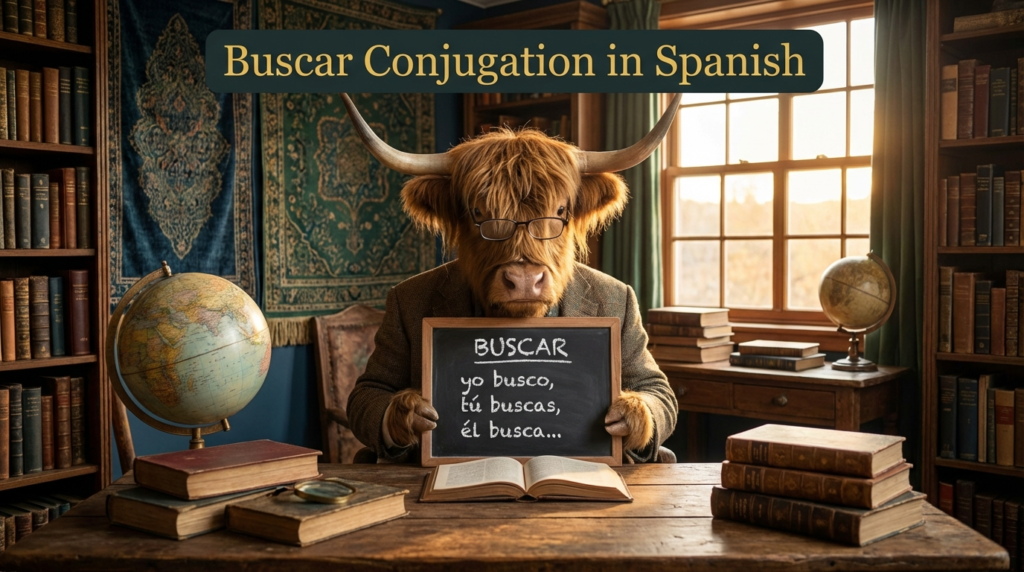
Buscar Conjugation in Spanish: Easy Charts, Real Examples, and Common Mistakes
Learn how to use buscar without the usual drama: clear charts, adult-life examples, and the tiny spelling change that loves to show off.
The first time I tried to say “I’m looking for my keys” in Spanish, I proudly said estoy buscando por mis llaves. A friend in Mexico gave me the kind smile reserved for people who are trying very hard and getting very creative. The fix was simple: just buscar, no por. Humbling? Yes. Useful? Extremely.
I once heard a teacher say that buscar is the verb of mildly annoying adult life: you look for your charger, your apartment keys, a better job, a pharmacy, a parking spot, and sometimes your will to answer emails. Fair. The good news is that buscar is mostly regular, so once you learn the main pattern and the sneaky c → qu spelling change, you can use it with a lot more confidence.
Quick Answer
- Buscar means to look for, to search for, and sometimes to go get / pick up.
- In Spanish, you usually say buscar + object, not buscar por.
- The big spelling change is c → qu before e: busqué, busque, busquemos, no busques.
- In Mexican Spanish, you will use ustedes for “you all.” The vosotros forms exist, but they are mostly for Spain.
What Buscar Means In Real Life
Buscar is one of those verbs that works a lot harder than people expect. It can mean “look for,” “search for,” “seek,” and in some contexts “go get” or “pick up.” That range makes it useful fast.
| Spanish Pattern | English Meaning | Example Sentence |
|---|---|---|
| buscar algo | to look for something | Busco mis llaves. = I’m looking for my keys. |
| buscar a alguien | to look for someone | Busco a mi abogada. = I’m looking for my lawyer. |
| ir a buscar | to go get / pick up | Voy a buscar a mi hijo. = I’m going to pick up my son. |
| se busca | wanted / help wanted / seeking | Se busca contador con experiencia. = Accountant wanted. |
Buscar Conjugation Cheat Sheet
busco
English: I look for / I am looking for
Example: Busco trabajo remoto. = I’m looking for remote work.
busqué
English: I looked for / I searched for
Example: Ayer busqué estacionamiento por media hora. = Yesterday I looked for parking for half an hour.
buscaba
English: I was looking for / I used to look for
Example: Cuando me mudé, buscaba un departamento tranquilo. = When I moved, I was looking for a quiet apartment.
buscaré
English: I will look for
Example: Mañana buscaré al técnico. = Tomorrow I’ll look for the technician.
busque
English: that I look for / you look for / formal command “look for”
Example: Busco un cargador que funcione. = I’m looking for a charger that works.
busca / no busques
English: look for / don’t look for
Example: Busca la factura en tu correo, pero no busques en spam todavía. = Look for the invoice in your email, but don’t look in spam yet.
Full Buscar Conjugation Table
Here is the compact version first. I’m including vosotros for completeness, but for Mexican Spanish you can safely focus on ustedes. Your brain has enough going on already.
| Pronoun | Present | Preterite | Imperfect | Future | Conditional |
|---|---|---|---|---|---|
| yo | busco | busqué | buscaba | buscaré | buscaría |
| tú | buscas | buscaste | buscabas | buscarás | buscarías |
| él / ella / usted | busca | buscó | buscaba | buscará | buscaría |
| nosotros / nosotras | buscamos | buscamos | buscábamos | buscaremos | buscaríamos |
| vosotros / vosotras | buscáis | buscasteis | buscabais | buscaréis | buscaríais |
| ellos / ellas / ustedes | buscan | buscaron | buscaban | buscarán | buscarían |
Subjunctive, Commands, And Non-Finite Forms
| Pronoun | Present Subjunctive | Affirmative Command | Negative Command |
|---|---|---|---|
| yo | busque | — | — |
| tú | busques | busca | no busques |
| él / ella / usted | busque | busque | no busque |
| nosotros / nosotras | busquemos | busquemos | no busquemos |
| vosotros / vosotras | busquéis | buscad | no busquéis |
| ellos / ellas / ustedes | busquen | busquen | no busquen |
| Form | English Meaning | Example Sentence |
|---|---|---|
| buscando (gerund) | looking for / searching | Estoy buscando una farmacia. = I’m looking for a pharmacy. |
| buscado (past participle) | looked for / searched for | He buscado mis lentes por toda la casa. = I’ve looked for my glasses all over the house. |
| voy a buscar | am going to look for / go get | Voy a buscar a los niños a las tres. = I’m going to pick up the kids at three. |
| se busca | wanted / seeking | Se busca plomero urgente. = Plumber wanted urgently. |
| buscara / buscase | past subjunctive | Quería que buscara otro proveedor. = I wanted him to look for another supplier. |
Why The Spelling Changes: c → qu
Buscar is regular most of the time. The only real drama is spelling. When the c would come before e, it changes to qu so the hard k sound stays the same. That is why you get busqué, not buscé. Spanish likes consistency. Honestly, fair enough.
| Pattern | What Happens | Why | Example |
|---|---|---|---|
| busc + o | No change | The c already sounds right before o. | Busco trabajo. = I’m looking for work. |
| busc + é | c → qu | Spanish keeps the hard k sound before e. | Busqué mis documentos. = I looked for my documents. |
| busc + e | c → qu | Same sound rule in the subjunctive and some commands. | Espero que busques una mejor opción. = I hope you look for a better option. |
When To Use Each Form
| Form | Main Use | Example |
|---|---|---|
| Present: busco, buscas | What you look for now, generally, or regularly | Busco un cajero cercano. = I’m looking for a nearby ATM. |
| Preterite: busqué | A completed search in the past | Ayer busqué mi pasaporte. = Yesterday I looked for my passport. |
| Imperfect: buscaba | An ongoing or repeated search in the past | Buscaba trabajo cuando me llamaste. = I was looking for work when you called me. |
| Future: buscaré | What you will look for later | Mañana buscaré otro vuelo. = Tomorrow I’ll look for another flight. |
| Conditional: buscaría | What you would look for under certain conditions | Yo buscaría un hotel más tranquilo. = I would look for a quieter hotel. |
| Present subjunctive: busque, busques | Wishes, doubt, recommendations, and unknown things | Busco un departamento que tenga balcón. = I’m looking for an apartment that has a balcony. |
| Commands: busca, busque, no busques | Telling someone to look for something | Busca el contrato. = Look for the contract. |
| Progressive: estoy buscando | What is happening right now | Estoy buscando un taxi. = I’m looking for a taxi right now. |
| Perfect: he buscado | Something you have already looked for | He buscado esa respuesta mil veces. = I’ve looked for that answer a thousand times. |
Useful Phrases And Real-Life Sentences
- Busco una farmacia abierta. = I’m looking for an open pharmacy.
- ¿Buscas trabajo remoto o híbrido? = Are you looking for remote or hybrid work?
- Busco a la doctora Ramírez. = I’m looking for Dr. Ramírez.
- Estamos buscando un departamento más tranquilo. = We’re looking for a quieter apartment.
- Ayer busqué estacionamiento cerca de la oficina. = Yesterday I looked for parking near the office.
- Buscábamos un proveedor más confiable. = We were looking for a more reliable supplier.
- Mañana buscaré otro vuelo. = Tomorrow I’ll look for another flight.
- Yo buscaría una opción más barata. = I would look for a cheaper option.
- Busco un cargador que funcione. = I’m looking for a charger that works.
- No busques mis recibos en ese cajón. = Don’t look for my receipts in that drawer.
- Voy a buscar a mi hijo a la escuela. = I’m going to pick up my son at school.
- He buscado mis lentes por toda la casa. = I’ve looked for my glasses all over the house.
- Se busca recepcionista con experiencia. = Receptionist wanted.
- Busquen la factura en su correo. = Look for the invoice in your email.
Common Mistakes And Fast Fixes
- Saying buscar por
Use buscar by itself.
Busco trabajo. = I’m looking for work.
Not: Busco por trabajo. - Forgetting the personal a with a specific person or pet
Busco a mi hermano. = I’m looking for my brother.
Busco mis llaves. = I’m looking for my keys. - Confusing buscar with encontrar
Buscar = to look for.
Encontrar = to find.
Busco mis lentes, pero no los encuentro. = I’m looking for my glasses, but I can’t find them. - Missing the spelling change
Write busqué, not buscé.
Write busque, not busce. - Using progressive forms for everything
Busco trabajo often sounds more natural than Estoy buscando trabajo when you mean it generally, not just this exact second.
Practice Section
- Change to the preterite: Yo busco un taxi.
- Change to the future: Nosotros buscamos otra opción.
- Make it negative command for tú: Busca mis documentos.
- Add the personal a if needed: Busco ___ mi perro.
- Complete with the subjunctive: Busco un departamento que ___ (tener) balcón.
- Translate: “I’m going to pick up my daughter at school.”
Check Your Answers
- Yo busqué un taxi.
- Nosotros buscaremos otra opción.
- No busques mis documentos.
- Busco a mi perro.
- Busco un departamento que tenga balcón.
- Voy a buscar a mi hija a la escuela.
Quick Reference Summary
- buscar = to look for / to search for
- No por after buscar
- Use personal a with a specific person or pet: Busco a Ana
- Main spelling change: c → qu before e
- Key forms: busco, busqué, buscaba, buscaré, buscaría, busque, busca, no busques, buscando, buscado
- In Mexico, focus on ustedes rather than vosotros
Final Yak
Buscar is not a monster verb. It is mostly regular, wildly useful, and just a little dramatic with its qu. Learn the core forms, stop adding por, remember the personal a, and suddenly you can talk about jobs, apartments, doctors, chargers, receipts, and missing keys like a functioning adult. Or at least like a functioning adult who is still looking for the keys.