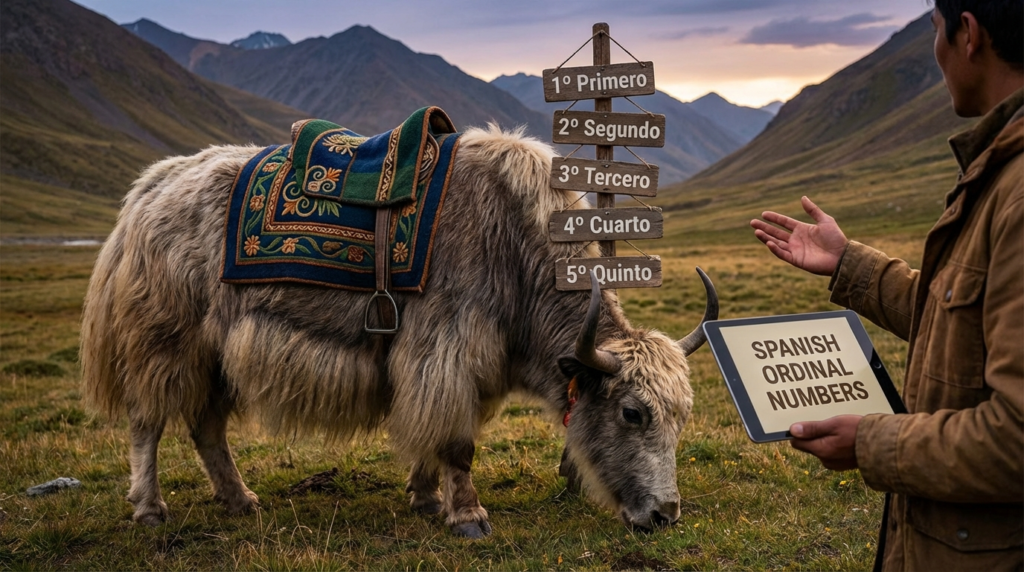
Spanish Ordinal Numbers For Beginners
Learn first, second, third, and the rest without memorizing a weird grammar jungle you will barely use.
The first time I checked into a small hotel in Mexico City, I understood every number right up until the receptionist smiled and said, “Su habitación está en el tercer piso.” I knew tres. I did not know tercer. So I nodded with false confidence, walked toward the wrong elevator, and immediately learned that knowing numbers is not the same as knowing the order of things. Spanish loves that distinction. Very rude. Very useful.
That is exactly what Spanish ordinal numbers do: they tell you the position of something in a series. In this guide, you will learn the forms you will actually hear, the rules that matter, the mistakes beginners make, and the real-life phrases that show up in offices, apartments, meetings, contracts, and everyday conversation.
Yak Box: The Quick Truth
- You really need 1st to 10th first. Those are the workhorses.
- Spanish ordinal numbers usually go before the noun: la segunda reunión.
- They must match the noun in gender and number: primer pago, primera llamada, primeros días.
- After 10th, everyday Spanish often switches to a cardinal number: el piso veinte instead of el vigésimo piso.
Spanish Ordinal Numbers 1 To 10
These are the forms you will actually use the most. Learn them well, because higher ordinal numbers exist, but everyday Spanish gets a lot less enthusiastic about using them.
| Spanish | English Meaning | Example In Spanish | English Translation |
|---|---|---|---|
| primero / primer | first | Hoy es mi primer día en la oficina. | Today is my first day at the office. |
| segundo | second | Vivo en el segundo piso. | I live on the second floor. |
| tercero / tercer | third | Esta es tu tercera opción. | This is your third option. |
| cuarto | fourth | La reunión es en el cuarto salón. | The meeting is in the fourth room. |
| quinto | fifth | Es la quinta vez que cambian la fecha. | It is the fifth time they have changed the date. |
| sexto | sixth | Estamos en el sexto mes del proyecto. | We are in the sixth month of the project. |
| séptimo | seventh | Su oficina está en el séptimo edificio. | His office is in the seventh building. |
| octavo | eighth | Revisa la octava cláusula del contrato. | Check the eighth clause of the contract. |
| noveno | ninth | Vamos por el noveno capítulo del curso. | We are on the ninth chapter of the course. |
| décimo | tenth | Celebran su décimo aniversario este año. | They are celebrating their tenth anniversary this year. |
How Spanish Ordinal Numbers Behave
Spanish ordinal numbers act like adjectives, so they agree with the noun they describe. That means the ending changes depending on whether the noun is masculine, feminine, singular, or plural. Yes, the number has homework too.
| Pattern | Meaning | Example |
|---|---|---|
| el primer pago | masculine singular | Mi primer pago llega el viernes. — My first payment arrives on Friday. |
| la primera reunión | feminine singular | La primera reunión empieza a las nueve. — The first meeting starts at nine. |
| los primeros días | masculine plural | Los primeros días fueron intensos. — The first days were intense. |
| las primeras semanas | feminine plural | Las primeras semanas pasan rápido. — The first weeks go by fast. |
Usual Position
Most of the time, the ordinal comes before the noun.
- la segunda cita — the second date / appointment
- el tercer intento — the third attempt
- la cuarta llamada — the fourth call
Real-Life Usage
After tenth, everyday Spanish often prefers a cardinal number after the noun.
- el piso veinte — the twentieth floor
- el capítulo once — the eleventh chapter
- la página treinta — the thirtieth page
The Two Changes That Trip Beginners Up
Primero And Tercero Get Shorter
Before a singular masculine noun, primero becomes primer and tercero becomes tercer.
- primer piso — first floor — La oficina está en el primer piso.
- primer pago — first payment — Mi primer pago vence mañana.
- tercer intento — third attempt — Fue mi tercer intento hoy.
- tercer día — third day — Hoy es el tercer día del evento.
But when the noun is feminine, keep the full form: primera llamada, tercera semana.
How The Abbreviations Work
You will often see ordinal numbers written with a numeral plus a small letter. These are common in dates, lists, titles, contests, and formal writing.
| Form | English Meaning | Example |
|---|---|---|
| 1.º | first, masculine | el 1.º premio — the first prize |
| 1.er | first, shortened before masculine noun | el 1.er día — the first day |
| 1.ª | first, feminine | la 1.ª vez — the first time |
| 3.er | third, shortened before masculine noun | el 3.er piso — the third floor |
After Tenth: What You Need To Recognize
You do not need to use high ordinal numbers all day long to sound natural. You mostly need to recognize them, especially in writing, formal speech, titles, anniversaries, and rankings.
The two most important extra forms are these: undécimo or decimoprimero for eleventh, and duodécimo or decimosegundo for twelfth. Both pairs are correct. In normal life, many speakers still prefer a cardinal after the noun: capítulo once, piso doce.
| Spanish | English Meaning | Example |
|---|---|---|
| undécimo / decimoprimero | eleventh | El undécimo capítulo es corto. — The eleventh chapter is short. |
| duodécimo / decimosegundo | twelfth | Es su duodécimo aniversario. — It is their twelfth anniversary. |
| decimotercero | thirteenth | El decimotercer piso está cerrado. — The thirteenth floor is closed. |
| vigésimo | twentieth | Celebran el vigésimo aniversario de la empresa. — They are celebrating the company’s twentieth anniversary. |
| vigésimo primero / vigesimoprimero | twenty-first | Hoy es mi vigésimo primer día aquí. — Today is my twenty-first day here. |
| trigésimo primero | thirty-first | Terminó en el trigésimo primer lugar. — He finished in thirty-first place. |
| centésimo | hundredth | Esa fue la centésima llamada de la semana. — That was the hundredth call of the week. |
One more useful warning: onceavo and doceavo are usually fractional forms, not ordinal ones. So for “eleventh floor,” go with undécimo piso or, more naturally in everyday speech, piso once.
Useful Real-Life Phrases
These are the kinds of chunks you can actually steal for real conversation. Much better than staring at a 1-to-100 list and pretending that helped.
primer pago — first payment
Mi primer pago llega el viernes.
segunda cita — second date / appointment
Tuvimos una segunda cita el sábado.
tercer piso — third floor
La oficina está en el tercer piso.
cuarta llamada — fourth call
No contestó la cuarta llamada.
quinta vez — fifth time
Es la quinta vez que me piden ese documento.
sexto mes — sixth month
Ya estamos en el sexto mes del proyecto.
séptimo asiento — seventh seat
Su boleto es para el séptimo asiento.
octava cláusula — eighth clause
La octava cláusula habla de pagos.
noveno capítulo — ninth chapter
El noveno capítulo resume todo.
décimo aniversario — tenth anniversary
Celebran su décimo aniversario en julio.
A Tiny Date Note That Matters
In Mexico and much of Latin America, the first day of the month is usually expressed with primero: primero de mayo, primero de enero. After that, dates normally use cardinal numbers: dos de mayo, quince de enero.
Common Mistakes And Fast Fixes
- primero piso ❌ → primer piso ✅
Use the short form before a singular masculine noun. - tercero intento ❌ → tercer intento ✅
Same rule. Spanish is consistent here, which is suspicious but helpful. - la segundo reunión ❌ → la segunda reunión ✅
The ordinal has to match the feminine noun. - el onceavo piso ❌ → el undécimo piso ✅
Or, in everyday speech, just say el piso once. - el vigésimo piso everywhere, every time ❌ → sometimes el piso veinte ✅
Formal ordinals exist, but everyday Spanish often prefers the simpler version after tenth.
Practice Section
Try these before peeking at the answers. Your brain deserves at least one honest attempt.
- Translate: my first payment
- Translate: the third floor
- Fix the mistake: la segundo reunión
- Translate: the first of June
- Choose the more natural everyday Spanish option: the twentieth floor
- Fix the mistake: el onceavo capítulo
Answer Key
- mi primer pago
- el tercer piso
- la segunda reunión
- el primero de junio
- el piso veinte is usually more natural in everyday speech. El vigésimo piso is possible, but more formal.
- el undécimo capítulo or, more naturally in many everyday contexts, el capítulo once
Quick Reference Summary
- primero, segundo, tercero, cuarto, quinto, sexto, séptimo, octavo, noveno, décimo are your core forms.
- Ordinal numbers usually come before the noun: la tercera llamada.
- They must agree in gender and number: primer pago, primera cita, primeros pasos.
- primero → primer and tercero → tercer before singular masculine nouns.
- After 10th, everyday Spanish often uses cardinals after the noun: piso once, capítulo veinte.
- undécimo / decimoprimero and duodécimo / decimosegundo are both correct.
- For dates in Mexico and much of Latin America, use primero only for the first day: primero de abril.
Final Yak
If you remember nothing else, remember this: learn first to tenth well, master primer and tercer, and do not panic about giant formal ordinals yet. Real Spanish does not expect you to walk around saying vigesimoprimero every five minutes. Start with the forms you will actually use, and your Spanish will sound clearer, faster, and much more natural.