Simplified Chinese 的 (de): Easy Possession And Description Guide For Beginners
Learn how 的 (de) links people, things, and descriptions in real Mandarin without turning your brain into soup.
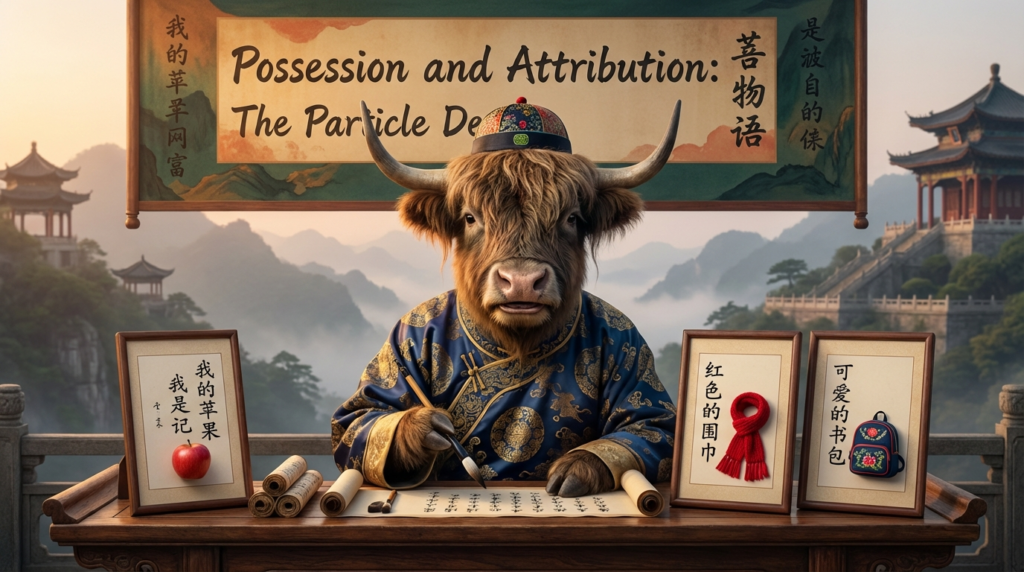
Today’s tiny hero is 的 (de). It shows possession, like “my book,” and attribution, like “a red car” or “an interesting movie.” Small particle, huge workload. Very on-brand for Chinese grammar.
If you can use 的 (de) well, your Chinese immediately sounds more natural. You can say who something belongs to, describe nouns more clearly, and build longer phrases without guessing wildly.
The good news: the core idea is simple. Put 的 (de) between a word that describes or owns something and the noun that follows. That is the engine. Everything else is just practice and pattern recognition.
Yak Snark Box
English uses apostrophes, word order, and random vibes. Chinese often just uses 的 (de) and gets on with it. Honestly, efficient behavior.
What 的 (de) Actually Does
的 (de) connects two parts of a phrase. The first part gives information about the second part.
- Possession: 谁的东西 — shéi de dōngxi — whose thing / who owns it
- Description: 什么样的东西 — shénme yàng de dōngxi — what kind of thing
- Attribution: a noun gets linked to a quality, person, place, or phrase that defines it
| Pattern | Meaning | Example | Pinyin | English |
|---|---|---|---|---|
| A + 的 (de) + B | A is linked to B | 我的书 | wǒ de shū | my book |
| A + 的 (de) + B | A describes B | 红色的车 | hóngsè de chē | red car |
| A + 的 (de) + B | A identifies B | 中国的菜 | Zhōngguó de cài | Chinese food |
Rule One: 的 (de) For Possession
Use 的 (de) to show that something belongs to someone or is related to someone.
我的书
wǒ de shū
my book
这是我的书。
Zhè shì wǒ de shū.
This is my book.
他的朋友
tā de péngyou
his friend
他的是我的朋友。
Tā de shì wǒ de péngyou.
His is my friend.
More natural full phrase: 他是我的朋友。
Tā shì wǒ de péngyou.
He is my friend.
老师的电脑
lǎoshī de diànnǎo
the teacher’s computer
老师的电脑很新。
Lǎoshī de diànnǎo hěn xīn.
The teacher’s computer is very new.
Common possession words with 的 (de):
| Hanzi | Pinyin | Meaning | Example (ZH) | Example (Pinyin) | Translation (EN) |
|---|---|---|---|---|---|
| 我的 | wǒ de | my / mine | 我的手机在这里。 | Wǒ de shǒujī zài zhèlǐ. | My phone is here. |
| 你的 | nǐ de | your / yours | 这是你的咖啡吗? | Zhè shì nǐ de kāfēi ma? | Is this your coffee? |
| 他的 | tā de | his | 他的中文很好。 | Tā de Zhōngwén hěn hǎo. | His Chinese is very good. |
| 她的 | tā de | her | 她的包很漂亮。 | Tā de bāo hěn piàoliang. | Her bag is very pretty. |
| 我们的 | wǒmen de | our / ours | 我们的老师很有意思。 | Wǒmen de lǎoshī hěn yǒu yìsi. | Our teacher is very interesting. |
| 他们的 | tāmen de | their / theirs | 他们的猫很可爱。 | Tāmen de māo hěn kě’ài. | Their cat is very cute. |
Rule Two: 的 (de) For Attribution And Description
Use 的 (de) after adjectives, noun phrases, places, or short clauses to describe a noun.
- 红色的车 — hóngsè de chē — red car
- 便宜的衣服 — piányi de yīfu — cheap clothes
- 北京的冬天 — Běijīng de dōngtiān — Beijing winter
- 我喜欢的电影 — wǒ xǐhuan de diànyǐng — the movie that I like
红色的车
hóngsè de chē
red car
我想买红色的车。
Wǒ xiǎng mǎi hóngsè de chē.
I want to buy a red car.
中国的菜
Zhōngguó de cài
Chinese food / food from China
我很喜欢中国的菜。
Wǒ hěn xǐhuan Zhōngguó de cài.
I really like Chinese food.
我喜欢的电影
wǒ xǐhuan de diànyǐng
the movie that I like
这是我喜欢的电影。
Zhè shì wǒ xǐhuan de diànyǐng.
This is a movie that I like.
Useful Description Patterns
| Pattern | Meaning | Example (ZH) | Example (Pinyin) | Translation (EN) |
|---|---|---|---|---|
| Adjective + 的 (de) + Noun | describes quality | 漂亮的房子 | piàoliang de fángzi | beautiful house |
| Noun + 的 (de) + Noun | shows category or relation | 学校的老师 | xuéxiào de lǎoshī | the school’s teacher / teacher at the school |
| Place + 的 (de) + Noun | shows origin or location | 上海的咖啡店 | Shànghǎi de kāfēidiàn | a café in Shanghai |
| Clause + 的 (de) + Noun | modifies with more detail | 昨天买的书 | zuótiān mǎi de shū | the book bought yesterday |
Rule Three: When 的 (de) Is Often Dropped
Beginners usually learn 的 (de) first and drop it later. That is normal. Native speakers sometimes leave it out, especially with close relationships or very common combinations.
- 我妈妈 — wǒ māma — my mom
- 我爸爸 — wǒ bàba — my dad
- 我朋友 — wǒ péngyou — my friend
- 我老师 — wǒ lǎoshī — my teacher
These can also appear with 的 (de), but dropping it often sounds more natural in everyday speech when the relationship is close and obvious.
我妈妈很忙。
Wǒ māma hěn máng.
My mom is very busy.我的妈妈很忙。
Wǒ de māma hěn máng.
My mom is very busy.Both work. The version without 的 (de) is often more conversational.
Core Patterns You Will Use All The Time
| Hanzi | Pinyin | Meaning | Example (ZH) | Example (Pinyin) | Translation (EN) |
|---|---|---|---|---|---|
| 我的名字 | wǒ de míngzi | my name | 我的名字很简单。 | Wǒ de míngzi hěn jiǎndān. | My name is simple. |
| 你的问题 | nǐ de wèntí | your question | 你的问题很好。 | Nǐ de wèntí hěn hǎo. | Your question is very good. |
| 老师的办公室 | lǎoshī de bàngōngshì | the teacher’s office | 老师的办公室在二楼。 | Lǎoshī de bàngōngshì zài èr lóu. | The teacher’s office is on the second floor. |
| 好喝的茶 | hǎohē de chá | tasty tea | 这是很好喝的茶。 | Zhè shì hěn hǎohē de chá. | This is very tasty tea. |
| 便宜的东西 | piányi de dōngxi | cheap thing / cheap stuff | 我喜欢买便宜的东西。 | Wǒ xǐhuan mǎi piányi de dōngxi. | I like buying cheap things. |
| 新的工作 | xīn de gōngzuò | new job | 她找到新的工作了。 | Tā zhǎodào xīn de gōngzuò le. | She found a new job. |
| 北京的天气 | Běijīng de tiānqì | Beijing weather | 北京的天气很干。 | Běijīng de tiānqì hěn gān. | Beijing’s weather is dry. |
| 我买的衣服 | wǒ mǎi de yīfu | the clothes I bought | 我买的衣服到了。 | Wǒ mǎi de yīfu dào le. | The clothes I bought arrived. |
Practice Section
Try these without peeking first. Yes, your future self will judge you kindly. Probably.
Swap The English Into Chinese
- my teacher → 我的老师 — wǒ de lǎoshī
- his cat → 他的猫 — tā de māo
- cheap coffee → 便宜的咖啡 — piányi de kāfēi
- the book I bought yesterday → 我昨天买的书 — wǒ zuótiān mǎi de shū
Spot The Structure
- 我的手机 — wǒ de shǒujī — possession
- 蓝色的包 — lánsè de bāo — description
- 上海的朋友 — Shànghǎi de péngyou — relation/origin
- 我喜欢的歌 — wǒ xǐhuan de gē — clause modifying a noun
Build A Full Sentence
- 这是 + 我的书 → 这是我的书。
Zhè shì wǒ de shū.
This is my book. - 我喜欢 + 中国的菜 → 我喜欢中国的菜。
Wǒ xǐhuan Zhōngguó de cài.
I like Chinese food. - 她买了 + 漂亮的裙子 → 她买了漂亮的裙子。
Tā mǎi le piàoliang de qúnzi.
She bought a pretty skirt.
Common Mistakes And Fixes
| Mistake | Why It Happens | Fix |
|---|---|---|
| 我书 — wǒ shū | Directly copying English “my book” without the particle | 我的书 — wǒ de shū — my book |
| 红车 — hóng chē | Trying to use a bare color word before a noun too early | 红色的车 — hóngsè de chē — red car |
| 我的妈妈 every single time | Overusing 的 (de) with close relations | 我妈妈 — wǒ māma — often sounds more natural |
| Confusing possession and description | Both use the same pattern | Ask: does the first part own it or describe it? |
| Forgetting clause + 的 (de) + noun | Longer phrases look scary | Break it into chunks: 我买的书 — wǒ mǎi de shū — the book I bought |
Quick Reference Summary
- Possession: 我的书 — wǒ de shū — my book
- Description: 漂亮的房子 — piàoliang de fángzi — beautiful house
- Origin/Relation: 北京的天气 — Běijīng de tiānqì — Beijing weather
- Clause Modifier: 我喜欢的歌 — wǒ xǐhuan de gē — the song that I like
- Often Dropped In Close Relationships: 我妈妈 — wǒ māma — my mom
- Core Pattern: A + 的 (de) + B
Final Yak Box
If you remember one thing, remember this: 的 (de) is the glue. It links a person, quality, place, or whole mini-clause to the noun that follows. Glue first, panic never.
FAQ: Do I Always Need 的 (de)?
No. With close relationships and some common noun pairs, native speakers often drop it: 我妈妈 — wǒ māma — my mom, 我朋友 — wǒ péngyou — my friend. But when you are unsure, using 的 (de) is usually safer than leaving it out.
For descriptions and longer modifiers, keep it. 红色的车 — hóngsè de chē — red car, 我买的书 — wǒ mǎi de shū — the book I bought.