Simplified Chinese Measure Words: The Concept And Top 10 Essential Ones
Measure words in simplified Chinese are called 量词 liàngcí. They sit between a number or pointing word and a noun, because Chinese likes structure and apparently chaos was not invited.
The basic pattern is number + measure word + noun: 一个人 yí gè rén — one person. You also use them with words like 这 zhè — this and 那 nà — that: 这本书 zhè běn shū — this book.
If you already know nouns in Chinese but keep freezing when you want to say “a book,” “three dogs,” or “that cup of tea,” measure words are the missing piece. Tiny words, big job.
The good news is that you do not need to memorize every classifier on Earth before speaking. Start with the top 10 essential ones below, and you will cover a huge chunk of everyday Mandarin without sounding like a phrasebook exploded.
Yak Snark Box
English lets you say “three book” only if grammar has fully left the building. Chinese does something cleaner: it uses a measure word. Once you get the pattern, it is weirdly satisfying.
How Measure Words Work
The most common patterns are easy to spot:
| Pattern | Meaning | Example In Chinese | Pinyin | English |
|---|---|---|---|---|
| 一 + 量词 + 名词 yī + liàngcí + míngcí | one + measure word + noun | 一本书 | yì běn shū | one book |
| 数字 + 量词 + 名词 shùzì + liàngcí + míngcí | number + measure word + noun | 三只猫 | sān zhī māo | three cats |
| 这 / 那 + 量词 + 名词 zhè / nà + liàngcí + míngcí | this / that + measure word + noun | 那辆车 | nà liàng chē | that car |
One small pronunciation note: 一 yī often changes tone before another word. So 一个人 becomes 一个人 yí gè rén, not flat robotic textbook mode.
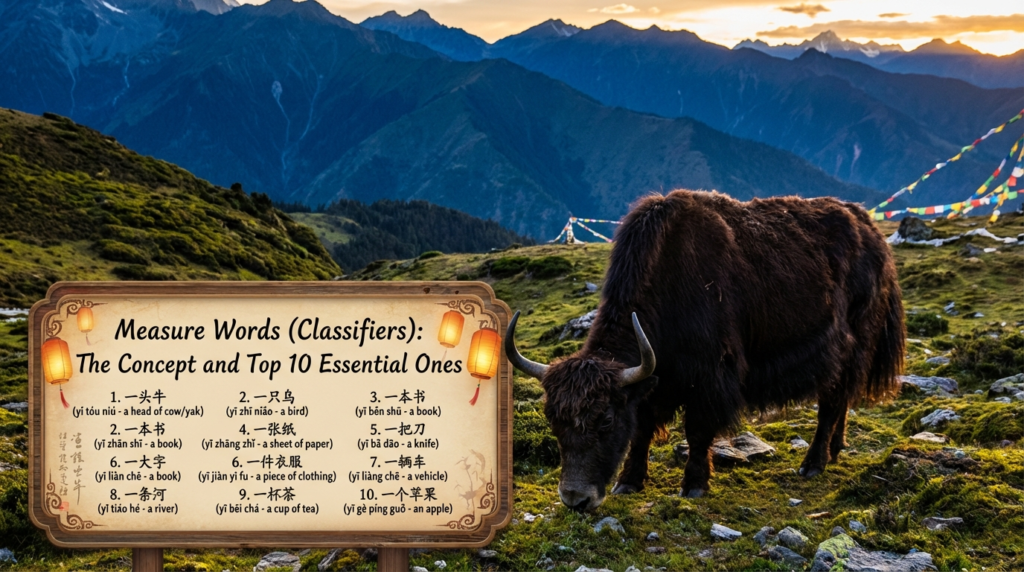
Top 10 Essential Measure Words
个 gè
Meaning: general measure word for people and many common things
Example: 三个人 sān gè rén — three people
我有三个朋友。Wǒ yǒu sān gè péngyou. — I have three friends.
本 běn
Meaning: for books, magazines, notebooks
Example: 一本书 yì běn shū — one book
这本书很有意思。Zhè běn shū hěn yǒu yìsi. — This book is very interesting.
张 zhāng
Meaning: for flat things like paper, tickets, tables, beds
Example: 两张票 liǎng zhāng piào — two tickets
我买了两张电影票。Wǒ mǎi le liǎng zhāng diànyǐng piào. — I bought two movie tickets.
只 zhī
Meaning: for many animals and one item of a pair
Example: 一只猫 yì zhī māo — a cat
她家有一只猫。Tā jiā yǒu yì zhī māo. — Her family has a cat.
条 tiáo
Meaning: for long, narrow things like fish, pants, roads, rivers
Example: 一条鱼 yì tiáo yú — a fish
这条裤子有点长。Zhè tiáo kùzi yǒudiǎn cháng. — These pants are a bit long.
杯 bēi
Meaning: for cups or glasses of drinks
Example: 一杯茶 yì bēi chá — a cup of tea
我想喝一杯咖啡。Wǒ xiǎng hē yì bēi kāfēi. — I want to drink a cup of coffee.
碗 wǎn
Meaning: for bowls of food
Example: 一碗米饭 yì wǎn mǐfàn — a bowl of rice
他吃了两碗面。Tā chī le liǎng wǎn miàn. — He ate two bowls of noodles.
辆 liàng
Meaning: for vehicles with wheels, especially cars
Example: 一辆车 yí liàng chē — a car
那辆车很贵。Nà liàng chē hěn guì. — That car is very expensive.
件 jiàn
Meaning: for clothes, matters, and some abstract things
Example: 一件衣服 yí jiàn yīfu — one piece of clothing
我买了一件新衣服。Wǒ mǎi le yí jiàn xīn yīfu. — I bought a new item of clothing.
位 wèi
Meaning: polite measure word for people
Example: 一位老师 yí wèi lǎoshī — one teacher
那位老师很亲切。Nà wèi lǎoshī hěn qīnqiè. — That teacher is very kind.
家 jiā
Meaning: for businesses such as restaurants, shops, companies
Example: 一家饭馆 yì jiā fànguǎn — a restaurant
这家店很好吃。Zhè jiā diàn hěn hǎochī. — This shop has very tasty food.
Rule By Rule: When To Use Them
Use 个 gè When You Are Not Sure
个 gè is the general fallback classifier. Native speakers use it constantly. It is not always the most precise choice, but it will save you in a lot of beginner situations.
一个苹果 yí gè píngguǒ — an apple
我想吃一个苹果。Wǒ xiǎng chī yí gè píngguǒ. — I want to eat an apple.
Use Specific Measure Words For Common Nouns
Some nouns strongly prefer their own classifier. Books like 本 běn. Flat objects like 张 zhāng. Vehicles like 辆 liàng. This is where you start sounding more natural.
那本杂志 nà běn zázhì — that magazine
三张桌子 sān zhāng zhuōzi — three tables
两辆出租车 liǎng liàng chūzūchē — two taxis
Some Measure Words Describe Shape Or Container
A lot of classifiers tell you something about shape, form, or packaging. 条 tiáo suggests something long. 杯 bēi and 碗 wǎn act like containers.
一条河 yì tiáo hé — a river
一杯水 yì bēi shuǐ — a glass of water
一碗汤 yì wǎn tāng — a bowl of soup
Useful Real-Life Sentences
- 这个人是我朋友。Zhè gè rén shì wǒ péngyou. — This person is my friend.
- 我今天买了两本书。Wǒ jīntiān mǎi le liǎng běn shū. — I bought two books today.
- 请给我一张地图。Qǐng gěi wǒ yì zhāng dìtú. — Please give me a map.
- 那只狗很可爱。Nà zhī gǒu hěn kě’ài. — That dog is very cute.
- 我想点一条鱼。Wǒ xiǎng diǎn yì tiáo yú. — I would like to order a fish.
- 他喝了三杯咖啡。Tā hē le sān bēi kāfēi. — He drank three cups of coffee.
- 我还想再来一碗米饭。Wǒ hái xiǎng zài lái yì wǎn mǐfàn. — I would like another bowl of rice.
- 门口停着一辆车。Ménkǒu tíng zhe yí liàng chē. — A car is parked at the door.
- 这件衣服太大了。Zhè jiàn yīfu tài dà le. — This piece of clothing is too big.
- 那位先生在等你。Nà wèi xiānsheng zài děng nǐ. — That gentleman is waiting for you.
- 我们找到了一家小饭馆。Wǒmen zhǎodào le yì jiā xiǎo fànguǎn. — We found a small restaurant.
- 那条路很安静。Nà tiáo lù hěn ānjìng. — That road is very quiet.
Mini Reference Table
| Measure Word | Pinyin | Meaning / Use | Example (ZH) | Example (Pinyin) | Translation (EN) |
|---|---|---|---|---|---|
| 个 | gè | general classifier | 一个问题 | yí gè wèntí | one question |
| 本 | běn | books and bound items | 两本词典 | liǎng běn cídiǎn | two dictionaries |
| 张 | zhāng | flat objects | 一张桌子 | yì zhāng zhuōzi | a table |
| 只 | zhī | many animals | 三只鸟 | sān zhī niǎo | three birds |
| 条 | tiáo | long narrow things | 一条裤子 | yì tiáo kùzi | a pair of pants |
| 杯 | bēi | cups or glasses of drinks | 两杯茶 | liǎng bēi chá | two cups of tea |
| 碗 | wǎn | bowls of food | 一碗汤 | yì wǎn tāng | a bowl of soup |
| 辆 | liàng | vehicles | 一辆公交车 | yí liàng gōngjiāochē | a bus |
| 件 | jiàn | clothes, matters | 一件外套 | yí jiàn wàitào | a coat |
| 位 | wèi | polite classifier for people | 两位客人 | liǎng wèi kèrén | two guests |
Common Mistakes And Fast Fixes
- Skipping the measure word: 三书 sān shū is wrong. Say 三本书 sān běn shū — three books.
- Using 个 gè for everything forever: understandable at first, but do not stop there. 一本书 yì běn shū sounds better than 一个书 yí gè shū.
- Forgetting polite 位 wèi: 一位老师 yí wèi lǎoshī is more polite than 一个老师 yí gè lǎoshī in formal situations.
- Mixing up long objects and flat objects: 条 tiáo is for long narrow things, while 张 zhāng is for flat things. 一条路 yì tiáo lù — a road, but 一张纸 yì zhāng zhǐ — a sheet of paper.
- Ignoring tone changes with 一 yī: you will often hear yí and yì in real speech. That is normal, not the language being dramatic.
Practice Section
Try these before peeking at the answers. Your brain deserves at least five seconds of effort.
- one book = ________
- three cats = ________
- that car = ________
- two cups of tea = ________
- this teacher, politely = ________
Answers
- 一本书 yì běn shū
- 三只猫 sān zhī māo
- 那辆车 nà liàng chē
- 两杯茶 liǎng bēi chá
- 这位老师 zhè wèi lǎoshī
Quick Reference Summary
- 量词 liàngcí means measure word or classifier.
- The core pattern is number + measure word + noun.
- 个 gè is the general fallback.
- Learn high-frequency pairings first: 本 běn for books, 张 zhāng for flat things, 只 zhī for animals, 条 tiáo for long things, 辆 liàng for vehicles.
- Container words matter too: 杯 bēi for cups, 碗 wǎn for bowls.
- 位 wèi is the polite classifier for people.
- Use measure words with 这 zhè — this and 那 nà — that as well.
Final Yak Box
If you remember only one thing today, make it this: do not glue a number directly to a noun in Chinese. Drop in the right measure word, and suddenly your sentence stops wobbling and starts walking.