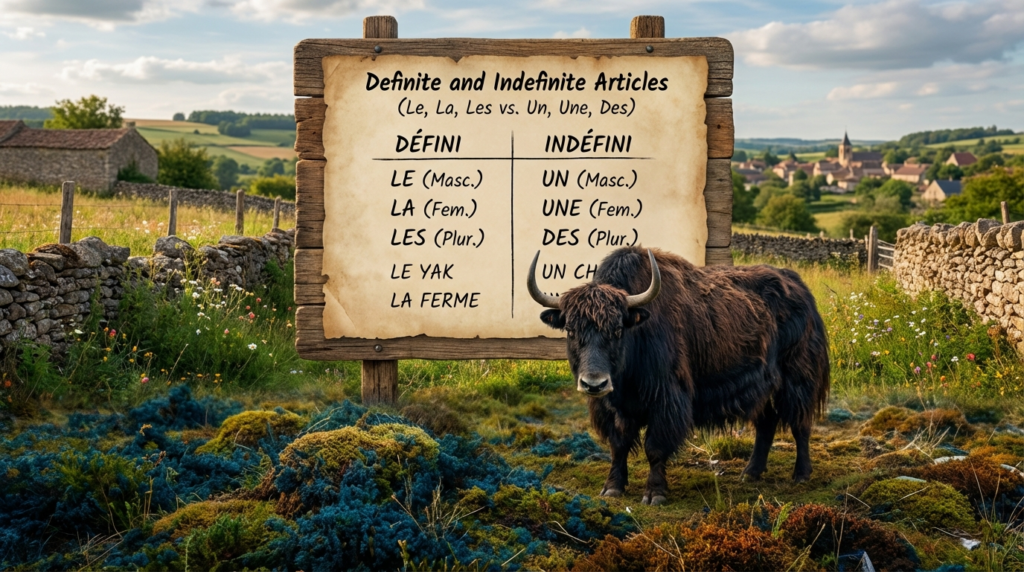
Definite And Indefinite Articles In French
French articles look tiny, harmless, and deeply annoying until they suddenly make sense. This guide shows you when to use le, la, les for the and un, une, des for a, an, some—without turning your brain into cold soup.
By the end, you will know how to say the book, a table, some friends, and why French insists on giving every noun a gender. Rude, yes. Useful, also yes.
Yak Box: The Fast Version
- le = the for a masculine singular noun. Le livre est sur la table. = The book is on the table.
- la = the for a feminine singular noun. La table est grande. = The table is big.
- l’ = the before a vowel sound or silent h. L’hôtel est calme. = The hotel is quiet.
- les = the for plural nouns. Les enfants jouent. = The children are playing.
- un = a for a masculine singular noun. J’ai un chien. = I have a dog.
- une = a for a feminine singular noun. Elle a une voiture. = She has a car.
- des = some for plural nouns. Nous avons des amis ici. = We have some friends here.
What Is The Difference?
The basic idea is simple:
- Use definite articles when you mean the.
- Use indefinite articles when you mean a, an, or some.
| Type | French | English Meaning | Example |
|---|---|---|---|
| Definite | le / la / l’ / les | the | Les cafés sont ouverts. = The cafés are open. |
| Indefinite | un / une / des | a / an / some | Une idée arrive. = An idea comes up. |
Definite Articles: Le, La, L’, Les
Use these when you mean a specific thing: the book, the woman, the shops. French does this all the time, often more than English does, because apparently one language had to be extra.
Le
Meaning: the (masculine singular)
Example: Le film commence à huit heures.
The film starts at eight o’clock.
La
Meaning: the (feminine singular)
Example: La porte est ouverte.
The door is open.
L’
Meaning: the before a vowel sound or silent h
Example: L’école est près d’ici.
The school is near here.
Les
Meaning: the (plural)
Example: Les étudiants travaillent.
The students are working.
Rule → Example
| Rule | Meaning | Example 1 | Example 2 |
|---|---|---|---|
| Use le with a masculine singular noun | the | Le café est chaud. The coffee is hot. | Le voisin parle fort. The neighbor speaks loudly. |
| Use la with a feminine singular noun | the | La musique est douce. The music is soft. | La voiture roule vite. The car is going fast. |
| Use l’ before vowel sound / silent h | the | L’ami arrive. The friend arrives. | L’histoire est intéressante. The story is interesting. |
| Use les with plural nouns | the | Les magasins ferment tôt. The shops close early. | Les fleurs sentent bon. The flowers smell nice. |
Indefinite Articles: Un, Une, Des
Use these when the thing is not specific yet: a book, a woman, some shops. This is your go-to set when you are introducing something for the first time.
Un
Meaning: a (masculine singular)
Example: Un chat dort sur le canapé.
A cat is sleeping on the sofa.
Une
Meaning: a (feminine singular)
Example: Une lampe éclaire la pièce.
A lamp lights the room.
Des
Meaning: some (plural)
Example: Des touristes prennent des photos.
Some tourists are taking photos.
Rule → Example
| Rule | Meaning | Example 1 | Example 2 |
|---|---|---|---|
| Use un with a masculine singular noun | a | Un professeur parle. A teacher is speaking. | Un billet coûte dix euros. A ticket costs ten euros. |
| Use une with a feminine singular noun | a | Une question reste. A question remains. | Une minute suffit. One minute is enough. |
| Use des with plural nouns | some | Des enfants courent dehors. Some children are running outside. | Des idées arrivent vite. Some ideas come quickly. |
How To Choose The Right Article
- Ask whether the noun is specific or not specific.
- Ask whether the noun is masculine, feminine, or plural.
- If it starts with a vowel sound or silent h, use l’ instead of le or la.
That gives you this tiny decision map:
| You Mean | Masculine Singular | Feminine Singular | Plural |
|---|---|---|---|
| the | le | la | les |
| the before vowel / silent h | l’ | les | |
| a / an / some | un | une | des |
Useful Real-Life Sentences
These are the kinds of sentences you will actually say, hear, or mutter while trying to remember whether table is feminine. It is. Thankfully.
- Le train arrive à midi. = The train arrives at noon.
- La fenêtre est fermée. = The window is closed.
- L’appartement est petit mais joli. = The apartment is small but pretty.
- Les clés sont sur la table. = The keys are on the table.
- Un ami m’attend. = A friend is waiting for me.
- Une serveuse apporte le menu. = A waitress brings the menu.
- Des clients entrent dans le café. = Some customers enter the café.
- Je cherche un hôtel. = I am looking for a hotel.
- Nous visitons la ville. = We are visiting the city.
- Ils achètent des souvenirs. = They are buying some souvenirs.
- Elle lit le journal. = She is reading the newspaper.
- J’ai une idée. = I have an idea.
Mini Practice
Pick the correct article. No dramatic music needed, but it would help.
- ___ livre (book)
- ___ maison (house)
- ___ amis (friends)
- ___ école (school) when you mean the school
- ___ voiture (car) when you mean a car
- ___ restaurants (restaurants) when you mean the restaurants
Show The Answers
- le livre = the book
- la maison = the house
- des amis = some friends
- l’école = the school
- une voiture = a car
- les restaurants = the restaurants
Common Mistakes And Fast Fixes
- Mistake: using un for every singular noun.
Fix: check the noun’s gender. Un livre but une chaise. = A book but a chair. - Mistake: forgetting l’ before a vowel sound.
Fix: say l’idée, not la idée. L’idée est bonne. = The idea is good. - Mistake: using les when you mean some.
Fix: les = the, but des = some. Les enfants = the children; des enfants = some children. - Mistake: assuming word endings always tell you the gender.
Fix: endings can help, but not always. Learn nouns with the article attached: la table, le problème. Sneaky little language.
Quick Reference Summary
| Article | English Meaning | When To Use It | Example |
|---|---|---|---|
| le | the | masculine singular noun | Le téléphone sonne. The phone is ringing. |
| la | the | feminine singular noun | La rue est calme. The street is quiet. |
| l’ | the | before vowel sound or silent h | L’heure approche. The hour is getting close. |
| les | the | plural noun | Les voisins arrivent. The neighbors are arriving. |
| un | a | masculine singular noun | Un message arrive. A message arrives. |
| une | a | feminine singular noun | Une réponse suffit. An answer is enough. |
| des | some | plural noun | Des invités attendent. Some guests are waiting. |
Final Yak
Remember the job of the article first, then the gender. Le, la, l’, les point to something specific. Un, une, des introduce something less specific. Learn nouns as pairs like la maison and le livre, and French articles stop feeling random quite so fast.