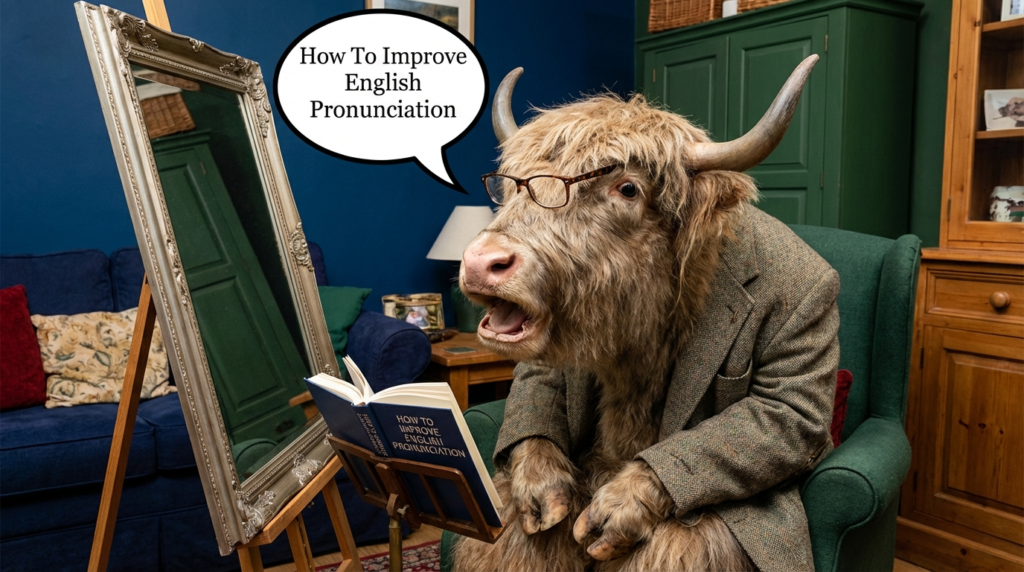
How To Improve English Pronunciation
Your goal: sound clearer and more natural in American English—without trying to “erase” your accent. You can keep your accent and still be easy to understand. (That’s the win.)
Your shortcut: focus on the things that listeners actually notice: sounds, word stress, sentence rhythm, and linking. Not “perfect” pronunciation. Clear pronunciation.
If English pronunciation feels like a messy puzzle, good news: you don’t need 500 rules. You need a small daily routine and a few high-impact targets (the ones that cause most misunderstandings). Below is a practical plan, mouth tips that actually help, and real-life sentences you can copy.
Yak Box: The “Clear English” Formula
- 50% = Stress + rhythm (which words you hit harder)
- 30% = Key sounds (a few “trouble” sounds cause most confusion)
- 20% = Linking (how words connect in real speech)
Translation: you can improve a lot even if some individual sounds are still imperfect. That’s why native speakers with different accents can still be super clear.
A Simple Daily Practice Plan (10 Minutes)
| Minute | What To Do | Why It Works |
| 1 | Warm-up mouth: big smile → round lips → open jaw | Looser mouth = clearer sounds |
| 3 | Pick 1 sound target (like /r/ or “th”) + 10 reps | Small focus beats random practice |
| 3 | Stress practice: read 3 short sentences, punch the content words | Rhythm is what listeners “hear” most |
| 2 | Linking practice: connect words (wanna / gonna / “next_day”) | Makes you sound more natural |
| 1 | Record yourself once | You catch patterns fast (and yes, it’s weird at first) |
Pro tip: Don’t practice 20 things badly. Practice one thing well each day.
The 8 Pronunciation “Power Moves” (High Impact)
1) Slow Down… But Not Like a Robot
Meaning: Reduce speed just enough to finish sounds and stress the right words.
Try it: Pause between ideas, not between every word.
Example: “I can meet you after work… if traffic isn’t crazy.”
2) Open Your Mouth More (Yes, Really)
Meaning: Many learners speak with a “small mouth,” which makes vowels unclear.
Mouth tip: Drop your jaw a little more on vowels: cat / bad / map.
Example: “That’s a bad plan.” (Make bad wide and open.)
3) Fix Word Stress (The Secret Boss)
Meaning: Word stress = one syllable is stronger/longer/higher.
How: Clap the stressed syllable.
Examples: TAble, hoTEL, imPORtant, phoTOgraph vs phoTOGraphy.
4) Use Sentence Stress (Content Words)
Meaning: In American English, we stress content words (nouns, main verbs, adjectives, adverbs). Small grammar words get reduced.
Example: “I need to buy a new laptop.” (Need / buy / new / laptop)
Another: “Can you send me the address?”
5) Master The Schwa (The Lazy “Uh” Sound)
Meaning: Schwa = the most common vowel in American English. It sounds like a relaxed “uh” /ə/.
Examples: about (aBOUT), banana (baNAna), support (supPORT).
Example sentence: “I’m about to leave.” (First “a-” is relaxed.)
6) Link Words Like Native Speakers Do
Meaning: Native speakers connect words so speech flows.
Common links: consonant + vowel (“pick_it_up”), same consonants (“big_girl”), t/d + y (“did you” → “didja”).
Example: “Can you pick it up later?” → “Can you pickitup later?”
7) Learn The American R (Without Pain)
Meaning: American /r/ is “tight tongue, no roll.” The tongue pulls back a bit and the lips can round slightly.
Mouth tip: Keep the tongue off your teeth. Don’t tap or roll it.
Example: “I’m really sorry.” (Hold the /r/ smoothly: reaa-lly)
8) Don’t “Kill” Final Sounds
Meaning: Many misunderstandings come from missing final consonants (t, d, k, s, z).
Fix: You don’t need a huge final sound—just a clear ending.
Example: “I asked.” vs “I ask.” (That final -ed matters.)
Useful Phrases And Real-Life Sentences (Copy These)
Read these out loud. Stress the bold words. Link the words with an underscore idea in your mind (no pause).
- “I’ll be there in ten minutes.”
- “Can you send it to me?”
- “I need to reschedule.”
- “What time does it start?”
- “I’m not sure yet.”
- “That makes sense.”
- “I can’t hear you—can you repeat that?”
- “Let’s meet up after work.”
- “I’m working on it.”
- “Do you want to grab coffee?”
- “I should’ve told you earlier.”
- “It depends on the price.”
- “I’m trying to be clear.”
- “Could you write it down?”
The Most Common Sounds That Need Attention
You don’t need to fix every sound. Fix the ones that change meaning the most in American English.
TH (/θ/ and /ð/)
Meaning: “th” is two sounds: thin (quiet) and this (voiced).
Mouth tip: Put your tongue lightly between your teeth. Blow air for thin; add voice for this.
Examples: “Think about it.” / “Is this yours?”
L vs R
Meaning: Confusing light/right or glass/grass can cause real misunderstandings.
Mouth tip: For L, tongue touches behind top teeth. For R, tongue pulls back and doesn’t touch.
Example: “Turn right at the light.”
Vowels (Ship/Sheep, Full/Fool)
Meaning: Vowel length changes meaning.
Mouth tip: Short vowels are quicker and smaller; long vowels are longer and often tenser.
Examples: “ship” vs “sheep” / “full” vs “fool”
B vs P
Meaning: pat/bat can flip the meaning.
Mouth tip: For P, push more air. Hold your hand in front of your mouth: you should feel a puff.
Example: “I bought a pen.” (Feel that air on p.)
Quick Tables Of Words (Practice Sets)
Say each word slowly, then say it in a sentence at normal speed. That’s the real test.
Final Consonants Practice
| Vocabulary | Meaning | Example 1 | Example 2 | Example 3 |
| asked | past of ask | “I asked a question.” | “She asked for help.” | “We asked yesterday.” |
| worked | past of work | “I worked late.” | “He worked hard.” | “They worked together.” |
| saved | past of save | “I saved the file.” | “She saved money.” | “We saved time.” |
| missed | didn’t catch | “I missed the bus.” | “He missed your call.” | “We missed the start.” |
| next | after this one | “Next week works.” | “Try the next option.” | “Who’s next?” |
Tricky Vowel Pairs
| Vocabulary | Meaning | Example 1 | Example 2 | Example 3 |
| ship | large boat | “The ship arrived.” | “A ship is in the harbor.” | “They work on a ship.” |
| sheep | farm animal | “The sheep are quiet.” | “A sheep is eating grass.” | “We saw sheep today.” |
| full | not empty | “I’m full.” | “The room is full.” | “My schedule is full.” |
| fool | silly person (strong word) | “Don’t be a fool.” | “I felt like a fool.” | “That was a fool mistake.” |
| beach | sandy shore | “Let’s go to the beach.” | “The beach is crowded.” | “We walked on the beach.” |
Common Mistakes And Quick Fixes
- Mistake: You copy spelling, not sound. Fix: Learn 1 pronunciation per word (stress + reduced vowels).
- Mistake: You practice single words only. Fix: Always practice the word inside a sentence.
- Mistake: You avoid difficult sounds. Fix: Practice them slowly for 60 seconds daily.
- Mistake: You speak too quietly. Fix: Add energy on stressed words (not on every word).
- Mistake: You don’t move your mouth much. Fix: Bigger mouth shapes for vowels, clean endings for consonants.
Practice: Mini Drills You Can Do Anywhere
Drill 1: Stress Switch
How: Say the sentence 3 times. Each time, stress different words. Notice how meaning changes.
- “I didn’t say you were late.”
- “I didn’t say you were late.” (Not me.)
- “I didn’t say you were late.” (Not someone else.)
- “I didn’t say you were late.” (Something else.)
Drill 2: Link It
How: Read it slow, then normal. Your goal is smooth connection, not speed.
- “Turn it off.” → “Turnitoff.”
- “Pick it up.” → “Pickitup.”
- “I’ll ask her.” → “I’llaskher.”
- “Next week.” → “Nextweek.”
Quick Reference Summary
- Improve clarity fastest by practicing stress + rhythm.
- Pick one sound target per day (th, r, final consonants, vowel pairs).
- Practice words in sentences and record yourself.
- Use linking to sound natural: “pick_it_up,” “turn_it_off.”
Final Yak
If you want a pronunciation glow-up, don’t chase “perfect.” Chase clear. Stress the important words, reduce the tiny ones, link smoothly, and keep your word endings alive. Do that for two weeks and people will magically start saying, “Wow, your English is really clear.” (Not magic. Just… mouth physics.)