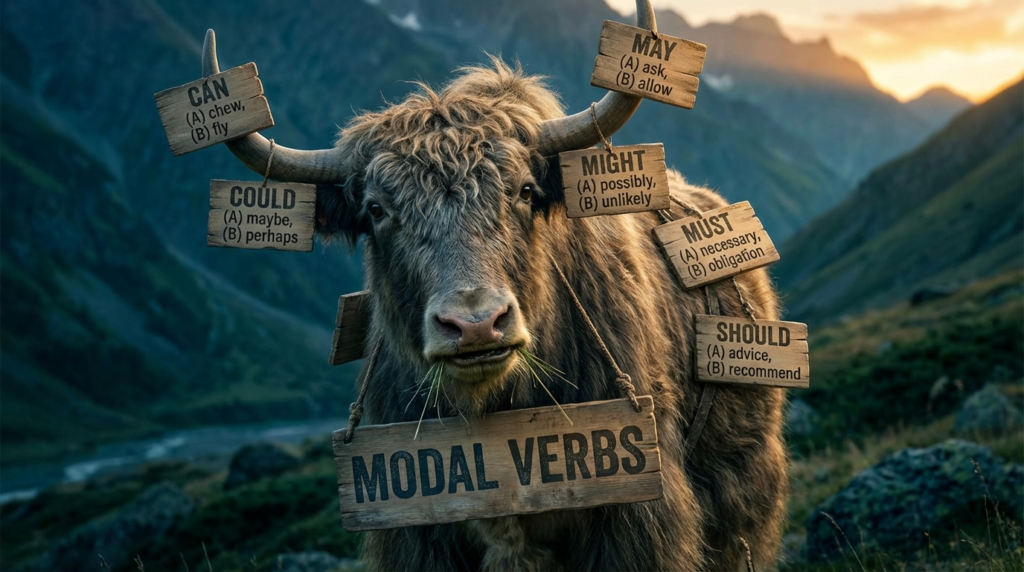
Modal Verbs (The Ones You Actually Use)
Sound more natural fast: express ability, permission, advice, possibility, and obligation with a few small verbs.
Heads-up: Modals are tiny, but they control the whole sentence. Like a small remote that runs your entire TV.
Modal verbs help you say how sure you are, how polite you want to be, and how strong the rule is.
In this guide, you’ll learn the main modals, the simple grammar pattern, and the real-life meanings—plus quick practice so your brain stops panicking mid-sentence.
Yak Box: The One Pattern To Remember
Modal + base verb (base verb = the simple form, like go, eat, help, be)
✅ I can help. ✅ She might be late. ✅ We should leave now.
🚫 Not: “She can to help.” (No to after most modals.)
What Modal Verbs Are
Modal verbs are “helper” verbs that show attitude: ability, permission, possibility, advice, necessity, and more. They don’t change much for grammar (no -s, no -ing forms), and they usually come before the main verb.
- They don’t take -s: ✅ He can drive. 🚫 He cans drive.
- They use the base verb: ✅ She should go. 🚫 should goes
- They’re great for politeness: “Could you…?” is softer than “Can you…?”
The Core Modal Verbs (And What They Mean)
These are the big ones in everyday American English:
Can
Meaning: ability, permission (casual), possibility
Example: I can meet you after work.
Example: Can I use your charger?
Could
Meaning: past ability, polite requests, possibility
Example: When I was 10, I could swim well.
Example: Could you help me for a minute?
May
Meaning: formal permission, possibility (more formal)
Example: May I come in?
Example: It may rain later.
Might
Meaning: weak possibility (less sure than “may”)
Example: I might go to the gym. (Not sure.)
Example: She might be in a meeting.
Must
Meaning: strong obligation, strong logical conclusion
Example: You must wear a seat belt.
Example: It’s 2 a.m.—he must be asleep.
Should
Meaning: advice, expectation, “best idea”
Example: You should drink more water.
Example: The bus should arrive soon.
The Other High-Use Modals And Semi-Modals
These show up constantly in real life, even if grammar books act mysterious about them.
| Word / Phrase | Meaning | Example Sentence |
|---|---|---|
| Will | future, willingness, promises | I will call you tonight. |
| Would | polite requests, imagined situations, habits in the past | Would you mind closing the door? |
| Shall | offers/suggestions (more British; also formal US) | Shall we start? |
| Ought to | advice (similar to “should,” a bit formal) | You ought to apologize. |
| Have to | necessity (very common in American English) | I have to leave at 6. |
| Need to | necessity (often softer than “have to”) | You need to save your work. |
| Had better | strong advice / warning | You’d better bring a jacket. |
| Be able to | ability (useful for other tenses) | I was able to fix it yesterday. |
| Be supposed to | expectation / rule | We’re supposed to be quiet here. |
| Used to | past habits or states (not now) | I used to live in Chicago. |
How To Build Modal Sentences
Positive
Subject + modal + base verb
I can drive. / She might come. / We should leave.
Negative
Subject + modal + not + base verb
I can’t go. / She shouldn’t say that. / It might not work.
American English tip: “mustn’t” exists, but Americans often prefer “can’t” (prohibited) or “don’t have to” (not necessary).
Questions
Modal + subject + base verb?
Can you help? / Should we order now? / May I sit here?
Meanings In Real Life (The Useful Buckets)
Instead of memorizing 47 “rules,” learn these meaning buckets. Your brain likes buckets.
| Bucket | Common Modals | Natural Examples |
|---|---|---|
| Ability | can, could, be able to | I can lift that. / I could read at age four. / I was able to finish on time. |
| Permission | can, could, may, be allowed to | Can I park here? / Could I borrow this? / May I ask a question? |
| Possibility | may, might, could | It might snow. / This could take a while. |
| Advice | should, ought to, had better | You should sleep. / You ought to text her. / You’d better leave now. |
| Obligation | must, have to, need to | You must show ID. / I have to work late. / You need to sign here. |
| Prediction / Future | will, may, might | I will see you tomorrow. / It may be expensive. |
| Polite Requests | could, would, can | Could you hold this? / Would you open the window? |
| Logical Conclusion | must, can’t | She must be tired. / That can’t be true. |
Modal “Time Travel”: Talking About The Past
To talk about past guesses, past regrets, or past possibilities, English often uses:
Modal + have + past participle (past participle = eaten, gone, done, seen)
- could have = it was possible (but didn’t happen): I could have helped, but I didn’t see your message.
- should have = regret / missed best choice: I should have studied more.
- might have = maybe happened / maybe was true: She might have forgotten.
- must have = strong conclusion about the past: He must have left early.
- can’t have = strong negative conclusion: They can’t have known about it.
Useful Phrases You’ll Hear Every Day
Steal these. Use them. Sound fluent. (Legally.)
- Can you…? = casual request: Can you send that file?
- Could you…? = polite request: Could you repeat that?
- Would you…? = polite request: Would you mind waiting a second?
- May I…? = formal permission: May I ask a quick question?
- I can’t… = inability/refusal: I can’t make it tonight.
- I might… = unsure plan: I might go later.
- You should… = advice: You should back up your phone.
- You have to… = rule/necessity: You have to show your ticket.
- You don’t have to… = not necessary: You don’t have to rush.
- You must be… = strong guess: You must be exhausted.
- That can’t be… = strong disbelief: That can’t be right.
- We could… = suggestion: We could try the new café.
Common Mistakes (And Quick Fixes)
- Mistake: “He can to drive.” → Fix: He can drive.
- Mistake: “She should goes.” → Fix: She should go.
- Mistake: Using mustn’t when you mean “not necessary.” → Fix: Use don’t have to: You don’t have to come early.
- Mistake: “I’m can…” → Fix: Say “I can…” or “I’m able to…” (different structures).
- Mistake: “I could to help.” → Fix: I could help.
Practice Time (Quick And Real)
Do these out loud if you can. Yes, out loud. That’s where the magic is.
1) Choose The Best Modal
- ______ you help me carry this? (polite request)
- I ______ be late. My train is delayed. (possibility)
- You ______ wear a helmet here. It’s the rule. (obligation)
- We ______ try the new restaurant. (suggestion)
- She ______ be at home. Her car isn’t here. (logical conclusion, negative)
Answers
- Could you help me carry this?
- I might be late.
- You have to (or must) wear a helmet here.
- We could try the new restaurant.
- She can’t be at home.
2) Make It More Polite
- Can you send it today? → make it softer
- Open the window. → make it polite
- I want a water. → make it more natural
Possible Answers
- Could you send it today?
- Could you open the window? / Would you open the window?
- Could I get a water? / Can I get a water?
3) Past Modals (Regret Or Guess)
- I didn’t call her. (regret) → I ______ ______ called her.
- He didn’t answer. (strong guess) → He ______ ______ been asleep.
- Maybe they missed the bus. → They ______ ______ missed the bus.
Answers
- I should have called her.
- He must have been asleep.
- They might have missed the bus.
Quick Reference Summary
| Modal | Main Use | Fast Feel | Example |
|---|---|---|---|
| can | ability / casual permission | direct, common | I can help. |
| could | polite request / possibility | softer | Could you help? |
| may | formal permission / possibility | formal | May I sit? |
| might | weak possibility | not sure | I might go. |
| must | strong rule / strong conclusion | strong | You must stop. |
| should | advice / expectation | helpful | You should rest. |
| will | future / promise | confident | I will call. |
| would | polite / hypothetical | polite, thoughtful | Would you mind…? |
| have to | necessity (common US) | real-life rules | I have to go. |
| don’t have to | not necessary | relaxing | You don’t have to come. |
Final Yak
If you remember nothing else, remember this: modal + base verb. Then choose your “feeling”:
- can = I’m able / it’s okay
- could / would = polite mode
- might = not sure
- should = advice
- must / have to = strong rule