在 vs 著: Ongoing Actions Vs Ongoing States
Traditional Chinese: 在 zài (action in progress) vs 著 zhe (state continuing)
If you’ve ever said something like “I’m wearing my coat” and accidentally told people you’re putting it on right now… yep. This is the 在 vs 著 problem.
By the end, you’ll know when to use 在 zài for an ongoing action, when to use 著 zhe for an ongoing state, and how they can team up in one sentence without starting a grammar fight.
🦬 Yak Snark Box: 在 zài is like a “LIVE” badge on a video. 著 zhe is like the “still on the screen” situation after you hit pause.
The Big Idea: Action Vs State
Use 在 zài For Ongoing Actions
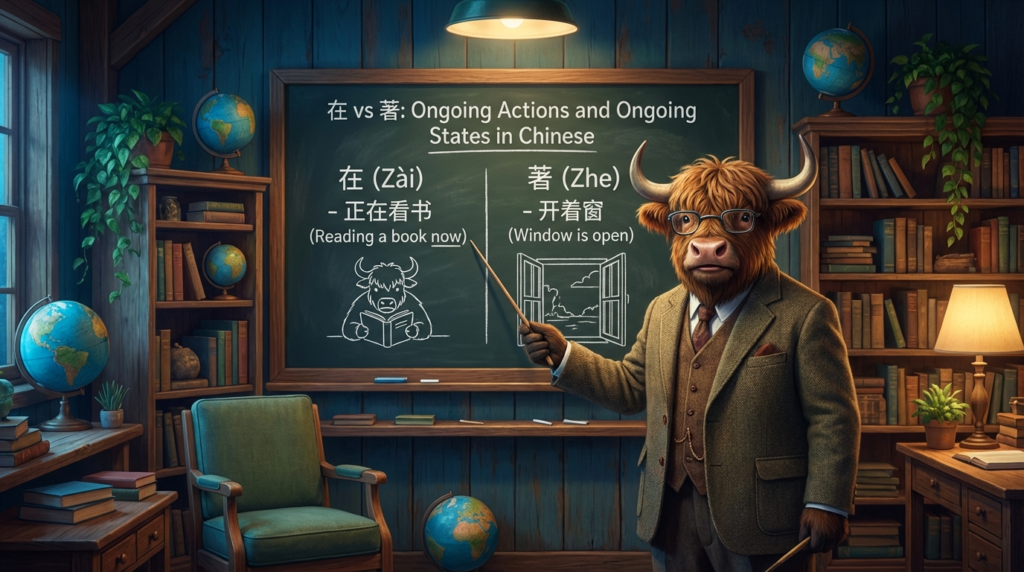
在 zài + verb = “currently doing…” (progressive)
我在吃飯。 wǒ zài chī fàn
I’m eating (right now).
Use 著 zhe For Ongoing States
verb + 著 zhe = “in a continuing state” (durative / result-state)
門開著。 mén kāi zhe
The door is open (and stays open).
How To Use 在 zài
Core pattern
Subject + 在 zài + Verb = “Subject is (currently) doing Verb.”
- 他在工作。 tā zài gōngzuò
He’s working. - 我在找手機。 wǒ zài zhǎo shǒujī
I’m looking for my phone. - 她在學中文。 tā zài xué Zhōngwén
She’s studying Chinese.
Common add-ons (optional, but super natural):
- 正在 zhèngzài = right in the middle of doing it
我正在開會。 wǒ zhèngzài kāihuì
I’m in a meeting (right now). - 在…呢 zài…ne = casual “doing it” vibe
他在睡覺呢。 tā zài shuìjiào ne
He’s sleeping (at the moment). - 一直 yìzhí = continuously, for a while
外面一直在下雨。 wàimiàn yìzhí zài xià yǔ
It’s been raining nonstop outside.
How To Use 著 zhe
Core pattern
Verb + 著 zhe = the situation/state continues.
Think: posture, placement, “left on,” “kept open,” “wearing,” “holding.”
Posture & Position
他坐著。 tā zuò zhe
He’s sitting (seated).
你站著等我。 nǐ zhàn zhe děng wǒ
Stand there and wait for me.
Open / On / Left As-Is
門開著。 mén kāi zhe
The door is open.
燈亮著。 dēng liàng zhe
The light is on.
Wearing & Holding
他穿著外套。 tā chuān zhe wàitào
He’s wearing a coat.
我拿著咖啡。 wǒ ná zhe kāfēi
I’m holding a coffee.
The Famous Trap: “Putting On” Vs “Wearing”
穿 chuān is “to wear/put on,” so the particle changes the meaning:
我在穿外套。 wǒ zài chuān wàitào
I’m putting on a coat (action in progress).
我穿著外套。 wǒ chuān zhe wàitào
I’m wearing a coat (state continuing).
Yes, You Can Use Them Together
When you want to show an action happening plus a continuous posture/state, you’ll often see both in one sentence.
| Pattern | Meaning | Example (ZH) | Pinyin | EN |
| 在 zài + 地方 + V + 著 zhe | Doing something while staying in a state/posture | 他在門口站著。 | tā zài ménkǒu zhàn zhe | He’s standing at the entrance. |
| 在 zài + V + 著 zhe + 受詞 | Less common, but can emphasize ongoing + maintained focus | 我在看著你。 | wǒ zài kàn zhe nǐ | I’m (currently) watching you. |
In everyday speech, the second pattern often simplifies to either:
我在看你。 wǒ zài kàn nǐ (I’m watching you.)
我看著你。 wǒ kàn zhe nǐ (I’m looking at you / keeping my eyes on you.)
Useful Real-Life Sentences You Can Steal
- 我在煮湯。 wǒ zài zhǔ tāng
I’m cooking soup. - 孩子在哭。 háizi zài kū
The kid is crying. - 你在忙嗎? nǐ zài máng ma
Are you busy (right now)? - 手機在充電。 shǒujī zài chōngdiàn
The phone is charging. - 窗戶開著,會冷。 chuānghù kāi zhe, huì lěng
The window is open, it’ll get cold. - 電視開著,但沒人在看。 diànshì kāi zhe, dàn méi yǒu rén zài kàn
The TV is on, but no one is watching. - 他戴著眼鏡。 tā dài zhe yǎnjìng
He’s wearing glasses. - 桌上放著一杯水。 zhuō shàng fàng zhe yì bēi shuǐ
There’s a cup of water placed on the table. - 牆上掛著一張照片。 qiáng shàng guà zhe yì zhāng zhàopiàn
A photo is hanging on the wall. - 我拿著你的鑰匙。 wǒ ná zhe nǐ de yàoshi
I have your keys (I’m holding them). - 他在沙發上躺著滑手機。 tā zài shāfā shàng tǎng zhe huá shǒujī
He’s lying on the sofa scrolling on his phone. - 你看著路,別看手機。 nǐ kàn zhe lù, bié kàn shǒujī
Keep your eyes on the road—don’t look at your phone.
Common Mistakes And Fast Fixes
- Mistake: Using 在 zài when you mean a stable condition.
Fix: Use 著 zhe for “kept/left in a state.”
燈在開。 dēng zài kāi (sounds like “the light is turning on”) → 燈開著。 dēng kāi zhe (The light is on.) - Mistake: Saying you’re “wearing” something with 在.
Fix: 在 = putting on; 著 = wearing.
我在穿鞋。 wǒ zài chuān xié (putting on shoes) / 我穿著鞋。 wǒ chuān zhe xié (wearing shoes) - Mistake: Forgetting that 在 zài can also mean “located at.” (Different job!)
我在台北。 wǒ zài Táiběi = I’m in Taipei. (location, not progressive) - Mistake: Confusing 著 zhe (aspect particle) with other pronunciations of 著.
睡著 shuìzháo = fall asleep (zháo), not the same as 著 zhe meaning “continuing state.”
Quick Practice
Choose 在 zài or 著 zhe (and write it into the blank). Don’t overthink it. Overthinking is how houseplants die.
- 我____看電影。 wǒ ____ kàn diànyǐng (I’m watching a movie.)
- 門____,你關一下。 mén ____ (The door is open—close it.)
- 她____穿外套。 tā ____ chuān wàitào (She’s wearing a coat.)
- 他____寫作業。 tā ____ xiě zuòyè (He’s doing homework.)
- 桌上____放一支筆。 zhuō shàng ____ fàng yì zhī bǐ (There’s a pen on the table.)
- 我____找我的鑰匙。 wǒ ____ zhǎo wǒ de yàoshi (I’m looking for my keys.)
- 他在椅子上____坐____。 tā zài yǐzi shàng ____ zuò ____ (He’s sitting on the chair.)
- 燈____亮____,不用開。 dēng ____ liàng ____ (The light is on; no need to turn it on.)
Answer Key (Click To Reveal)
1) 我在看電影。 wǒ zài kàn diànyǐng
2) 門開著,你關一下。 mén kāi zhe
3) 她穿著外套。 tā chuān zhe wàitào
4) 他在寫作業。 tā zài xiě zuòyè
5) 桌上放著一支筆。 zhuō shàng fàng zhe yì zhī bǐ
6) 我在找我的鑰匙。 wǒ zài zhǎo wǒ de yàoshi
7) 他在椅子上坐著。 tā zài yǐzi shàng zuò zhe
8) 燈亮著,不用開。 dēng liàng zhe
Quick Reference Summary
| What You Mean | Use | Mini Example | Pinyin | EN |
| Action happening now | 在 zài + V | 我在吃。 | wǒ zài chī | I’m eating. |
| State continues | V + 著 zhe | 門開著。 | mén kāi zhe | The door is open. |
| Action + posture/state | 在 + 地方 + V著 | 他在外面等著。 | tā zài wàimiàn děng zhe | He’s waiting outside. |
🦬 Final Yak Box: If it’s a movie that’s currently playing, use 在 zài. If it’s a screen that’s left on, use 著 zhe. And yes, you can say 他在門口站著 tā zài ménkǒu zhàn zhe when you want both.