Animal Names in Spanish: 90+ Useful Words & Phrases
Tema en español: Animales • Mexican Spanish • Audio buttons + IPA pronunciation
Want to talk about animals in Mexican Spanish without sounding like you learned everything from a cartoon lion? Here you’ll get 90+ animal words plus real-life phrases, each with IPA pronunciation, a clean example sentence, and a 🔊 button you can tap to hear it out loud.
Pro move: learn the phrases first (so you can actually use the words), then scoop up the animal names by category.
8 “Use-These-Today” Animal Words
High-frequency basics you’ll actually say.
el perro
/el ˈpe.ro/
dog
Mi perro es muy juguetón.
My dog is very playful.
el gato
/el ˈɡa.to/
cat
El gato se durmió en el sofá.
The cat fell asleep on the couch.
el caballo
/el kaˈβa.ʝo/
horse
Vi un caballo en el rancho.
I saw a horse at the ranch.
la vaca
/la ˈba.ka/
cow
La vaca está en el campo.
The cow is in the field.
el pollo
/el ˈpo.ʝo/
chicken
El pollo corre por el patio.
The chicken runs around the yard.
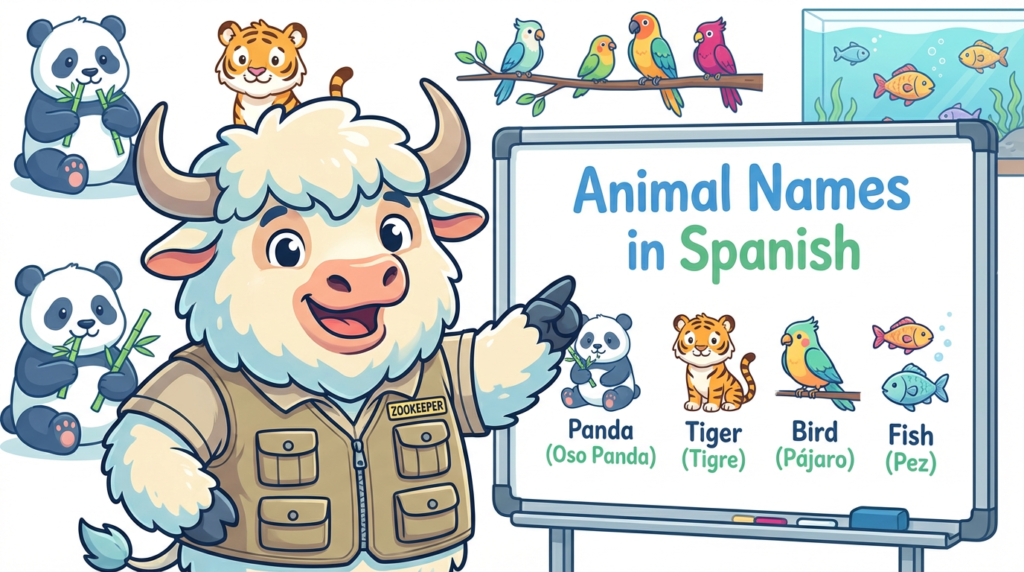
el pez
/el pes/
fish
Ese pez es de colores.
That fish is colorful.
el pájaro
/el ˈpa.xa.ɾo/
bird
Un pájaro canta en la mañana.
A bird sings in the morning.
la serpiente
/la seɾˈpjen.te/
snake
Hay una serpiente cerca de las piedras.
There’s a snake near the rocks.
Real-Life Phrases You’ll Actually Use (12)
Because vocabulary without phrases is just… decorative.
¿Tienes mascota?
/ˈtjenes masˈko.ta/
Do you have a pet?
¿Tienes mascota o prefieres no tener animales en casa?
Do you have a pet or do you prefer not to have animals at home?
Me gustan los perros.
/me ˈɡus.tan los ˈpe.ros/
I like dogs.
Me gustan los perros, pero también me caen bien los gatos.
I like dogs, but I also like cats.
Cuidado con el perro.
/kwiˈða.do kon el ˈpe.ro/
Beware of the dog.
Aquí dice: “Cuidado con el perro”.
It says here: “Beware of the dog.”
¿Cómo se llama este animal?
/ˈko.mo se ˈʝa.ma ˈes.te a.niˈmal/
What is this animal called?
¿Cómo se llama este animal? Se ve muy raro.
What is this animal called? It looks really weird.
Es venenoso.
/es be.neˈno.so/
It’s venomous/poisonous.
No lo toques; es venenoso.
Don’t touch it; it’s venomous.
No muerde, es tranquilo.
/no ˈmweɾ.ðe es tɾaŋˈki.lo/
He doesn’t bite; he’s calm.
Mi perro no muerde, es tranquilo.
My dog doesn’t bite; he’s calm.
Se me escapó el gato.
/se me es.kaˈpo el ˈɡa.to/
The cat got away from me.
Se me escapó el gato y lo estoy buscando.
The cat got away from me and I’m looking for him.
Está asustado.
/esˈta a.susˈta.ðo/
He’s scared.
El perrito está asustado con los cohetes.
The little dog is scared of the fireworks.
¡Qué tierno!
/ke ˈtjeɾ.no/
How cute!
¡Qué tierno! Ese conejito es chiquito.
How cute! That bunny is tiny.
Hay un animal afuera.
/ai un a.niˈmal aˈfwe.ɾa/
There’s an animal outside.
Hay un animal afuera; creo que es un mapache.
There’s an animal outside; I think it’s a raccoon.
¿Dónde está el veterinario?
/ˈdon.de esˈta el be.te.ɾiˈna.ɾjo/
Where is the vet?
¿Dónde está el veterinario más cercano?
Where is the nearest vet?
Le tengo miedo a las arañas.
/le ˈteŋ.ɡo ˈmje.ðo a las aˈɾa.ɲas/
I’m afraid of spiders.
Le tengo miedo a las arañas, aunque sean pequeñas.
I’m afraid of spiders, even if they’re small.
Find What You Need Fast
Search + category filter (works on the tables below).
Pets & Home Critters
The ones that live with you (or invite themselves in).
| Spanish | IPA | Meaning (EN) | Example (ES) | Translation (EN) | Audio |
|---|---|---|---|---|---|
| el perro | /el ˈpe.ro/ | dog | Mi perro duerme aquí. | My dog sleeps here. | |
| la perra | /la ˈpe.ra/ | female dog | La perra es muy noble. | The female dog is very gentle. | |
| el gato | /el ˈɡa.to/ | cat | El gato está en la ventana. | The cat is at the window. | |
| la gata | /la ˈɡa.ta/ | female cat | La gata tuvo gatitos. | The female cat had kittens. | |
| el conejo | /el koˈne.xo/ | rabbit | El conejo come zanahoria. | The rabbit eats carrot. | |
| el hámster | /ˈxams.teɾ/ | hamster | Mi hámster corre en la ruedita. | My hamster runs on the wheel. | |
| el pez | /el pes/ | fish | El pez nada rápido. | The fish swims fast. | |
| la tortuga | /la toɾˈtu.ɣa/ | turtle | La tortuga camina despacio. | The turtle walks slowly. | |
| el perico | /el peˈɾi.ko/ | parakeet (common in MX) | El perico repite palabras. | The parakeet repeats words. | |
| el canario | /el kaˈna.ɾjo/ | canary | El canario canta bonito. | The canary sings nicely. | |
| el hurón | /el uˈɾon/ | ferret | El hurón se esconde en la cobija. | The ferret hides in the blanket. | |
| la iguana | /la iˈɣwa.na/ | iguana | La iguana toma el sol. | The iguana sunbathes. | |
| la mascota | /la masˈko.ta/ | pet | Mi mascota se llama Luna. | My pet’s name is Luna. | |
| el veterinario / la veterinaria | /be.te.ɾiˈna.ɾjo/ • /be.te.ɾiˈna.ɾja/ | vet | Voy al veterinario con mi perro. | I’m going to the vet with my dog. |
Farm Animals
The ranch / farm crew (very useful in Mexico).
| Spanish | IPA | Meaning (EN) | Example (ES) | Translation (EN) | Audio |
|---|---|---|---|---|---|
| la vaca | /la ˈba.ka/ | cow | La vaca come pasto. | The cow eats grass. | |
| el toro | /el ˈto.ɾo/ | bull | El toro es grande. | The bull is big. | |
| el becerro | /el beˈse.ro/ | calf | El becerro sigue a su mamá. | The calf follows its mom. | |
| el caballo | /el kaˈβa.ʝo/ | horse | El caballo corre fuerte. | The horse runs hard. | |
| la yegua | /la ˈʝe.ɣwa/ | mare | La yegua está con su cría. | The mare is with her baby. | |
| el burro | /el ˈbu.ro/ | donkey | El burro carga cosas. | The donkey carries things. | |
| la mula | /la ˈmu.la/ | mule | La mula sube la montaña. | The mule climbs the mountain. | |
| la oveja | /la oˈβe.xa/ | sheep | La oveja tiene lana. | The sheep has wool. | |
| el carnero | /el kaɾˈne.ɾo/ | ram | El carnero tiene cuernos. | The ram has horns. | |
| la cabra | /la ˈka.βɾa/ | goat | La cabra come de todo. | The goat eats everything. | |
| el chivo MX common | /el ˈtʃi.βo/ | goat (often “male goat” in MX) | El chivo está en el corral. | The goat is in the pen. | |
| el cerdo | /el ˈseɾ.ðo/ | pig | El cerdo está en el lodo. | The pig is in the mud. | |
| el puerco MX common | /el ˈpweɾ.ko/ | pig (common in MX) | El puerco se salió del corral. | The pig got out of the pen. | |
| el lechón | /el leˈtʃon/ | piglet | El lechón es muy pequeño. | The piglet is very small. | |
| la gallina | /la ɡaˈʝi.na/ | hen | La gallina pone huevos. | The hen lays eggs. | |
| el gallo | /el ˈɡa.ʝo/ | rooster | El gallo canta temprano. | The rooster crows early. | |
| el pollo | /el ˈpo.ʝo/ | chicken | El pollo está cerca del árbol. | The chicken is near the tree. | |
| el pato | /el ˈpa.to/ | duck | El pato nada en el estanque. | The duck swims in the pond. | |
| el ganso | /el ˈɡan.so/ | goose | El ganso es muy ruidoso. | The goose is very loud. | |
| el pavo | /el ˈpa.βo/ | turkey | El pavo camina por el patio. | The turkey walks around the yard. | |
| el guajolote MX common | /el ɡwa.xoˈlo.te/ | turkey (very Mexican) | El guajolote hace mucho ruido. | The turkey makes a lot of noise. |
Wild Mammals
Zoo, nature, documentaries, and your friend’s “I saw this once” story.
| Spanish | IPA | Meaning (EN) | Example (ES) | Translation (EN) | Audio |
|---|---|---|---|---|---|
| el león | /el leˈon/ | lion | El león duerme casi todo el día. | The lion sleeps almost all day. | |
| el tigre | /el ˈti.ɣɾe/ | tiger | El tigre tiene rayas. | The tiger has stripes. | |
| el jaguar | /el xaˈɣwaɾ/ | jaguar | El jaguar vive en la selva. | The jaguar lives in the jungle. | |
| el puma | /el ˈpu.ma/ | puma / cougar | El puma es muy sigiloso. | The puma is very stealthy. | |
| el oso | /el ˈo.so/ | bear | El oso busca comida. | The bear looks for food. | |
| el lobo | /el ˈlo.βo/ | wolf | El lobo aúlla en la noche. | The wolf howls at night. | |
| el zorro | /el ˈso.ro/ | fox | El zorro es muy listo. | The fox is very clever. | |
| el coyote | /el koˈʝo.te/ | coyote | Escuché un coyote cerca. | I heard a coyote nearby. | |
| el venado MX common | /el beˈna.ðo/ | deer | Vi un venado en el bosque. | I saw a deer in the forest. | |
| el mapache | /el maˈpa.tʃe/ | raccoon | El mapache abre la basura. | The raccoon opens the trash. | |
| el tlacuache MX word | /el tlaˈkwa.tʃe/ | opossum (Mexico) | Anoche vi un tlacuache en el patio. | Last night I saw an opossum in the yard. | |
| la ardilla | /la aɾˈði.ʝa/ | squirrel | La ardilla se sube al árbol. | The squirrel climbs the tree. | |
| el murciélago | /el muɾˈsjela.ɣo/ | bat | El murciélago sale al atardecer. | The bat comes out at sunset. | |
| la nutria | /la ˈnu.tɾja/ | otter | La nutria nada en el río. | The otter swims in the river. | |
| el castor | /el kasˈtoɾ/ | beaver | El castor construye con palos. | The beaver builds with sticks. | |
| el elefante | /el e.leˈfan.te/ | elephant | El elefante tiene trompa. | The elephant has a trunk. | |
| la jirafa | /la xiˈɾa.fa/ | giraffe | La jirafa es altísima. | The giraffe is very tall. | |
| el hipopótamo | /el i.poˈpo.ta.mo/ | hippopotamus | El hipopótamo está en el agua. | The hippo is in the water. | |
| el rinoceronte | /el ri.no.seˈɾon.te/ | rhinoceros | El rinoceronte tiene un cuerno. | The rhino has a horn. | |
| el mono | /el ˈmo.no/ | monkey | El mono salta entre ramas. | The monkey jumps between branches. |
Birds
Useful for parks, hikes, and “what is that thing?” moments.
| Spanish | IPA | Meaning (EN) | Example (ES) | Translation (EN) | Audio |
|---|---|---|---|---|---|
| el ave | /el ˈa.βe/ | bird (general/biological) | Esa ave tiene un pico largo. | That bird has a long beak. | |
| el pájaro | /el ˈpa.xa.ɾo/ | bird (common word) | El pájaro canta en la tarde. | The bird sings in the afternoon. | |
| el águila | /el ˈa.ɣi.la/ | eagle | El águila vuela alto. | The eagle flies high. | |
| el halcón | /el alˈkon/ | hawk / falcon | El halcón busca comida desde arriba. | The hawk looks for food from above. | |
| el búho | /el ˈbu.o/ | owl | El búho está despierto de noche. | The owl is awake at night. | |
| la lechuza | /la leˈtʃu.sa/ | owl (another common word) | La lechuza se oye en el campo. | You can hear the owl in the countryside. | |
| la paloma | /la paˈlo.ma/ | dove / pigeon | La paloma camina en la plaza. | The pigeon walks in the plaza. | |
| el cuervo | /el ˈkweɾ.βo/ | crow / raven | El cuervo es negro. | The crow is black. | |
| el colibrí | /el ko.liˈβɾi/ | hummingbird | El colibrí vuela rapidísimo. | The hummingbird flies super fast. | |
| el pingüino | /el piŋˈɡwi.no/ | penguin | El pingüino camina chistoso. | The penguin walks funny. | |
| el avestruz | /el a.βesˈtɾus/ | ostrich | El avestruz corre muy rápido. | The ostrich runs very fast. | |
| el flamenco | /el flaˈmeŋ.ko/ | flamingo | El flamenco es rosado. | The flamingo is pink. |
Reptiles & Amphibians
Great for hikes. Also for “nope” moments.
| Spanish | IPA | Meaning (EN) | Example (ES) | Translation (EN) | Audio |
|---|---|---|---|---|---|
| la serpiente | /la seɾˈpjen.te/ | snake | La serpiente se escondió. | The snake hid. | |
| la víbora | /la ˈβi.βo.ɾa/ | viper (often “snake” in daily speech) | Dicen que esa víbora es venenosa. | They say that viper is venomous. | |
| el cocodrilo | /el ko.koˈðɾi.lo/ | crocodile | El cocodrilo está cerca del río. | The crocodile is near the river. | |
| el caimán | /el kajˈman/ | caiman | El caimán se queda quieto. | The caiman stays still. | |
| el lagarto | /el laɣˈtaɾ.to/ | lizard (general) | Un lagarto cruzó el camino. | A lizard crossed the road. | |
| la lagartija | /la laɣaɾˈti.xa/ | small lizard | La lagartija vive en la pared. | The little lizard lives on the wall. | |
| la rana | /la ˈra.na/ | frog | La rana salta mucho. | The frog jumps a lot. | |
| el sapo | /el ˈsa.po/ | toad | El sapo está junto a la puerta. | The toad is next to the door. | |
| la salamandra | /la sa.laˈman.dɾa/ | salamander | La salamandra vive en lugares húmedos. | The salamander lives in damp places. | |
| la tortuga | /la toɾˈtu.ɣa/ | turtle | La tortuga se metió en su caparazón. | The turtle went into its shell. |
Sea Life
Beach trips, aquariums, and seafood menus (yes, that counts).
| Spanish | IPA | Meaning (EN) | Example (ES) | Translation (EN) | Audio |
|---|---|---|---|---|---|
| el tiburón | /el ti.βuˈɾon/ | shark | El tiburón nada cerca. | The shark swims nearby. | |
| el delfín | /el delˈfin/ | dolphin | El delfín saltó fuera del agua. | The dolphin jumped out of the water. | |
| la ballena | /la baˈʝe.na/ | whale | La ballena es enorme. | The whale is huge. | |
| la foca | /la ˈfo.ka/ | seal | La foca descansa en la roca. | The seal rests on the rock. | |
| el pulpo | /el ˈpul.po/ | octopus | El pulpo tiene ocho brazos. | The octopus has eight arms. | |
| el calamar | /el ka.laˈmaɾ/ | squid | El calamar se mueve rápido. | The squid moves fast. | |
| la medusa | /la meˈðu.sa/ | jellyfish | Cuidado: hay medusas. | Careful: there are jellyfish. | |
| el cangrejo | /el kaŋˈɡɾe.xo/ | crab | El cangrejo camina de lado. | The crab walks sideways. | |
| el camarón | /el ka.maˈɾon/ | shrimp | El camarón es muy popular aquí. | Shrimp is very popular here. | |
| la langosta | /la laŋˈɡos.ta/ | lobster | La langosta es cara. | Lobster is expensive. | |
| la almeja | /la alˈme.xa/ | clam | La almeja está en la arena. | The clam is in the sand. | |
| el caracol marino | /el ka.ɾaˈkol maˈɾi.no/ | sea snail | Encontré un caracol marino vacío. | I found an empty sea snail shell. |
Bugs & Small Creatures
Tiny vocabulary. Big emotional reactions.
| Spanish | IPA | Meaning (EN) | Example (ES) | Translation (EN) | Audio |
|---|---|---|---|---|---|
| la hormiga | /la oɾˈmi.ɣa/ | ant | Hay hormigas en la cocina. | There are ants in the kitchen. | |
| la abeja | /la aˈβe.xa/ | bee | La abeja está en la flor. | The bee is on the flower. | |
| la avispa | /la aˈβis.pa/ | wasp | La avispa me dio miedo. | The wasp scared me. | |
| el mosquito | /el mosˈki.to/ | mosquito | El mosquito me picó. | The mosquito bit me. | |
| la mosca | /la ˈmos.ka/ | fly | Hay una mosca en mi comida. | There’s a fly in my food. | |
| la mariposa | /la ma.ɾiˈpo.sa/ | butterfly | La mariposa tiene alas bonitas. | The butterfly has pretty wings. | |
| la polilla | /la poˈʝi.ʝa/ | moth | La polilla vuela hacia la luz. | The moth flies toward the light. | |
| el escarabajo | /el es.ka.ɾaˈβa.xo/ | beetle | El escarabajo es brillante. | The beetle is shiny. | |
| la cucaracha | /la ku.kaˈɾa.tʃa/ | cockroach | Vi una cucaracha en el baño. | I saw a cockroach in the bathroom. | |
| el grillo | /el ˈɡɾi.ʝo/ | cricket | El grillo suena en la noche. | The cricket chirps at night. | |
| el saltamontes | /el sal.taˈmon.tes/ | grasshopper | El saltamontes saltó lejos. | The grasshopper jumped far. | |
| la araña | /la aˈɾa.ɲa/ | spider | La araña está en la esquina. | The spider is in the corner. | |
| el alacrán MX common | /el a.laˈkɾan/ | scorpion | Ten cuidado: hay alacranes aquí. | Be careful: there are scorpions here. | |
| la lombriz | /la lomˈbɾis/ | worm (earthworm) | La lombriz sale cuando llueve. | The worm comes out when it rains. |
Quick Variants (Mexican Spanish Notes)
Same animal, different word—depending on region or vibe.
Turkey: pavo vs guajolote
el pavo is standard. In Mexico, el guajolote is very common (and very Mexican).
En el pueblo tienen guajolotes. — They have turkeys in the town.
Pig: cerdo vs puerco
Both mean “pig.” Puerco is super common in Mexico for the animal. (Context matters: it can also mean “dirty” as an adjective.)
El puerco se ensució. — The pig got dirty.
Opossum in Mexico: tlacuache
You’ll hear el tlacuache a lot in Mexico. It’s the go-to word in many places.
Un tlacuache se metió al jardín. — An opossum went into the garden.
Bird words: ave vs pájaro
Ave is more general/biological. Pájaro is the everyday word you’ll use most.
Qué bonito pájaro. — What a pretty bird.