Picture this: you’re standing in a bustling Madrid café, the barista’s waiting for your order, and you freeze. You know you studied something about coffee, but which phrase was it? Here’s the truth—learning random vocabulary is one thing, but knowing the actual phrases people use every day? That’s your golden ticket to real conversations.
By the end of this guide, you’ll have 50+ essential Spanish phrases that’ll carry you through greetings, restaurant orders, emergencies, and everything in between. No fluff, no textbook stiffness—just the stuff native speakers actually say.
Quick Primer
Spanish phrases are different from isolated words. A phrase is a ready-to-use chunk of language that expresses a complete thought or action. Instead of memorizing “hello,” “my,” “name,” and “is” separately, you learn hola, me llamo /ˈo.la me ˈʝa.mo/ as one fluid unit. This is how your brain naturally acquires language—in meaningful chunks, not puzzle pieces.
Most beginner phrases in Spanish follow predictable patterns. You’ll see structures like “quiero + noun” (I want + thing), “¿dónde está + noun?” (where is + thing), and “me gusta + noun” (I like + thing). Once you recognize these patterns, you can swap in different words and suddenly you’re making dozens of new sentences.
Essential Greetings and Social Phrases
These are your conversation starters. Master these and you’ll never feel awkward approaching someone in Spanish.
| Spanish | IPA | English |
| hola | /ˈo.la/ | hello/hi |
| buenos días | /ˈbwe.nos ˈdi.as/ | good morning |
| buenas tardes | /ˈbwe.nas ˈtaɾ.des/ | good afternoon |
| buenas noches | /ˈbwe.nas ˈno.tʃes/ | good evening/good night |
| ¿cómo estás? | /ˈko.mo esˈtas/ | how are you? (informal) |
| ¿cómo está? | /ˈko.mo esˈta/ | how are you? (formal) |
| bien, gracias | /bjen ˈɡɾa.sjas/ | fine, thanks |
| ¿y tú? | /i tu/ | and you? (informal) |
| mucho gusto | /ˈmu.tʃo ˈɡus.to/ | pleased to meet you |
| encantado/encantada | /eŋ.kanˈta.do/ | delighted (m/f) |
| adiós | /aˈðjos/ | goodbye |
| hasta luego | /ˈas.ta ˈlwe.ɣo/ | see you later |
| nos vemos | /nos ˈbe.mos/ | we’ll see each other |
The phrase mucho gusto literally translates to “much pleasure,” but functions exactly like “nice to meet you.” You’ll hear this constantly in introductions. Use encantado if you’re male, encantada if you’re female—the ending changes to match your gender, not the person you’re meeting.
For goodbyes, hasta luego is more casual and implies you’ll see someone again relatively soon, while adiós feels more final. Among friends, nos vemos is extremely common and has that relaxed, “catch you later” vibe.
Time of day matters with greetings. Use buenos días until roughly noon, buenas tardes from noon until sunset (around 7-8 PM), and buenas noches after dark. In very casual settings, you might hear just “buenas” as a catch-all greeting.
Polite Expressions You’ll Use Constantly
Manners matter everywhere, but Spanish speakers particularly appreciate basic courtesy. These phrases are non-negotiable.
| Spanish | IPA | English |
| por favor | /poɾ faˈβoɾ/ | please |
| gracias | /ˈɡɾa.sjas/ | thank you |
| muchas gracias | /ˈmu.tʃas ˈɡɾa.sjas/ | thank you very much |
| de nada | /de ˈna.ða/ | you’re welcome |
| disculpe | /disˈkul.pe/ | excuse me (formal) |
| perdón | /peɾˈðon/ | pardon/sorry |
| lo siento | /lo ˈsjen.to/ | I’m sorry |
| con permiso | /kom peɾˈmi.so/ | excuse me (to pass by) |
The difference between disculpe and perdón is subtle. Use disculpe when getting someone’s attention politely, especially a stranger or someone older. Perdón works when you bump into someone or make a small mistake. Lo siento expresses genuine apology or sympathy.
Con permiso is brilliant for crowded spaces. Say it when you need to squeeze past someone on the bus, reach across the table, or enter someone’s personal space. It’s the verbal equivalent of “coming through” but more polite.
Here’s a pro move: combine phrases. “Disculpe, ¿dónde está el baño, por favor?” is perfectly natural. Stack your courtesies—Spanish speakers won’t think you’re overdoing it.
Questions That Get You Answers
These question phrases are survival tools. Whether you’re lost, confused, or just curious, these will save you.
| Spanish | IPA | English |
| ¿hablas inglés? | /ˈa.βlas iŋˈɡles/ | do you speak English? (informal) |
| ¿habla inglés? | /ˈa.βla iŋˈɡles/ | do you speak English? (formal) |
| no entiendo | /no enˈtjen.do/ | I don’t understand |
| ¿qué significa? | /ke siɡ.niˈfi.ka/ | what does it mean? |
| más despacio, por favor | /mas desˈpa.sjo poɾ faˈβoɾ/ | more slowly, please |
| ¿cómo se dice…? | /ˈko.mo se ˈði.se/ | how do you say…? |
| ¿puedes repetir? | /ˈpwe.ðes re.peˈtiɾ/ | can you repeat? (informal) |
| ¿dónde está…? | /ˈdon.de esˈta/ | where is…? |
| ¿cuánto cuesta? | /ˈkwan.to ˈkwes.ta/ | how much does it cost? |
The phrase ¿cómo se dice…? is incredibly useful. Point at something, say this phrase, and wait. Native speakers love helping learners, and this question makes it easy for them.
When someone’s speaking too fast (and they will), don’t just nod and smile. Actually say “más despacio, por favor.” Most Spanish speakers will slow down and even simplify their vocabulary. It’s not rude—it’s honest communication.
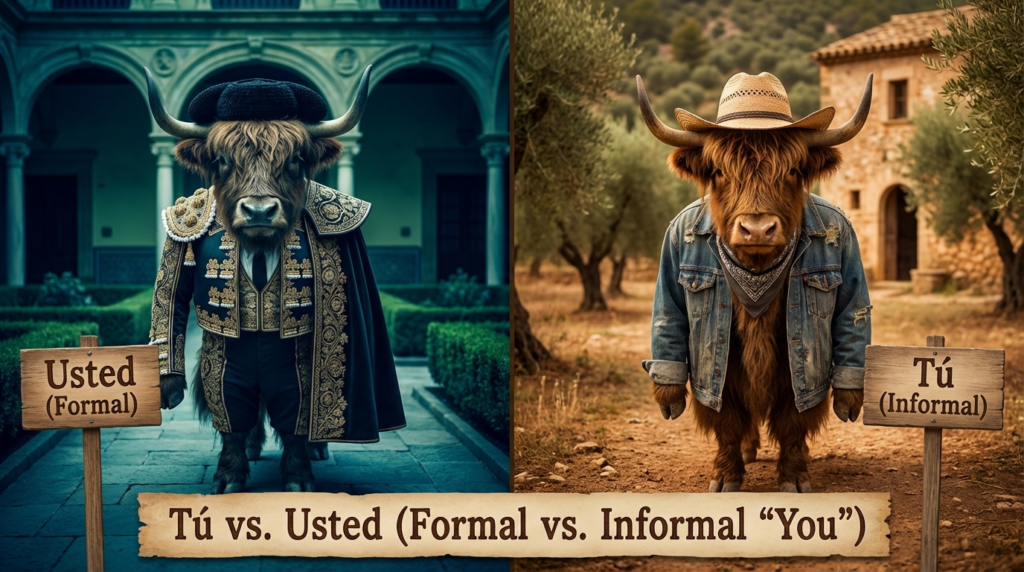
The formal versus informal distinction shows up in questions too. With strangers, elderly people, or professional contexts, use the usted form: ¿habla inglés? With friends, kids, or peers your age, use the tú form: ¿hablas inglés? When in doubt, start formal. People will tell you if you can switch to informal.
Restaurant and Food Phrases
Food is central to Spanish-speaking cultures, so these phrases get serious mileage. Whether you’re ordering tacos in Mexico City or tapas in Barcelona, you’ll need these.
| Spanish | IPA | English |
| una mesa para dos | /ˈu.na ˈme.sa ˈpa.ɾa dos/ | a table for two |
| la carta, por favor | /la ˈkaɾ.ta poɾ faˈβoɾ/ | the menu, please |
| voy a querer… | /boj a keˈɾeɾ/ | I’m going to want… |
| para mí… | /ˈpa.ɾa mi/ | for me… |
| quisiera… | /kiˈsje.ɾa/ | I would like… |
| la cuenta, por favor | /la ˈkwen.ta poɾ faˈβoɾ/ | the check, please |
| ¿qué recomienda? | /ke re.ko.ˈmjen.da/ | what do you recommend? |
| está delicioso | /esˈta de.liˈsjo.so/ | it’s delicious |
| buen provecho | /bwen pɾoˈβe.tʃo/ | enjoy your meal |
| tengo alergia a… | /ˈteŋ.ɡo aˈleɾ.xja a/ | I’m allergic to… |
| sin carne | /sim ˈkaɾ.ne/ | without meat |
| con hielo | /kon ˈje.lo/ | with ice |
| agua del grifo | /ˈa.ɣwa ðel ˈɡɾi.fo/ | tap water |
For ordering, voy a querer is incredibly natural and flows better than the textbook para mí for many English speakers. Say “voy a querer un café con leche, por favor” and you’ll sound local.
The phrase buen provecho deserves special attention. Say it to people at your table before eating, but also to nearby tables as you leave a casual restaurant. It’s like wishing everyone a good meal. In return, they’ll often say “gracias” or “igualmente” (likewise).
Spanish-speaking countries vary on menu terminology. In Spain, la carta usually means menu, while el menú often refers to a fixed-price lunch special called “menú del día.” In Latin America, both words work interchangeably for menu. When in doubt, just point and say “esto” (this).
Waiters won’t automatically bring your check at the end of the meal like in the US. They consider it rude to rush you. When you’re ready to leave, make eye contact and say “la cuenta, por favor” or even make a writing gesture in the air—they’ll understand.
Getting Around: Direction and Location Phrases
Navigation phrases are crucial when you’re exploring a new city. Don’t wander aimlessly when you could just ask.
| Spanish | IPA | English |
| ¿dónde está el baño? | /ˈdon.de esˈta el ˈba.ɲo/ | where is the bathroom? |
| ¿cómo llego a…? | /ˈko.mo ˈʝe.ɣo a/ | how do I get to…? |
| estoy perdido/perdida | /esˈtoj peɾˈði.ðo/ | I’m lost (m/f) |
| a la derecha | /a la deˈɾe.tʃa/ | to the right |
| a la izquierda | /a la is.ˈkjeɾ.ða/ | to the left |
| todo recto | /ˈto.ðo ˈrek.to/ | straight ahead |
| cerca | /ˈseɾ.ka/ | near/close |
| lejos | /ˈle.xos/ | far |
| aquí | /aˈki/ | here |
| allí | /aˈʝi/ | there |
| la estación | /la es.taˈsjon/ | the station |
Bathroom vocabulary varies by region. In Spain, you’ll hear el baño or los servicios. In Mexico and much of Latin America, el baño is standard, but you might also hear el sanitario. In more formal contexts, try los aseos. All work fine.
When someone gives you directions, listen for those key words: derecha, izquierda, recto. Even if you miss the rest, those three words will get you moving in the right direction. Often they’ll point while talking, which helps tremendously.
The gender of perdido changes to match you, not the place. If you’re male, say “estoy perdido.” If you’re female, “estoy perdida.” This is one of those moments where getting the ending right actually matters for clarity.
Emergency and Help Phrases
Nobody wants to need these, but knowing them provides peace of mind. In a real emergency, even broken Spanish is better than no Spanish.
| Spanish | IPA | English |
| ayuda | /aˈʝu.ða/ | help |
| ¡ayúdame! | /aˈʝu.ða.me/ | help me! |
| necesito ayuda | /ne.seˈsi.to aˈʝu.ða/ | I need help |
| es una emergencia | /es ˈu.na e.meɾˈxen.sja/ | it’s an emergency |
| llame a la policía | /ˈʝa.me a la po.liˈsi.a/ | call the police |
| necesito un médico | /ne.seˈsi.to um ˈme.ði.ko/ | I need a doctor |
| estoy enfermo/enferma | /esˈtoj em.ˈfeɾ.mo/ | I’m sick (m/f) |
| me duele | /me ˈdwe.le/ | it hurts me |
| ¿dónde está el hospital? | /ˈdon.de esˈta el os.piˈtal/ | where is the hospital? |
| me robaron | /me ro.ˈβa.ɾon/ | they robbed me |
The phrase me duele is incredibly useful. Add a body part after it: “me duele la cabeza” (my head hurts), “me duele el estómago” (my stomach hurts). The pattern is always “me duele” + “el/la” + body part.
For serious emergencies, most Spanish-speaking countries use 112 (Europe) or 911 (Latin America). But knowing how to describe your emergency in Spanish ensures faster, more accurate help.
If you’re struggling to communicate during an emergency, combine simple phrases: “Necesito ayuda. No hablo español. ¿Habla inglés?” This signals you need help, acknowledges the language barrier, and requests an English speaker. People will work with you.
Everyday Useful Phrases
These phrases don’t fit neatly into categories, but you’ll use them constantly in daily interactions.
| Spanish | IPA | English |
| ¿qué hora es? | /ke ˈo.ɾa es/ | what time is it? |
| me llamo… | /me ˈʝa.mo/ | my name is… |
| soy de… | /soj de/ | I’m from… |
| no hablo mucho español | /no ˈa.βlo ˈmu.tʃo es.paˈɲol/ | I don’t speak much Spanish |
| un momento | /um mo.ˈmen.to/ | one moment |
| claro | /ˈkla.ɾo/ | of course/clear |
| perfecto | /peɾˈfek.to/ | perfect |
| genial | /xe.ˈnjal/ | great/awesome |
| no problema | /no pɾo.ˈβle.ma/ | no problem |
| vale | /ˈba.le/ | okay (Spain) |
| está bien | /esˈta ˈbjen/ | it’s okay/fine |
Saying “no hablo mucho español” early in a conversation sets expectations and usually triggers patience from native speakers. It’s honest and helpful, not defeatist.
The word vale is everywhere in Spain but rarely used in Latin America. In Mexico, Colombia, and Argentina, you’ll hear está bien or just “okay” (yes, they borrowed the English word). These regional differences are normal—don’t stress about them.
Single-word responses like claro, perfecto, and genial make you sound more natural than constantly saying “sí.” They add flavor to your Spanish and show you’re engaged in the conversation, not just mechanically translating.
Region Notes
Spanish pronunciation and vocabulary shift across regions, but these popular phrases work universally with minor tweaks.
In Spain, you’ll hear vosotros as the informal plural “you.” This means phrases like “¿cómo estáis?” instead of “¿cómo están?” In Latin America, everyone uses ustedes for plural “you,” whether formal or informal. As a beginner, stick with the ustedes forms—they work everywhere.
Pronunciation varies most noticeably in how people say the letters “c” and “z.” In Spain, they produce a “th” sound: “gracias” sounds like “grathias.” In Latin America, these letters sound like “s”: “gracias” becomes “grasias.” Neither is wrong—it’s pure accent variation.
Vocabulary differences exist but won’t derail communication. Spain says “móvil” for cell phone while Mexico says “celular.” Spain uses “ordenador” for computer while Latin America prefers “computadora.” In context, everyone understands both versions. Focus on learning one version consistently, then absorb variations as you encounter them.
The speed of speech varies too. Caribbean Spanish (Cuba, Puerto Rico, Dominican Republic) tends to be rapid-fire with dropped sounds. Argentine Spanish has Italian-influenced melody. Mexican Spanish often feels slower and clearer to beginners. If you’re traveling to a specific region, watch content from that area to attune your ear.
Mini Dialogues
Here are practical conversations using the phrases you’ve learned. Read them aloud to build muscle memory.
Dialogue 1: Meeting Someone
¿Cómo te llamas?
/ˈko.mo te ˈʝa.mas/
What’s your name?
Me llamo Ana. ¿Y tú?
/me ˈʝa.mo ˈa.na i tu/
My name is Ana. And you?
Mucho gusto, Ana. Soy Carlos.
/ˈmu.tʃo ˈɡus.to ˈa.na soj ˈkaɾ.los/
Nice to meet you, Ana. I’m Carlos.
Dialogue 2: At a Café
Buenos días. ¿Qué quieres tomar?
/ˈbwe.nos ˈdi.as ke ˈkje.ɾes to.ˈmaɾ/
Good morning. What would you like to drink?
Voy a querer un café con leche, por favor.
/boj a keˈɾeɾ uŋ kaˈfe kom ˈle.tʃe poɾ faˈβoɾ/
I’m going to want a coffee with milk, please.
Perfecto. ¿Algo más?
/peɾˈfek.to ˈal.ɣo mas/
Perfect. Anything else?
No, gracias. Eso es todo.
/no ˈɡɾa.sjas ˈe.so es ˈto.ðo/
No, thanks. That’s everything.
Dialogue 3: Asking for Directions
Disculpe, ¿dónde está la estación de metro?
/disˈkul.pe ˈdon.de esˈta la es.taˈsjon de ˈme.tɾo/
Excuse me, where is the metro station?
Todo recto, y luego a la derecha.
/ˈto.ðo ˈrek.to i ˈlwe.ɣo a la deˈɾe.tʃa/
Straight ahead, and then to the right.
Muchas gracias.
/ˈmu.tʃas ˈɡɾa.sjas/
Thank you very much.
De nada. ¡Que tengas buen día!
/de ˈna.ða ke ˈteŋ.ɡas bwen ˈdi.a/
You’re welcome. Have a good day!
Quick Reference
Screenshot this table for your next Spanish-speaking adventure. These are the absolute essentials.
| Spanish | IPA | English |
| hola | /ˈo.la/ | hello |
| adiós | /aˈðjos/ | goodbye |
| por favor | /poɾ faˈβoɾ/ | please |
| gracias | /ˈɡɾa.sjas/ | thank you |
| perdón | /peɾˈðon/ | sorry/excuse me |
| ¿dónde está el baño? | /ˈdon.de esˈta el ˈba.ɲo/ | where is the bathroom? |
| ¿cuánto cuesta? | /ˈkwan.to ˈkwes.ta/ | how much? |
| no entiendo | /no enˈtjen.do/ | I don’t understand |
| ¿hablas inglés? | /ˈa.βlas iŋˈɡles/ | do you speak English? |
| la cuenta, por favor | /la ˈkwen.ta poɾ faˈβoɾ/ | the check, please |
| agua | /ˈa.ɣwa/ | water |
| ayuda | /aˈʝu.ða/ | help |
| sí | /si/ | yes |
| no | /no/ | no |
Five-Minute Practice Plan
Don’t just read these phrases—use them. Here’s your homework.
- Record yourself saying all the greetings and polite expressions. Play it back. Do you sound confident? Redo any that feel shaky.
- Pick three phrases from the restaurant section. Imagine you’re ordering your actual favorite meal. Say the full order out loud, including “por favor” at the end.
- Write down five questions you’d actually need to ask if you were traveling in a Spanish-speaking country right now. Look up any missing vocabulary, then practice asking those questions naturally.
- Find a Spanish speaker (language exchange apps work great) and use at least five phrases from this guide in a real conversation. Note which ones felt smooth and which ones tripped you up.
- Create your own mini-dialogue using six different phrases from this article. Say it aloud until it flows naturally. Bonus points if you record yourself.
- Tomorrow, review just the “Quick Reference” table three times. That’s it. Spaced repetition works better than marathon cram sessions.
Your Phrase Toolkit Is Ready
You now have 50+ phrases that real Spanish speakers use every single day. These aren’t museum pieces from dusty textbooks—they’re living language. The barista in Madrid uses them. The taxi driver in Buenos Aires uses them. The grandmother in Mexico City uses them.
The difference between learners who actually speak Spanish and those who just “study” it? The speakers use these phrases immediately and often. They mess up the pronunciation, fix it, and keep going. So go ahead—order that coffee, ask that question, greet that stranger. Your Spanish journey starts with these exact words.